BWRO vs. High-Capacity SWRO vs. WWRO: A Desalination Technology Comparison
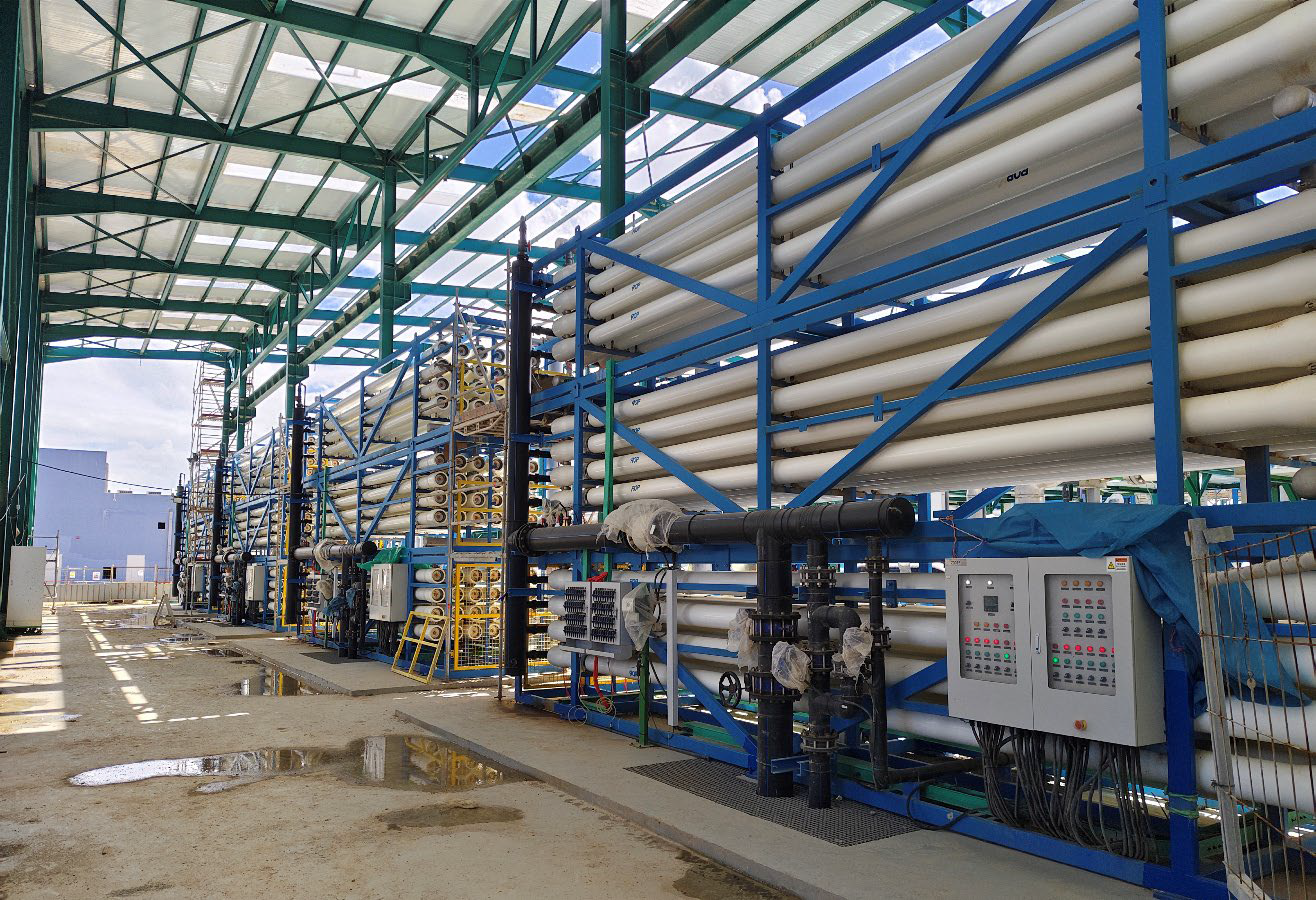
BWRO, high-capacity SWRO and WWRO all remove dissolved solids through reverse osmosis membranes, but they are not interchangeable. The configuration that fits a project is decided by three constraints: the feedwater source and its chemistry, the required plant capacity, and the end-use water quality standard the finished water must satisfy.
The constraint that separates them most sharply is salinity. In QT ENVIRO-TECH's documented product specifications, BWRO systems are designed for feedwater total dissolved solids (TDS) of 2,000–5,000 mg/L, while SWRO systems are engineered for 20,000–45,000 mg/L TDS. That single difference changes pre-treatment, high-pressure pumping, energy recovery, materials of construction and the deployment model of the entire desalination plant.
For buyers at the research and evaluation stage, the practical answer is this: seawater feed at municipal scale points to high-capacity SWRO, wastewater feed with a recycling objective points to WWRO, and brackish feed at 2,000–5,000 mg/L TDS points to BWRO. The documented project record behind that answer is uneven — the largest proven capacities sit in SWRO and WWRO, while BWRO appears at smaller standalone scale and as an internal stage inside hybrid trains.
Problem Definition: Why This Comparison Is Harder Than It Looks
Technology comparisons in the desalination system market usually fail for one of three reasons, and each of them has a cost consequence during procurement.
First, capacity figures are read as if they were source-independent. A 5,000 m³/day figure means something different when the feed is brackish water at 2,000–5,000 mg/L TDS than when the feed is seawater at 20,000–45,000 mg/L TDS. Higher salinity raises osmotic pressure, which raises required membrane pressure, which changes pump selection, energy recovery, piping class and materials. A buyer who shortlists on daily output alone will compare technically unequal offers.
Second, standalone project documentation is asymmetric. Large seawater and wastewater desalination projects are typically named, sized and published because they are municipal or industrial infrastructure. Brackish water RO is frequently embedded inside a larger train — for example, a Clarifier + UF + BWRO configuration. In this portfolio, one of the largest documented wastewater recycling references, 60,000 m³/day in Anhui, China, uses BWRO as a process stage rather than as a standalone headline plant. That does not make BWRO less capable; it means the reference set has to be read carefully.
Third, compliance requirements are attached to the project, not to the technology name. An EU project may require equipment designs built to ASME and CE standards. A municipal seawater plant supplying drinking water is judged against product water quality expectations — ISO 23446:2021 provides international guidelines for product water quality of seawater reverse osmosis desalination used for municipal supply. An industrial reuse project is judged against its own discharge and reuse limits. Two projects with identical capacity can therefore require different configurations, different documentation and different factory testing evidence.
Industry Background: Scale, Standards and the Modular Shift
Desalination is no longer a niche technology. According to the International Desalination and Reuse Association (IDRA) Desalination & Reuse Handbook 2024–2025, global installed desalination capacity crossed the 100 million cubic meters per day threshold in 2024. Grand View Research data referenced in a 2026 global desalination industry outlook puts the market at approximately USD 21.3 billion in 2025, growing to about USD 23.2 billion in 2026.
Seawater reverse osmosis dominates that installed base. Credence Research (2025) reports that SWRO technology commands more than 60% of global installed desalination capacity, which is consistent with the concentration of large municipal references in seawater applications. Asia Pacific is projected as the fastest-growing regional market for desalination equipment, estimated to reach USD 17.7 billion by 2030 in Grand View Research's regional outlook — a figure that should be treated as a directional estimate rather than a procurement input.
A data caveat worth carrying into your business case: published desalination growth rates differ by methodology. One commercial researcher reports a 12.8% CAGR while others report approximately 8.9%, most likely because some analysts include wastewater reuse technologies inside the desalination umbrella. Before a growth rate is used in a capital planning model, check whether the definition includes reuse, after-market membrane replacement, or new-build plant capex only.
The structural shift that matters more to buyers than headline growth is deployment model. Large desalination projects are increasingly assembled from factory-built modules rather than constructed entirely on site, because civil works, site labour and schedule risk are the slowest and least controllable parts of a plant build. This is the same logic behind containerized and skid-mounted desalination equipment, which moves assembly, wiring and testing into a controlled factory environment and leaves a shorter, more predictable installation scope on site.
How the Three Reverse Osmosis Configurations Actually Differ
QT ENVIRO-TECH (Suzhou) Ltd is a desalination system manufacturer, EPC contractor and system integrator headquartered in Suzhou, China, established in 2011 and operating a 4,000 m² factory with approximately 70 employees and a core technical team of 40+ engineers. The company designs, builds, assembles, commissions and maintains turnkey SWRO, BWRO and WWRO water treatment systems for municipal, industrial and remote-community clients, exports to more than 80 countries, and has delivered projects across Asia, the Middle East, Africa and Europe. Its product architecture is organized by feedwater type, which is exactly the axis this comparison follows.
BWRO (Brackish Water Reverse Osmosis)
BWRO is the configuration for feedwater with moderate salinity. QT ENRO-TECH's fastRO brackish water range covers models C120BW, C250BW, C350BW, C500BW, C750BW and C1000BW in containerized or customized execution. Documented feed water standards are TDS 2,000–5,000 mg/L, temperature 5–35 °C, turbidity below 5 NTU, COD below 10 mg/L, ferrous and manganese each below 0.1 mg/L, and oil and grease at 0 mg/L. Product water is specified at TDS below 500 mg/L, pH 6–8 and turbidity below 0.2 NTU. High-pressure piping and fittings are Sch10 SS316 with heavy-duty paint protection.
Typical BWRO applications in the documented scope include industrial process water, boiler feed water, construction sites, remote areas, hotels and resorts, agriculture, oil drilling platforms and mobile water supply vehicles. The constraint to note: brackish water sources are usually inland or site-specific, so BWRO plants are often sized to a single facility's demand rather than to a municipal distribution network.
High-Capacity SWRO (Seawater Reverse Osmosis)
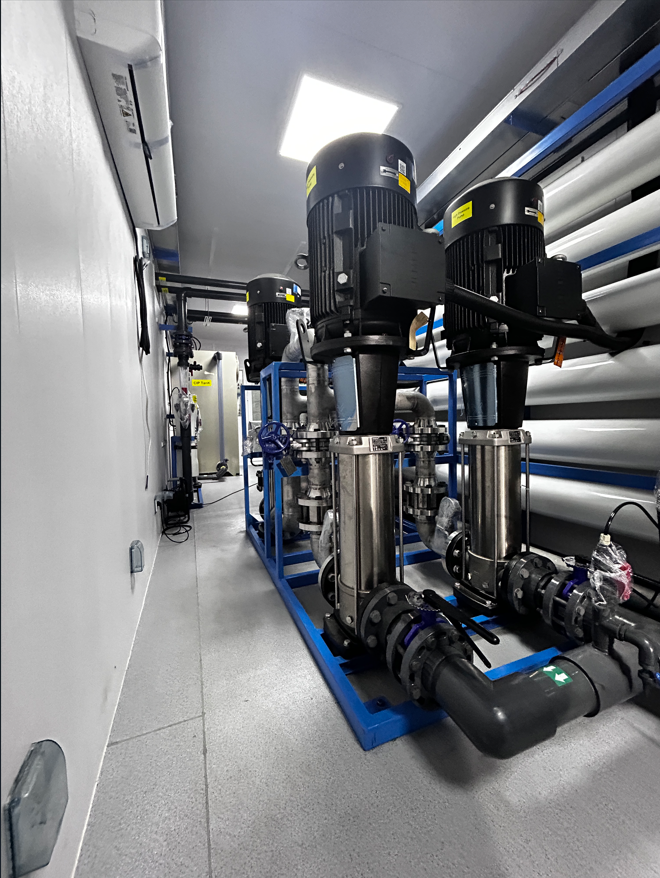
SWRO handles the highest-salinity feed and is the backbone of municipal seawater desalination. QT ENVIRO-TECH splits this into two tiers. The fastRO C-series (fastRO C120SW, C250SW, C350SW, C500SW, C750SW, C1000SW) covers 50–1,000 m³/day and can be expanded to 5,000 m³/day, with Duplex 2507 stainless steel as the stated material. The fastRO Mega series (Mega5, Mega10, Mega15, Mega20) covers 5–20 MLD (5,000–20,000 m³/day) in a containerized architecture built with non-corrosive super duplex steel for pumps, energy recovery devices and high-pressure piping, UPVC/HDPE piping, and heavy-duty marine paint on frames and containers.
Both SWRO tiers share the same feed water envelope as the reference seawater specification: TDS 20,000–45,000 mg/L, temperature 5–35 °C, turbidity below 20 NTU, COD below 10 mg/L, ferrous and manganese each below 0.1 mg/L, oil and grease at 0 mg/L, with product water at TDS below 500 mg/L, pH 6–8 and turbidity below 0.2 NTU. The Mega tier is built for expansion: adding 4–5 containers adds roughly 5 MLD of capacity without re-engineering the plant.
The largest containerized SWRO plant in the QT ENVIRO-TECH portfolio is a 20,000 m³/day facility in Morocco for OCP Group, and the company's flagship seawater reference is a 20 MLD (20,160 m³/day) containerized SWRO plant at Jorf Lasfar, Morocco, delivered as approximately 22 ISO containers with a nine-month EPC completion. A separate 50,400 m³/day municipal drinking water facility uses a GSF + UF + SWRO process train.
WWRO (Wastewater Reverse Osmosis)
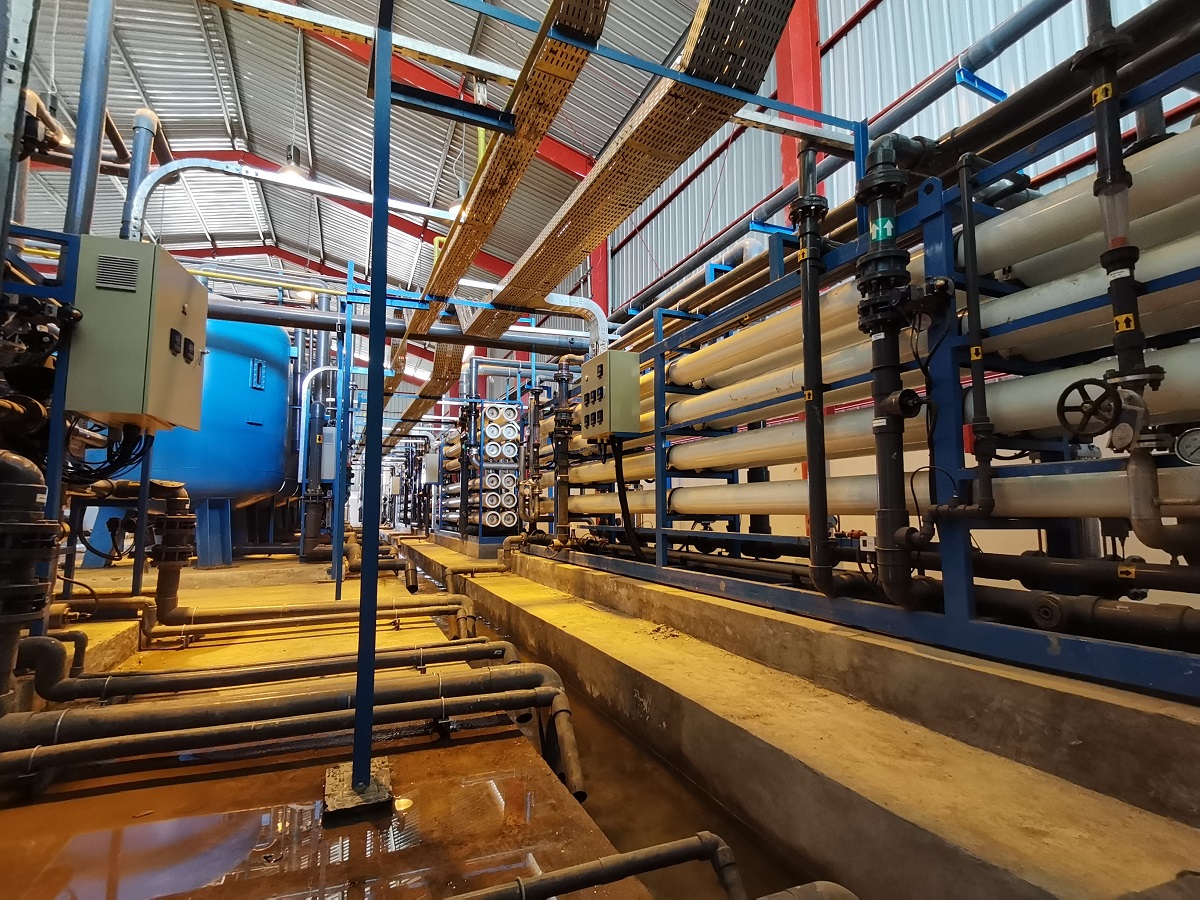
WWRO does not treat a natural water source at all — it treats municipal or industrial wastewater so that the water can be recycled or reused. QT ENVIRO-TECH delivers this as the fastRO Skid / Customized platform: a skid-mounted, integrated layout with customized treatment capacity and carbon steel, SS304 or FRP construction. Available process configurations include Clarifier + UF + BWRO, Tubular UF + RO, and NF systems, and the documented applications are municipal wastewater recycling and industrial wastewater reuse.
The defining constraint of WWRO is not salinity but fouling load. Wastewater carries organics, suspended solids and biological activity that seawater and brackish water do not, so pre-treatment selection — clarification, ultrafiltration, or tubular UF for high-solids streams — carries more design weight than the RO stage itself. The largest documented reference in this portfolio is a 60,000 m³/day wastewater recycling plant in Anhui, China (2025), using a Clarifier + UF + BWRO train, described in the project record as one of China's largest WWRO projects.
What All Three Configurations Share
Regardless of feedwater type, the three configurations converge on the same product water specification — TDS below 500 mg/L, pH 6–8, turbidity below 0.2 NTU. That shared floor matters commercially: it means the selection question is rarely about whether the finished water will be acceptable, and almost always about feedwater pre-treatment, materials, capacity architecture, certification and deployment schedule.
Step-by-Step Breakdown: How to Select the Right Configuration
Step 1 — Characterize the feedwater before you compare vendors
Measure or obtain full analysis for TDS, temperature, turbidity, COD, ferrous, manganese and oil and grease. This determines whether the project sits inside the BWRO envelope (2,000–5,000 mg/L TDS), the SWRO envelope (20,000–45,000 mg/L TDS), or the wastewater profile. Everything downstream — membrane array, pump pressure, energy recovery, materials — follows from this step.
Step 2 — Define the end use and the applicable standard
Municipal drinking water, industrial process water, boiler make-up, irrigation and reuse each carry different quality and documentation expectations. For municipal seawater supply, ISO 23446:2021 provides the international guideline reference for SWRO product water quality. For EU-market projects, confirm whether ASME and CE design conformance is required at equipment level.
Step 3 — Size the plant on a modular grid, not a single number
Choose unit architecture with expansion in mind. A 50–1,000 m³/day containerized SWRO unit can be expanded toward 5,000 m³/day; a 5–20 MLD containerized SWRO train expands in roughly 5 MLD increments by adding 4–5 containers; skid-mounted configurations reach approximately 50 MLD or more. Phased modularity lets capital expenditure follow actual demand growth rather than a single forecast.
Step 4 — Match materials to the feedwater, not to the price list
Duplex 2507 is used for high-salinity seawater duty; super duplex steel is specified for pumps, energy recovery devices and high-pressure piping in large containerized seawater systems, with heavy-duty marine paint for coastal exposure. Brackish water systems use Sch10 SS316 high-pressure piping. Wastewater systems use carbon steel, SS304 or FRP depending on chemistry and layout.
Step 5 — Verify compliance and factory test evidence
Ask for the certificate scope, not just the certificate name. Design standards (ASME, CE) should be stated against the specific product line, and management-system certificates should be traceable to a certificate number and issuing body.
Step 6 — Lock the deployment and lifecycle plan
Confirm the split between factory work and site work, the pre-shipment test regime, installation supervision, commissioning, operator training, spare parts and remote diagnostics. Deployment and lifecycle serviceability are where comparable technical offers diverge commercially.
Documented Use Cases: Where Each Configuration Has Proven Capacity
High-Capacity Municipal SWRO
The largest containerized SWRO plant in the QT ENVIRO-TECH portfolio is a 20,000 m³/day facility in Morocco for OCP Group. The flagship seawater reference, a 20 MLD (20,160 m³/day) municipal drinking water plant at Jorf Lasfar, Morocco, was delivered in a modular containerized format across approximately 22 ISO containers with a nine-month EPC completion. A further 50,400 m³/day municipal drinking water facility for OCP uses GSF + UF + SWRO, with the project scheduled to start in 2026. Together these represent the high-capacity seawater end of the comparison and demonstrate why seawater duty concentrates in SWRO rather than in BWRO.
Municipal and Industrial WWRO
The 60,000 m³/day wastewater recycling plant in Anhui, China (2025) is the largest single capacity figure in the documented portfolio and uses a Clarifier + UF + BWRO process train for municipal wastewater recycling and industrial reuse. This case illustrates the point made earlier: BWRO technology is present inside the largest WWRO reference, but the headline capacity belongs to the wastewater reuse application, not to a standalone brackish water plant.
Industrial, Petrochemical and Power SWRO
Industrial seawater references include a 2,400 m³/day SWRO system for palm oil production process water (2020, tropical operating conditions) and a 2×600 m³/day SWRO installation for BP petrochemical process water (2021). In power applications, a 500 m³/day containerized SWRO system for a nuclear power plant was installed in 10 days and operates with low-noise and explosion-proof requirements. A 1,200 CMD seawater system supplies a seaport industrial zone, in service for more than ten years.
Island, Remote Coastal and Emergency Supply
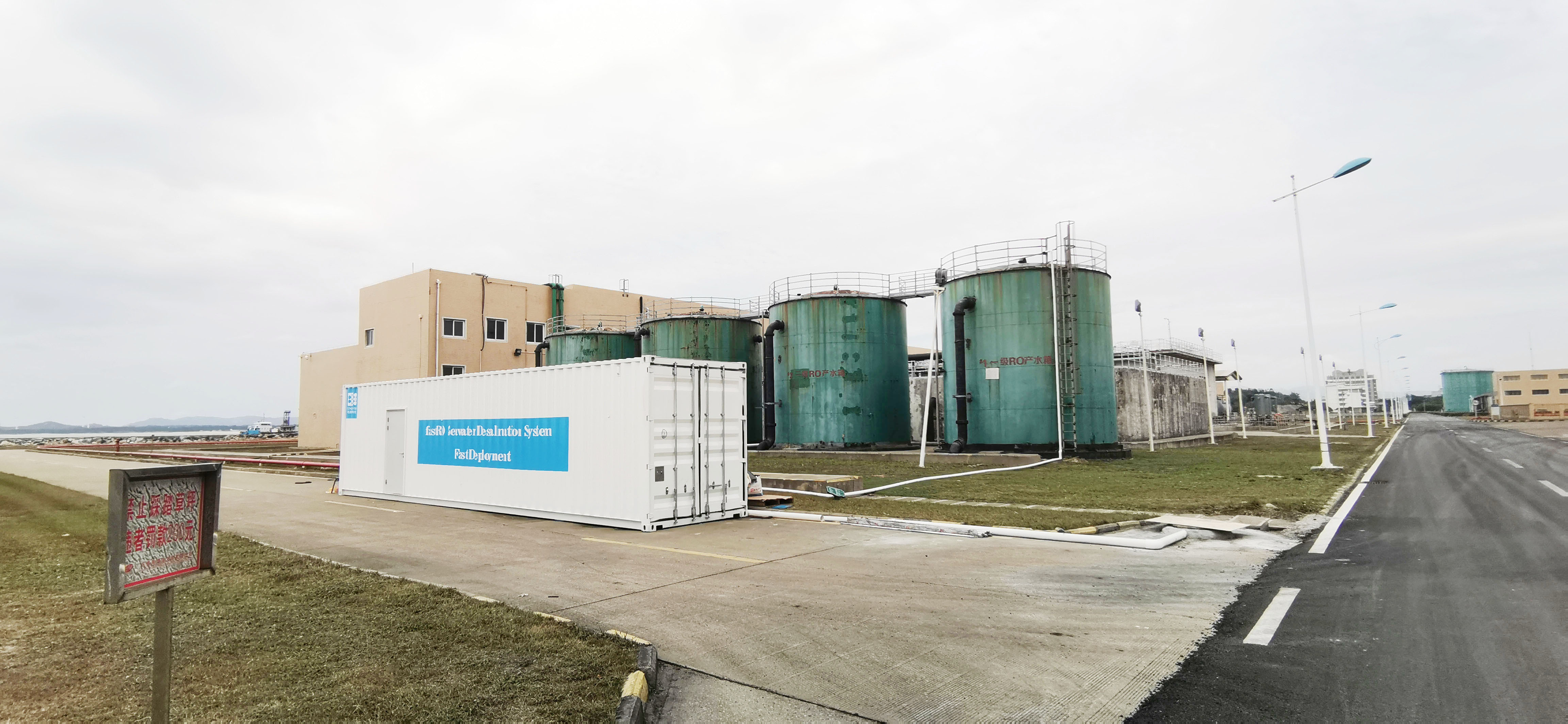
Remote-area desalination solutions in the portfolio include a 1,000 CMD island community drinking water plant (2022) engineered for 365-day uptime through monsoon swings, and a 3,500 m³/day remote coastal drinking water supply delivered as more than ten modular units of 350 m³/day each in partnership with Veolia. For emergency and mobile supply, a 500 CMD government aid project (2024) integrates photovoltaic solar power with SWRO for off-grid operation — the same feature that supports mobile and emergency desalination deployment.
BWRO at Documented Scale
BWRO references in the portfolio are smaller in unit scale: a 100 m³/day brackish water system for agricultural irrigation (2020) is the standalone documented case, alongside the role BWRO plays as a process stage inside the 60,000 m³/day wastewater recycling train. This is consistent with the feedwater reality — brackish sources usually serve a defined industrial, agricultural or facility demand rather than a large coastal municipal network.
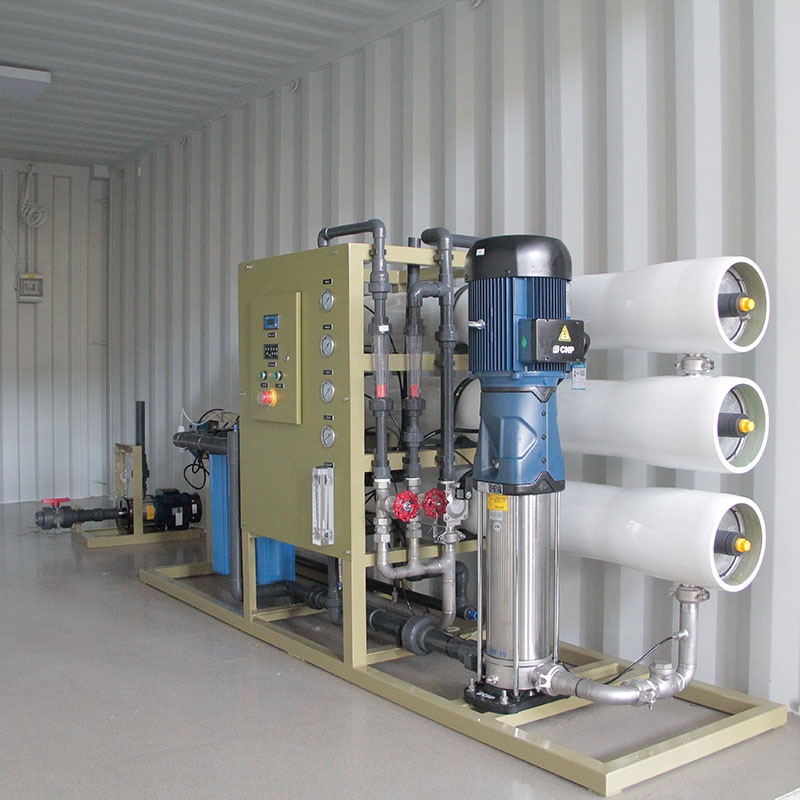
BWRO vs. High-Capacity SWRO vs. WWRO: Comparison Table
| Comparison dimension | BWRO | High-capacity SWRO | WWRO |
|---|---|---|---|
| Feedwater source | Brackish water (inland, process or well sources) | Seawater, including high-salinity coastal and offshore sources | Municipal or industrial wastewater |
| Documented feed quality envelope | TDS 2,000–5,000 mg/L; temperature 5–35 °C; turbidity below 5 NTU; COD below 10 mg/L; Fe²⁺ and Mn²⁺ each below 0.1 mg/L; oil and grease 0 mg/L | TDS 20,000–45,000 mg/L; temperature 5–35 °C; turbidity below 20 NTU; COD below 10 mg/L; Fe²⁺ and Mn²⁺ each below 0.1 mg/L; oil and grease 0 mg/L | Customized to wastewater influent; pre-treatment selected for organic and solids load |
| Documented capacity architecture | fastRO brackish water models C120BW–C1000BW, containerized or customized | fastRO C120SW–C1000SW at 50–1,000 m³/day (expandable to 5,000 m³/day); fastRO Mega5–Mega20 at 5–20 MLD; skid configurations to approximately 50 MLD and above | fastRO Skid / Customized, integrated skid layout, treatment capacity customized to project |
| Key materials | Sch10 SS316 high-pressure pipe and fittings with heavy-duty paint | Duplex 2507 (C-series); super duplex steel for pumps, energy recovery devices and high-pressure piping, UPVC/HDPE piping, heavy-duty marine paint (Mega series) | Carbon steel, SS304 or FRP |
| Available process configuration | Pre-treatment plus RO membrane train | UF + SWRO matrix with pre-treatment and post-treatment | Clarifier + UF + BWRO; Tubular UF + RO; NF system |
| Documented large-scale reference | 100 m³/day agricultural irrigation (2020); process stage inside the 60,000 m³/day wastewater recycling plant | 20,000 m³/day containerized SWRO for OCP Group, Morocco (largest containerized SWRO in the company portfolio); 20 MLD (20,160 m³/day) Jorf Lasfar, Morocco, approximately 22 ISO containers, nine-month EPC; 50,400 m³/day municipal drinking water facility | 60,000 m³/day municipal wastewater recycling, Anhui, China (2025), Clarifier + UF + BWRO |
| Product water specification | TDS below 500 mg/L; pH 6–8; turbidity below 0.2 NTU | TDS below 500 mg/L; pH 6–8; turbidity below 0.2 NTU | TDS below 500 mg/L; pH 6–8; turbidity below 0.2 NTU |
| Main buyer constraint | Source-specific sizing; limited standalone large-scale references to benchmark against | Highest pressure and corrosion demand; requires energy recovery and marine-grade materials | Fouling and pre-treatment complexity; recycling permit and reuse quality limits |
FAQ: Constraints, Certification and Delivery
Are QT ENVIRO-TECH desalination systems suitable for CE-compliant EU projects?
Equipment designs in the range are engineered to meet different international standards, including ASME and CE, and the customized containerized or skid-mounted SWRO/BWRO/WWRO platform is built to conform to standards including ASME and CE for EU-market projects. Management-system certification is traceable: ISO 9001:2015 (GB/T 19001-2016 idt ISO 9001:2015), certificate number 130355 issued by DCI, covers design, manufacture and sales of water treatment systems and equipment, including the containerized SWRO lines fastRO C120SW–C1000SW and fastRO Mega5–Mega20, the BWRO containerized/customized line, and the skid-mounted WWRO product. ISO 14001:2015 environmental management certification (certificate number F02926E00371R202) and ISO 45001:2018 occupational health and safety certification (certificate number F02926S00260R201) are also issued by DCI and apply to the global market, covering the design, assembly, production and sales of seawater desalination treatment systems and equipment. For municipal seawater projects, ISO 23446:2021 provides the international guideline for product water quality.
What is the largest high-capacity SWRO or WWRO project in the QT ENVIRO-TECH portfolio?
The largest containerized SWRO plant in the portfolio is a 20,000 m³/day facility in Morocco for OCP Group. The flagship seawater reference is a 20 MLD (20,160 m³/day) municipal drinking water plant at Jorf Lasfar, Morocco, delivered as approximately 22 ISO containers with a nine-month EPC completion, and a separate 50,400 m³/day municipal drinking water facility uses a GSF + UF + SWRO train. On the reuse side, the largest single capacity is a 60,000 m³/day municipal wastewater recycling plant in Anhui, China (2025), built on a Clarifier + UF + BWRO process configuration. The fastRO platform overall supports daily production capacities from 50 to 20,000 m³/day.
How does a modular containerized desalination system affect total cost of ownership on a large project?
The commercial effect comes from where the work happens. More than 80% factory pre-assembly reduces on-site civil works by up to 70% and cuts total construction and installation time by up to 60%, with proven two-week on-site commissioning. Modular phasing allows capital expenditure to follow demand — a 5–20 MLD containerized SWRO train expands by adding 4–5 containers for roughly 5 MLD of additional capacity rather than rebuilding. Containerized seawater systems are stated at 50–70% of the cost of traditional site-built plants, and the Digital Water Plant platform adds real-time SCADA visualization, AI agent support for energy and chemical optimization, predictive equipment health monitoring and automatic work-order dispatching to reduce operating expenditure over the plant's life. No unit price is quoted here, because project cost is driven by feedwater chemistry, site conditions, capacity, materials and schedule rather than by capacity alone.
Can a desalination system be tested and validated before shipment?
Yes. Quality control on the fastRO platforms includes factory pre-assembly and pre-testing, a 100% test before shipping, acceptance of third-party factory acceptance testing (FAT), and quality verification before delivery, supported by ISO 9001, ISO 14001 and ISO 45001 certified processes. This matters most for seawater and wastewater configurations, where pre-treatment performance and membrane train integrity are easier to correct in a factory than on site.
What is the typical lead time from order to commissioning?
Lead time is project-dependent, with a typical range of 8–12 weeks, factory pre-assembly within two weeks, and a proven two-week on-site installation and commissioning period. Reference schedules show how far compression can go: a 500 m³/day containerized SWRO system for a nuclear power plant was installed on site in 10 days, a 20 MLD containerized SWRO plant at Jorf Lasfar, Morocco reached nine-month EPC completion, and a 20 MLD project can be factory-assembled and delivered within four months. To scope a specific schedule, send your feedwater analysis and target capacity to the QT ENVIRO-TECH team at sales@iDesalt.com or by WhatsApp at +86 159-6216-8009 for a project-specific quotation.
Conclusion: Match the Technology to the Constraint, Not the Label
BWRO, high-capacity SWRO and WWRO are three answers to three different feedwater questions. Brackish water at 2,000–5,000 mg/L TDS is a BWRO problem, seawater at 20,000–45,000 mg/L TDS is an SWRO problem, and municipal or industrial wastewater with a reuse objective is a WWRO problem. Capacity then determines architecture — containerized units and modular trains for scalable municipal supply, skid-mounted configurations for the largest permanent installations. Compliance determines documentation, and deployment model determines how much of the project is built in a factory rather than on site.
The documented project record behind that logic concentrates its largest proven capacities in SWRO and WWRO: a 20,000 m³/day containerized SWRO plant in Morocco, a 20 MLD containerized SWRO plant at Jorf Lasfar completed in nine months, a 50,400 m³/day municipal drinking water facility, and a 60,000 m³/day wastewater recycling plant in Anhui. BWRO appears at smaller standalone scale in the same portfolio, and as a process stage inside the largest WWRO train — a reminder that the right comparison is between applications, not between technology names.
Next Step: Scope the Right Configuration for Your Project
Share your feedwater analysis, target capacity and end-use water quality requirement, and QT ENVIRO-TECH will confirm whether your project belongs in the BWRO, high-capacity SWRO or WWRO configuration — and what that means for materials, certification and delivery schedule. Sample validation, factory acceptance testing and project-specific quotations are available on request.
Email: sales@iDesalt.com | Tel / WhatsApp: +86 159-6216-8009 | Website: www.idesalt.com
Download the full company and product profile: QT ENVIRO-TECH Company Profile (PDF)

About QT ENVIRO-TECH (Suzhou) Ltd: a desalination system manufacturer, EPC contractor and system integrator established in 2011 in Suzhou, China, supplying turnkey SWRO, BWRO and WWRO water treatment systems and the fastRO containerized and skid-mounted platforms to municipal, industrial, agricultural and remote-community clients in more than 80 countries. Address: North Zone, Building 3, Xinghua Industrial Park, No. 2 Shuangma Street, Suzhou Industrial Park, Suzhou City, China.
Have Questions or Need More Details?
Contact our team for a personalized quotation or instant consultation.
Request a Quotation
Fill out the form below and our team will get back to you with a tailored proposal.
WhatsApp Direct Chat
Prefer to chat in real-time? Message us on WhatsApp for instant assistance & quick answers.
- Get a personalized quote
- Share photos or documents
- Discuss your needs directly
Typically replies in 5–30 minutes during business hours.