Island Water Security: How Modular SWRO Systems Provide Reliable Community Supply
Island water security is decided long before the first membrane is installed. The decisive question is whether a desalination plant can actually be built, shipped, powered and serviced in a place that has no large construction base, limited grid capacity and weather that interrupts everything else. A modular SWRO (seawater reverse osmosis) system answers that question by turning the plant into factory-assembled, containerized units that are tested before shipping and commissioned on site in weeks rather than years.
This guide covers how modular desalination is applied to remote island and coastal community water supply: what the failure points are, how the technology is adapted to marine and monsoon conditions, which capacity tier fits which community size, and what evidence exists from projects that are already running. QT ENVIRO-TECH (Suzhou) Ltd is used as the reference case throughout. QT ENVIRO-TECH is a desalination system manufacturer, EPC and system integrator headquartered in Suzhou, China, established in 2011, that designs, builds, assembles, commissions and maintains turnkey SWRO, BWRO and WWRO water treatment systems and operates its proprietary fastRO® containerized platform.
Core answer in brief
- Modular containerized SWRO moves more than 80% of the assembly work into the factory, reducing on-site civil works by up to 70% and total construction and installation time by up to 60% compared with a conventional site-built approach.
- A documented 1,000 CMD (cubic meters per day) island community SWRO system delivered in 2022 operates 24/7 with 365-day uptime through monsoon swings, using pre-treatment, SWRO and post-treatment in a marine coastal environment.
- A 2024 China aid project combined SWRO with PV solar power to supply 500 CMD of fresh water to an off-grid remote site.
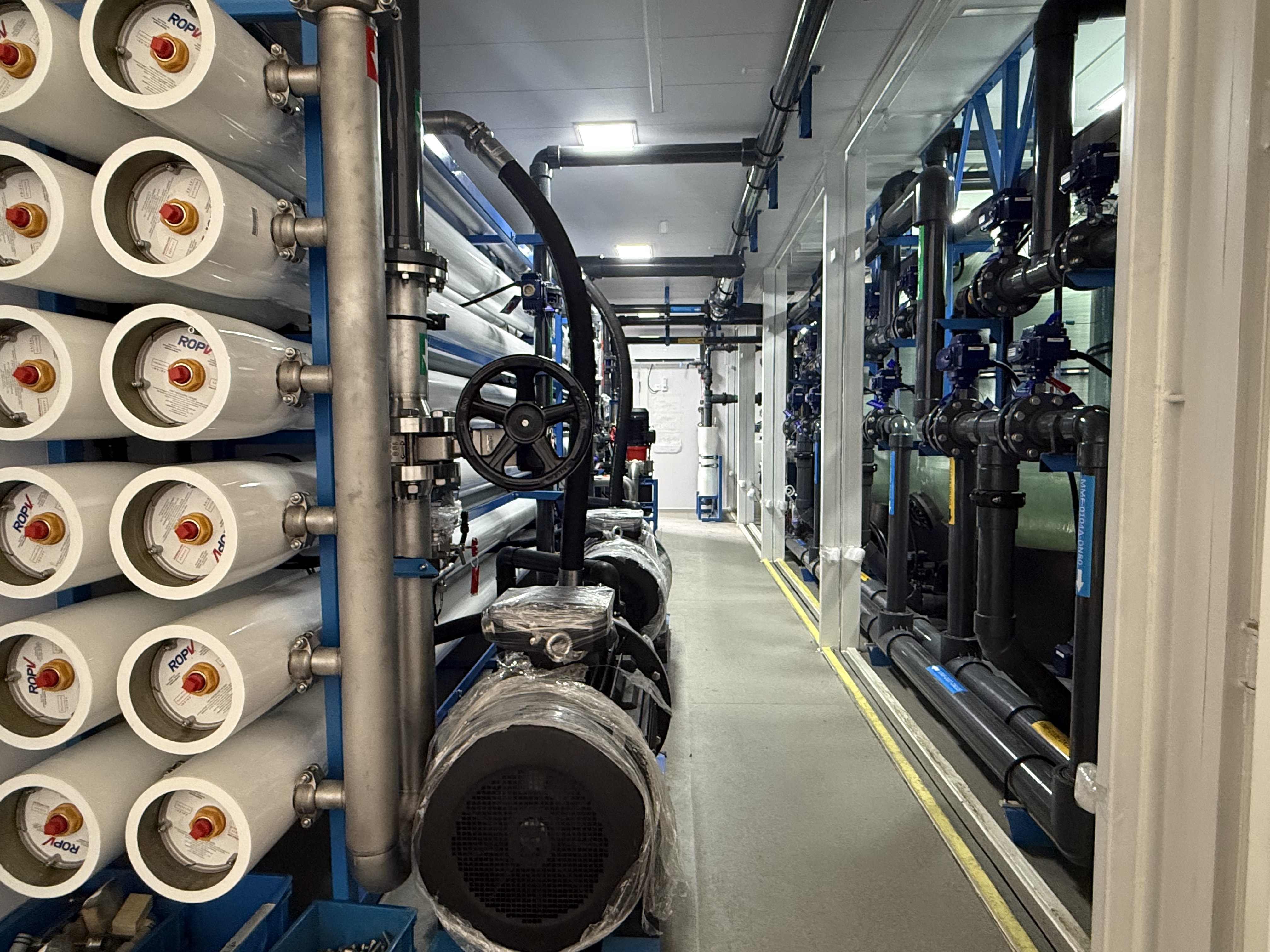
Problem Definition: Why Islands and Remote Coasts Stay Water-Insecure
The paradox of island water supply is that the resource is everywhere and the infrastructure is nowhere. A community surrounded by seawater still depends on rainwater tanks, trucked water, brackish wells or an ageing plant that cannot be repaired quickly. Six constraints recur in almost every remote island or coastal water program.
- The source is unlimited; the treatment capacity is not. Seawater is available at the shoreline, but converting it into drinking water requires a plant that must be delivered to a site with limited port and road access.
- Fuel and logistics dependency. Where power comes from diesel, every cubic meter of water carries a fuel logistics chain behind it. Any supply interruption becomes a water interruption.
- Weather exposure. Monsoon seasons, storm surges and salt-laden air attack both the equipment and the operating schedule. A plant that stops for weeks during the wet season is not a water security asset.
- Construction constraints. Permanent concrete structures require a contractor base, materials, accommodation and heavy lifting equipment that small islands rarely have locally.
- Thin operations teams. A community plant may be run by a small municipal team with limited membrane or high-pressure pump expertise, so monitoring and diagnostics matter as much as capacity.
- Demand profile. Island communities often have flat baseline demand with sharp seasonal peaks, which makes a single fixed-size plant an inefficient answer.
These are exactly the conditions behind the reference island project in this article: a 1,000 CMD community drinking water supply built in 2022 in a marine coastal environment with a seawater feed source, specified for 24/7 continuous operation and 365-day uptime through monsoon swings, using pre-treatment, SWRO and post-treatment. That specification set — uptime through weather, not just peak capacity — is the standard against which island water security should be judged.
Industry Background: Desalination Is Growing Fastest Where Traditional Infrastructure Is Hardest
Desalination has moved from a niche municipal technology to a baseline water supply option. According to the International Desalination and Reuse Association (IDRA) Desalination & Reuse Handbook 2024–2025, global installed desalination capacity crossed the 100 million cubic meters per day threshold in 2024. Grand View Research estimates the global desalination market at approximately USD 21.3 billion in 2025, projected to reach about USD 23.2 billion in 2026, and Credence Research places SWRO technology at more than 60% of global installed desalination capacity.
Growth is not evenly distributed. Grand View Research projects Asia Pacific as the fastest-growing regional market for desalination equipment, estimated to reach USD 17.7 billion by 2030 — a region with thousands of inhabited islands and long coastal stretches where piped freshwater supply is not practical. On the quality side, ISO 23446:2021 provides international guidelines for the product water quality of seawater reverse osmosis desalination used for municipal supply, giving island programs a recognized benchmark for drinking water output rather than an ad hoc local target.
The technical shift accompanying this growth is a move away from purely civil-works-heavy plants toward modular, factory-built systems. For remote communities this matters more than raw market size: a plant that can arrive in ISO containers is a plant that can actually be financed, shipped and commissioned on an island, while a plant that requires a multi-year concrete program may never reach financial close.
Detailed Solution: How Modular SWRO Is Adapted for Island and Coastal Conditions
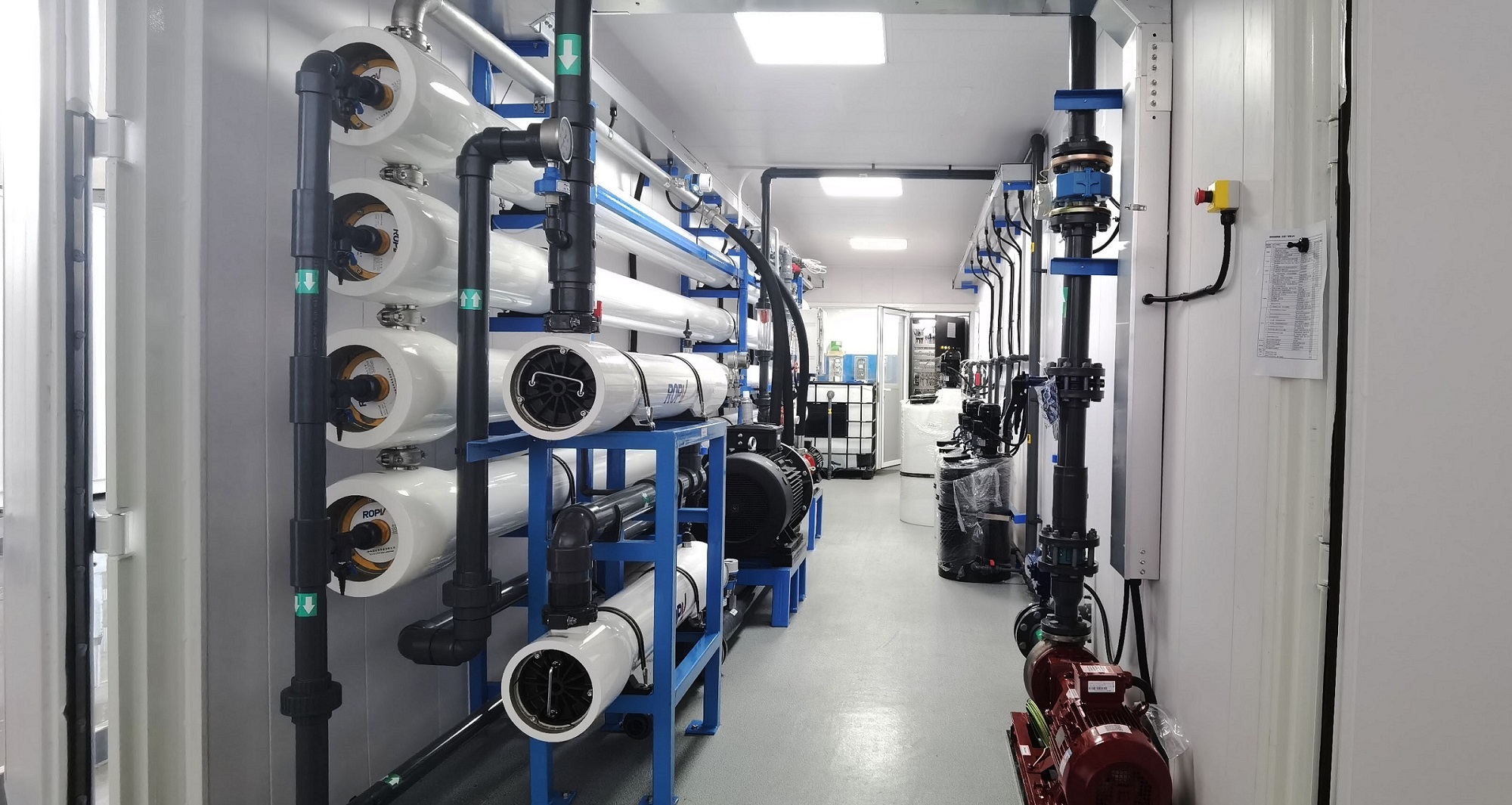
A modular SWRO system is not simply a small desalination plant. It is a different delivery model in which the plant is engineered as transportable modules, assembled and tested in a controlled factory environment, then installed and connected on site. QT ENVIRO-TECH builds this model on its fastRO® containerized platform, with more than 80% factory pre-assembly as the design baseline.
Factory assembly replaces island construction
On-site civil works can be reduced by up to 70% and total construction and installation time by up to 60%, with proven 2-week on-site commissioning. In practice, this means the island site needs a prepared foundation, feed and product water connections, power supply and a control interface — not a full industrial construction campaign. For a community that has been waiting years for water infrastructure, delivery time is the project.
Marine-grade materials and corrosion protection
Coastal air and seawater are aggressive to ordinary carbon steel. The fastRO C-Series containerized SWRO system uses Duplex 2507 as its construction material. The larger fastRO Mega series specifies non-corrosive super duplex steel for pumps, energy recovery devices and high-pressure piping, UPVC/HDPE for piping, and heavy-duty marine paint for frames and containers. This material specification is the difference between equipment that survives a coastal environment and equipment that becomes a maintenance liability within a few seasons.
Pre-treatment and post-treatment sized for coastal water
Island community supply is specified as a complete train, not a membrane block. The reference configuration pairs pre-treatment with SWRO and post-treatment so that the plant delivers finished drinking water. The same logic applies at community scale: feed water quality drives the pre-treatment design, and community standards drive the post-treatment design.
The containerized SWRO platform is engineered for feed water with salinity (TDS) of 20,000–45,000 mg/L, temperature of 5–35 °C, turbidity below 20 NTU, COD below 10 mg/L, iron and manganese each below 0.1 mg/L, and oil and grease at 0 mg/L. Product water is specified at salinity (TDS) below 500 mg/L, pH 6–8 and turbidity below 0.2 NTU. Where an island has a usable brackish well or freshwater lens rather than open seawater, a BWRO system covers feed water with salinity of 2,000–5,000 mg/L and produces water below 500 mg/L TDS — often the lower-cost option when the source allows it.
Power architecture: grid, diesel, or solar
Energy is the largest operating cost in any reverse osmosis plant, and on islands energy is also the least reliable input. The fastRO C-Series carries a solar power option, and PV integration is already proven in the field: a 2024 China aid project combined SWRO with PV solar power to provide 500 CMD of fresh water to an off-grid remote site, operating continuously. For island programs this offers a route to decouple water production from diesel deliveries, or at least to reduce the volume of fuel that must be shipped in.
Capacity tiers: matching the platform to the community
Island demand is rarely a single number, so the platform is tiered rather than fixed. The fastRO C-Series covers a standard range of 50–1,000 m³/day and is expandable to 5,000 m³/day. The fastRO Mega series covers 5–20 MLD (5,000–20,000 m³/day) and can be expanded by adding 4–5 containers for an additional 5 MLD without re-engineering the plant. Customized containerized or skid-mounted systems reach approximately 50 MLD and above for permanent municipal, industrial and agricultural installations, using carbon steel, SS304 or FRP as required.
Digital operation for small maintenance teams
Remote sites rarely have deep specialist staffing, and the Digital Water Plant platform addresses that gap directly. It integrates real-time SCADA visualization, AI agent support for energy and chemical optimization, predictive equipment health monitoring, and automatic work-order dispatching. For an island plant, these functions translate into fewer unplanned stoppages and less dependence on specialist labor traveling to site.
Step-by-Step: Specifying a Modular SWRO System for an Island Community
The sequence below reflects how a community-scale island plant is actually scoped. Each step produces an input that the next step depends on, and skipping steps is the most common cause of under- or over-sized island desalination projects.
- Define the demand profile. Establish current daily demand, seasonal peaks and a realistic growth horizon. Because the fastRO C-Series can expand from 50–1,000 m³/day up to 5,000 m³/day, the initial unit can be sized to today's baseline while the site layout reserves room for later modules.
- Characterize the water source. Decide whether the source is open seawater or brackish groundwater. Seawater design assumes salinity of 20,000–45,000 mg/L. Brackish sources fall in the 2,000–5,000 mg/L band and call for a BWRO configuration. In both cases, record temperature (design range 5–35 °C), turbidity, COD, iron, manganese and any oil and grease risk.
- Select the platform tier. Community supply typically sits in the fastRO C-Series band; island clusters or multi-village distribution move into the fastRO Mega band; permanent large-scale municipal supply moves to a customized containerized or skid-mounted configuration.
- Design the full treatment train. Pair pre-treatment with SWRO and post-treatment so the plant outputs finished drinking water rather than partially treated water. Treat pre-treatment as a site-specific design driven by the coastal feed conditions identified in step two.
- Specify corrosion and marine protection. Apply the material standard appropriate to the site — Duplex 2507, super duplex steel for pumps, energy recovery devices and high-pressure piping, UPVC/HDPE piping, and heavy-duty marine paint for frames and containers.
- Choose the power architecture. Decide between grid supply, on-site generation, or PV integration. Where the site is off-grid, PV-integrated SWRO is a documented configuration rather than a concept.
- Factory-assemble, test, ship and install. The plant is built with more than 80% factory pre-assembly, tested before shipping, then connected and commissioned on site — a proven 2-week on-site commissioning window. For scale reference, the fastRO® containerized platform delivered a 20 MLD SWRO project across approximately 22 ISO containers, factory-assembled and delivered within 4 months.
- Plan operations from day one. Enable the Digital Water Plant layer — SCADA visualization, AI-assisted energy and chemical optimization, predictive equipment health monitoring and automatic work-order dispatch — so the plant can be run by the team actually available on the island.
Use Cases: Modular SWRO in Real Island and Remote Coastal Projects
1,000 CMD island community water supply (2022)
This project is the clearest demonstration of the island model. A 1,000 CMD SWRO community drinking water system was built in a marine coastal environment with a seawater feed source, configured with pre-treatment, SWRO and post-treatment, and specified for 24/7 continuous operation with 365-day uptime through monsoon swings. The significance is not only the daily output but the uptime requirement: the plant was engineered to stay in service through the weather that historically disrupted island water supply.
500 CMD off-grid community supply with PV + SWRO (China aid project, 2024)
A 2024 aid-funded project combined SWRO with PV solar power to deliver 500 CMD of fresh water to an off-grid remote site, operating in a mobile and continuous mode. This case shows that renewable-powered desalination is deployable for community supply today, and that the modular container format is what makes the integrated PV + SWRO package transportable to a site without grid infrastructure.
3,500 m³/day remote coastal drinking water supply
For larger remote coastal demand, the same modular logic scales by replication rather than by building a bigger single structure: this configuration delivers 3,500 m³/day in total, approximately 350 m³/day per container, with SWRO, a solar power option and storage, running 24/7 in remote coastal conditions. Container-level modularity allows incremental commissioning and simplifies replacement or servicing of individual units.
Scaling the same engineering to 20 MLD
Where an island group, a coastal municipality or an industrial site needs far larger capacity, the identical architecture is used at larger scale. QT ENVIRO-TECH's largest containerized SWRO reference is a 20,000 m³/day facility in Morocco for OCP Group, and the fastRO® containerized platform delivered a 20 MLD SWRO project across approximately 22 ISO containers, factory-assembled and delivered within 4 months. The value of this reference for island planners is that the modular delivery model is not limited to small plants — it is a scale-independent approach.
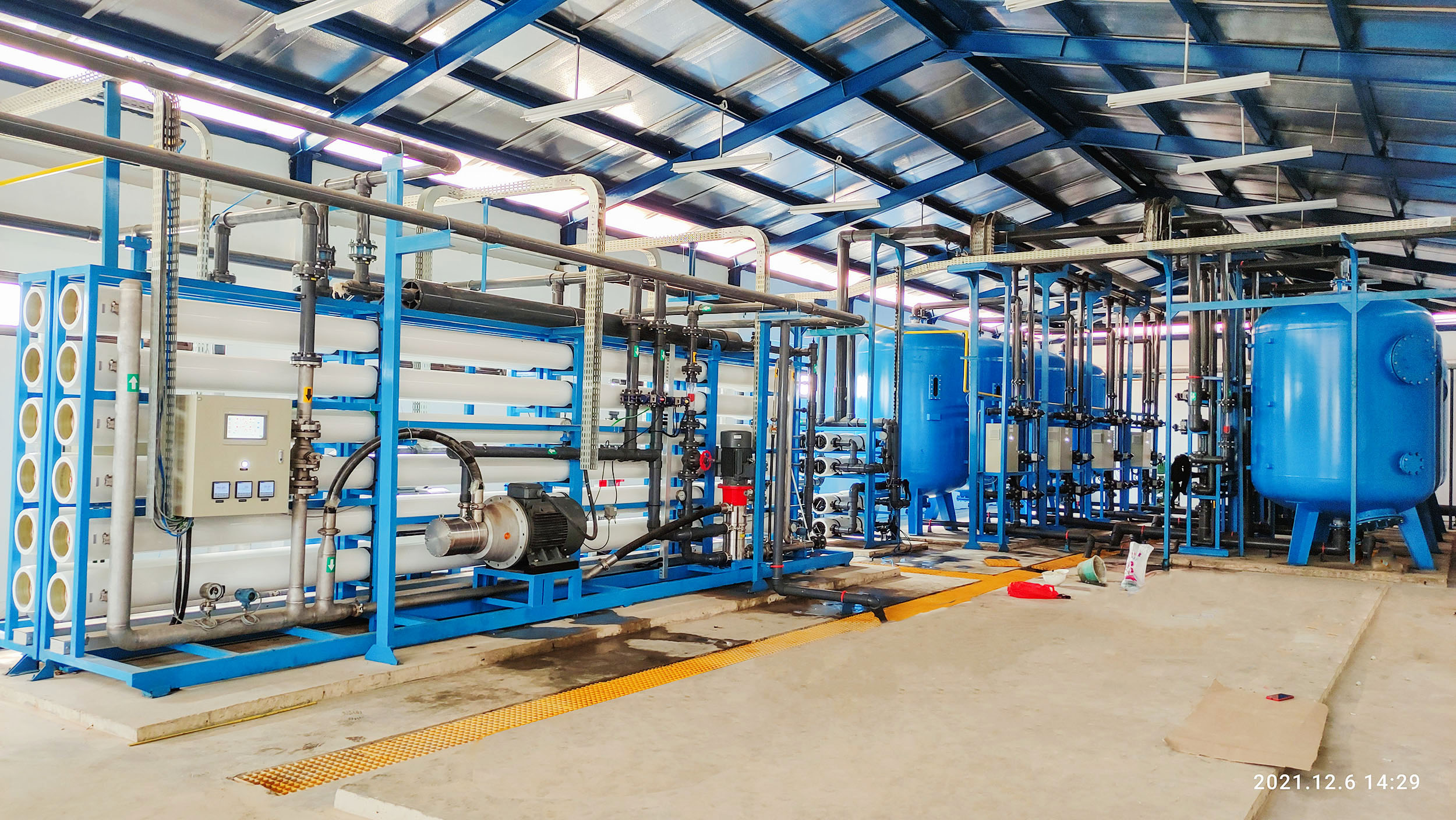
Comparison: Modular Containerized SWRO vs Conventional Site-Built Plant
The comparison below uses documented figures from the fastRO® containerized platform. Where a conventional site-built plant is described, the description is limited to general characteristics of that delivery method rather than any specific competitor.
| Decision factor | Modular containerized SWRO (fastRO® platform) | Conventional site-built SWRO plant |
|---|---|---|
| Assembly location | More than 80% factory pre-assembly in a controlled manufacturing environment | Assembled and erected on site from loose components |
| On-site civil works | Reduced by up to 70% | Civil construction is a major work package |
| Construction & installation time | Reduced by up to 60% | Site work sequence determines the schedule |
| Commissioning | Proven 2-week on-site commissioning | Commissioning follows completion of site works |
| Cost positioning | fastRO C-Series documented at 50–70% of traditional site-built cost | Higher site-built baseline |
| Expansion path | Add modules: 4–5 containers add 5 MLD on the fastRO Mega series; C-Series expandable from 50–1,000 m³/day up to 5,000 m³/day | Expansion generally requires new civil works and a new construction phase |
| Corrosion protection | Duplex 2507; super duplex steel for pumps, energy recovery devices and high-pressure piping; UPVC/HDPE piping; heavy-duty marine paint | Depends on the specification applied on site |
| Power options | Grid, generator, or solar/PV integration option | Depends on the site power design |
Capacity Selection Table
| Platform | Configuration | Capacity range | Typical island / coastal application |
|---|---|---|---|
| fastRO C-Series (C120SW, C250SW, C350SW, C500SW, C750SW, C1000SW) | Containerized SWRO | 50–1,000 m³/day standard, expandable to 5,000 m³/day | Island village and community drinking water, resorts, emergency response, coastal facilities |
| fastRO Mega (Mega5, Mega10, Mega15, Mega20) | Containerized SWRO | 5–20 MLD | Island clusters, distributed municipal supply, larger coastal communities |
| Customized containerized / skid-mounted | Containerized or skid-mounted SWRO, BWRO or WWRO | Approximately 50 MLD and above | Permanent municipal, industrial and agricultural water infrastructure |
| fastRO BW series (C120BW–C1000BW) | Containerized BWRO | Feed water 2,000–5,000 mg/L TDS | Islands with brackish wells or freshwater lenses rather than direct seawater feed |
FAQ: Island and Coastal Community SWRO Systems
What water quality and certification standards should an island community desalination system meet?
ISO 23446:2021 provides international guidelines for the product water quality of seawater reverse osmosis desalination used for municipal supply, and it is the appropriate reference for community drinking water schemes. On the equipment side, containerized SWRO systems for community supply are designed to produce water with salinity (TDS) below 500 mg/L, pH 6–8 and turbidity below 0.2 NTU from feed water of 20,000–45,000 mg/L TDS. QT ENVIRO-TECH equipment designs are certified to ASME and CE standards, and the company holds ISO 9001, ISO 14001 and ISO 45001 certifications.
Can a containerized SWRO plant keep running through monsoon season and coastal corrosion?
Yes — this is the specific design intent of island-rated modular SWRO. A documented reference is a 1,000 CMD community SWRO system delivered in 2022 for a marine coastal environment with a seawater feed source, configured with pre-treatment, SWRO and post-treatment for 24/7 continuous operation with 365-day uptime through monsoon swings. Corrosion protection is handled at material level: Duplex 2507 for the fastRO C-Series, and non-corrosive super duplex steel for pumps, energy recovery devices and high-pressure piping on the fastRO Mega series, with UPVC/HDPE piping and heavy-duty marine paint for frames and containers.
Can an island SWRO system run off-grid on solar power?
PV integration is a documented configuration, not a concept. A 2024 China aid project combined SWRO with PV solar power to provide 500 CMD of fresh water to an off-grid remote site operating continuously, and the fastRO C-Series containerized SWRO system carries a solar power option. Solar integration also compounds with the modular cost profile: because more than 80% of assembly happens in the factory and on-site civil works can be reduced by up to 70%, the site-side scope stays small enough to be practical in a remote location.
How can a community validate the plant before it is shipped to the island?
Validation happens in the factory rather than on the island. Modular SWRO systems are built with more than 80% factory pre-assembly and are pre-tested before shipping, so performance-related assembly and testing are completed under controlled conditions before the units are loaded. The delivery record for larger references shows the same model at scale: the fastRO® containerized platform delivered a 20 MLD SWRO project across approximately 22 ISO containers, factory-assembled and delivered within 4 months.
How long does it take to deliver and commission a modular SWRO plant for an island community?
Timelines depend on capacity and site access, but the modular model compresses both phases. Proven 2-week on-site commissioning is the standard for the containerized platform, and at large scale a 20 MLD SWRO project was factory-assembled across approximately 22 ISO containers and delivered within 4 months. The fastest way to obtain a project-specific schedule is to share two inputs: the island's daily demand figure and a feed water analysis. Send these to QT ENVIRO-TECH at sales@iDesalt.com or via WhatsApp at +86 159-6216-8009, and the engineering team can return a configuration, capacity tier and quotation for the appropriate fastRO® platform.
Conclusion: Water Security Is a Delivery Problem That Modular SWRO Solves
Island and coastal communities do not lack the sea. They lack a plant that can reach them, survive their weather, run on the power they have, and be maintained by the people who live there. Modular containerized SWRO addresses all four conditions at once: more than 80% factory pre-assembly, up to 70% less on-site civil work, up to 60% shorter construction and installation time, marine-grade materials such as Duplex 2507 and super duplex steel, PV integration for off-grid sites, and a digital monitoring layer that reduces dependence on specialist labor.
The evidence base is operational rather than theoretical. A 1,000 CMD island community SWRO system has delivered 24/7 supply with 365-day uptime through monsoon swings since 2022. A 2024 China aid project paired PV with SWRO for 500 CMD of off-grid community water. A 3,500 m³/day remote coastal configuration operates at roughly 350 m³/day per container. And the same modular architecture scales to a 20 MLD SWRO project delivered across approximately 22 ISO containers within 4 months, with the largest containerized reference in the QT ENVIRO-TECH portfolio being a 20,000 m³/day facility in Morocco for OCP Group.
QT ENVIRO-TECH (Suzhou) Ltd has operated since 2011, holds ISO 9001, ISO 14001 and ISO 45001 certifications with ASME- and CE-certified equipment designs, employs a core technical team of more than 40 engineers, and has served clients including Veolia, BP, GE, OCP, BAOSTEEL, China Petroleum and Shanghai Electric, with export business accounting for 80% of total sales across more than 80 countries.
Next Step: Size a System for Your Island or Coastal Community
Share your daily water demand, feed water analysis and site power conditions, and QT ENVIRO-TECH will propose the appropriate fastRO® capacity tier with a configuration and quotation. Sample and validation testing, factory pre-assembly and commissioning planning can be discussed as part of the same review.
Email: sales@iDesalt.com | WhatsApp: +86 159-6216-8009 | Website: www.idesalt.com
Download the full company and product profile: QT ENVIRO-TECH Profile Brochure (PDF)

Have Questions or Need More Details?
Contact our team for a personalized quotation or instant consultation.
Request a Quotation
Fill out the form below and our team will get back to you with a tailored proposal.
WhatsApp Direct Chat
Prefer to chat in real-time? Message us on WhatsApp for instant assistance & quick answers.
- Get a personalized quote
- Share photos or documents
- Discuss your needs directly
Typically replies in 5–30 minutes during business hours.