
What Is a Desalination System? A Practical Guide to Desalination Plants and Equipment
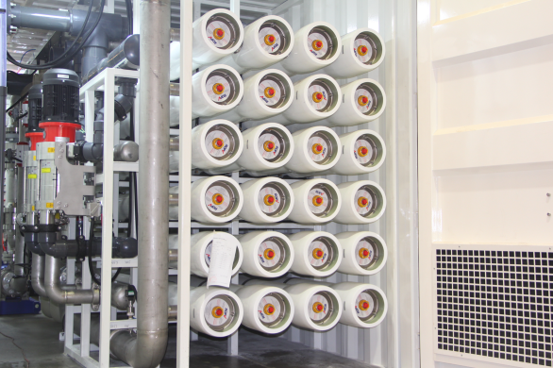
Containerized SWRO desalination system at a large-scale project site
A desalination system is an integrated water treatment system that removes dissolved salts and minerals from seawater or brackish water to produce fresh water. In modern water projects, seawater reverse osmosis—often called SWRO—has become the most widely used desalination technology because it can treat feed water with salinity of 20,000 to 45,000 mg/L and produce water with total dissolved solids below 500 mg/L.
This guide explains what a desalination system is, how reverse osmosis desalination works, what types of desalination equipment are available, which industries use them, and how buyers should evaluate desalination system manufacturers.
Why Desalination Systems Are Becoming Core Water Infrastructure
Global demand for fresh water continues to rise as coastal cities, islands, resorts, industrial plants, and agricultural projects look for new water sources. Desalination converts an abundant resource—seawater or saline groundwater—into a usable resource. The global desalination market was estimated at about USD 21.3 billion in 2025 and is projected to reach USD 23.2 billion in 2026, according to Grand View Research.
The International Desalination and Reuse Association reports that global installed desalination capacity passed 100 million m³/day in 2024. SWRO technology accounts for more than 60% of global installed desalination capacity. Asia Pacific is projected to be the fastest-growing regional market for desalination equipment, with a forecast value of approximately USD 17.7 billion by 2030.
This market shift is not only about large municipal desalination plants. Containerized desalination systems, mobile desalination systems, and modular skid-mounted systems are increasingly used for remote coastal communities, emergency water supply, islands, navy bases, hotels and resorts, golf courses, and industrial facilities.
What Problem Does a Desalination System Solve?
Seawater contains roughly 20,000 to 45,000 mg/L of total dissolved solids. Brackish water typically contains 2,000 to 5,000 mg/L TDS. These water sources are not suitable for most drinking, irrigation, boiler feed, or industrial process requirements without treatment.
A desalination system solves this problem by removing salt and impurities. In typical seawater reverse osmosis systems, the product water quality is designed to a salinity level below 500 mg/L TDS, with pH normally between 6 and 8 and turbidity below 0.2 NTU. These product-water parameters are common in QT ENVIRO-TECH's SWRO equipment specifications.
How Does a Reverse Osmosis Desalination System Work?
A reverse osmosis desalination system uses a semi-permeable membrane to separate water molecules from dissolved salts. In seawater desalination, the system must first make the feed water suitable for membrane treatment, then apply high pressure to push water through the membranes while rejecting salt and other contaminants.
- Intake and screening: Seawater is drawn from the ocean or a well and large particles, seaweed, marine organisms, and debris are removed.
- Pre-treatment: Media filtration, ultrafiltration, or chemical conditioning is used to reduce turbidity, iron, manganese, and organic fouling. Pre-treatment protects the reverse osmosis membranes and extends their service life.
- High-pressure pumping: A high-pressure pump raises the pressure of the feed water to overcome the osmotic pressure of seawater. Energy recovery devices are often used in large systems to reduce power consumption.
- Reverse osmosis separation: Pressurized seawater flows across RO membrane elements. Water passes through the membrane, while dissolved salts and most impurities are rejected and concentrated in a brine stream.
- Post-treatment: The permeate water is stabilized. pH adjustment, remineralization, and disinfection are often added when the water is produced for municipal drinking supply.
- Product water storage and distribution: Treated fresh water is stored in tanks and distributed to the network or point of use.
- Brine management: The concentrated saltwater stream is discharged under environmental permit conditions or further treated.
For industrial ultra-pure water applications, a desalination or reverse osmosis system may be followed by additional technologies such as mixed-bed ion exchange or electrodeionization.
Main Types of Desalination Systems Used Today
Desalination systems are usually classified by feed water source. SWRO systems treat seawater, BWRO systems treat brackish water, and WWRO systems treat wastewater for reuse. Equipment can be designed as site-built plants, containerized systems, skid-mounted systems, or customized combinations of container and skid components.
Seawater Reverse Osmosis Systems
SWRO desalination is the dominant seawater desalination technology. Containerized SWRO systems are factory pre-assembled in ISO containers, which reduces on-site construction and speeds up commissioning.
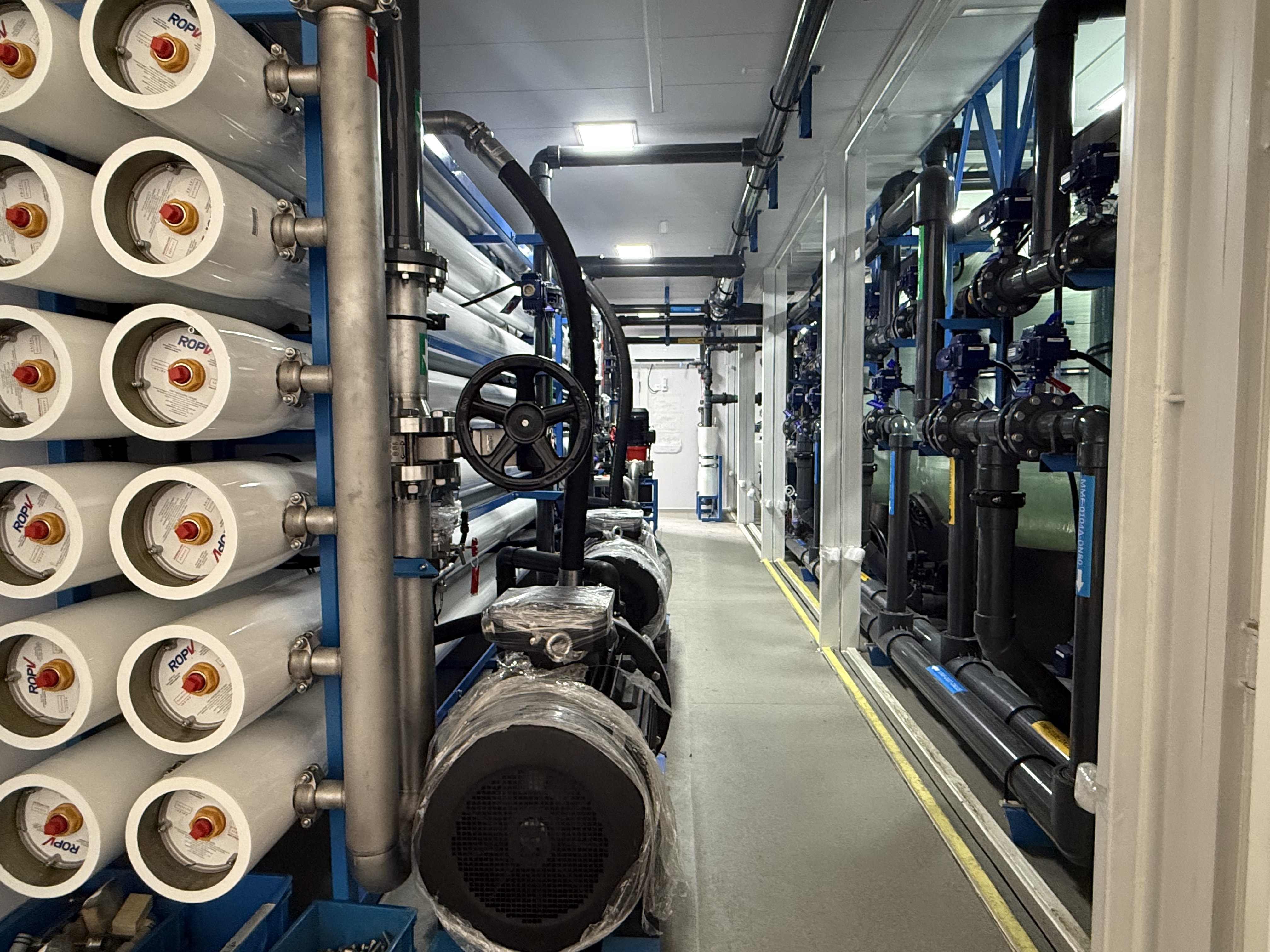
Containerized SWRO system suitable for municipal, industrial, hotel, and island applications
QT ENVIRO-TECH's fastRO C-Series is one example of a containerized seawater desalination system. Models include fastRO C120SW, C250SW, C350SW, C500SW, C750SW, and C1000SW. The standard capacity range is 50 to 1,000 m³/day, expandable to 5,000 m³/day. The system is designed for seawater with feed water salinity of 20,000 to 45,000 mg/L and produces water with salinity below 500 mg/L TDS.
Large Modular Containerized SWRO Systems
For larger distributed water supply, municipal, and industrial projects, modular containerized SWRO systems can be scaled from 5 MLD to 20 MLD. QT ENVIRO-TECH's fastRO Mega series includes fastRO Mega5, Mega10, Mega15, and Mega20 models.
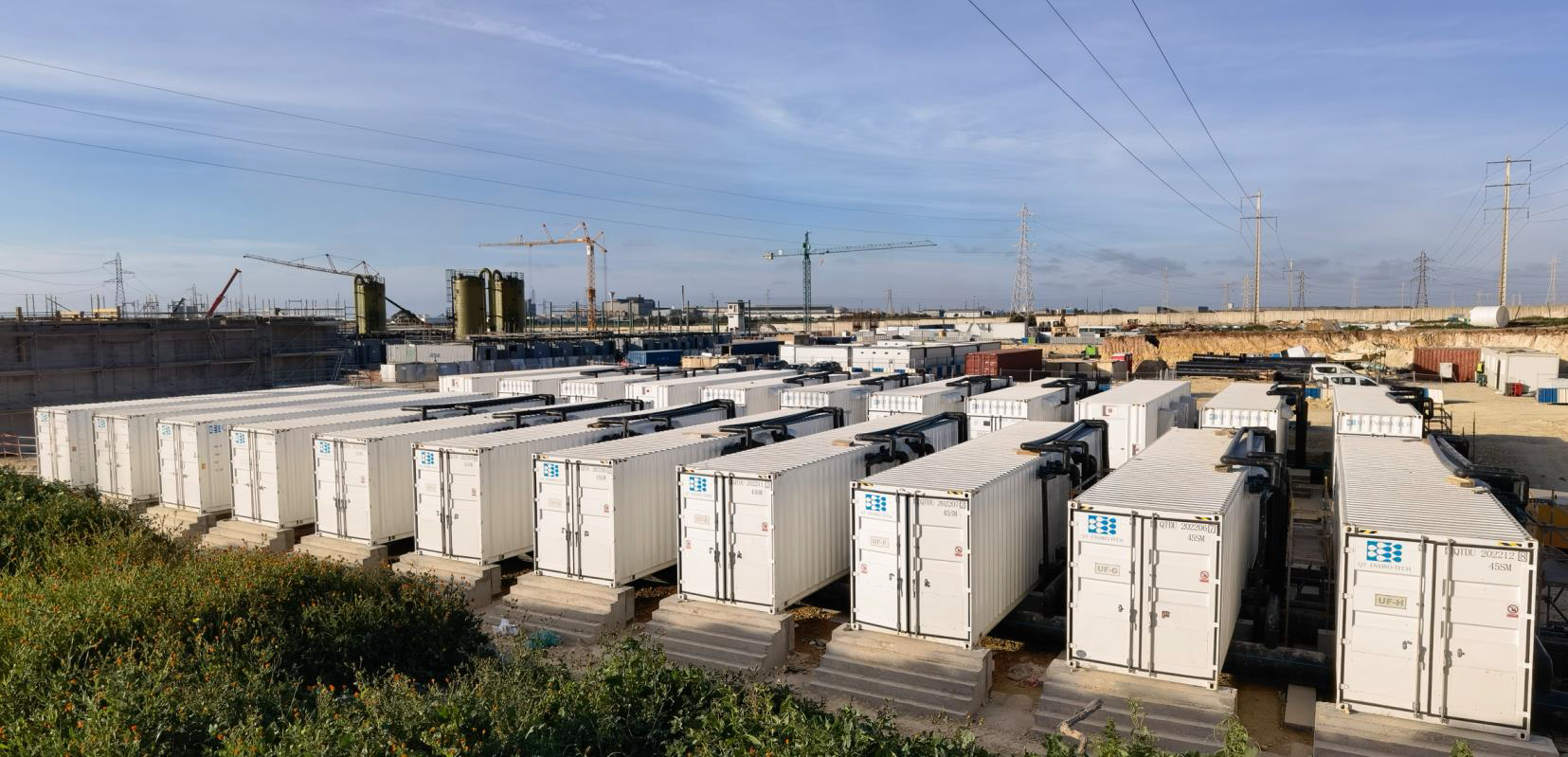
Modular 20 MLD containerized SWRO desalination project design
The fastRO Mega platform uses non-corrosive super duplex steel for pumps, energy recovery devices, and high-pressure piping. UPVC or HDPE piping is used in appropriate low-pressure sections, and the frame and container are finished with heavy-duty marine paint for coastal environments. The system is expandable by adding four to five containers for every additional 5 MLD of capacity. A 20 MLD containerized SWRO project has been demonstrated in Morocco at Jorf Lasfar.
Customized SWRO, BWRO, and WWRO Skid Systems
Larger permanent facilities or projects with unusual site conditions can use customized skid-mounted desalination systems. QT ENVIRO-TECH designs customized containerized or skid-mounted systems for municipal, industrial, power plant, construction, remote area, hotel, resort, and agricultural applications.
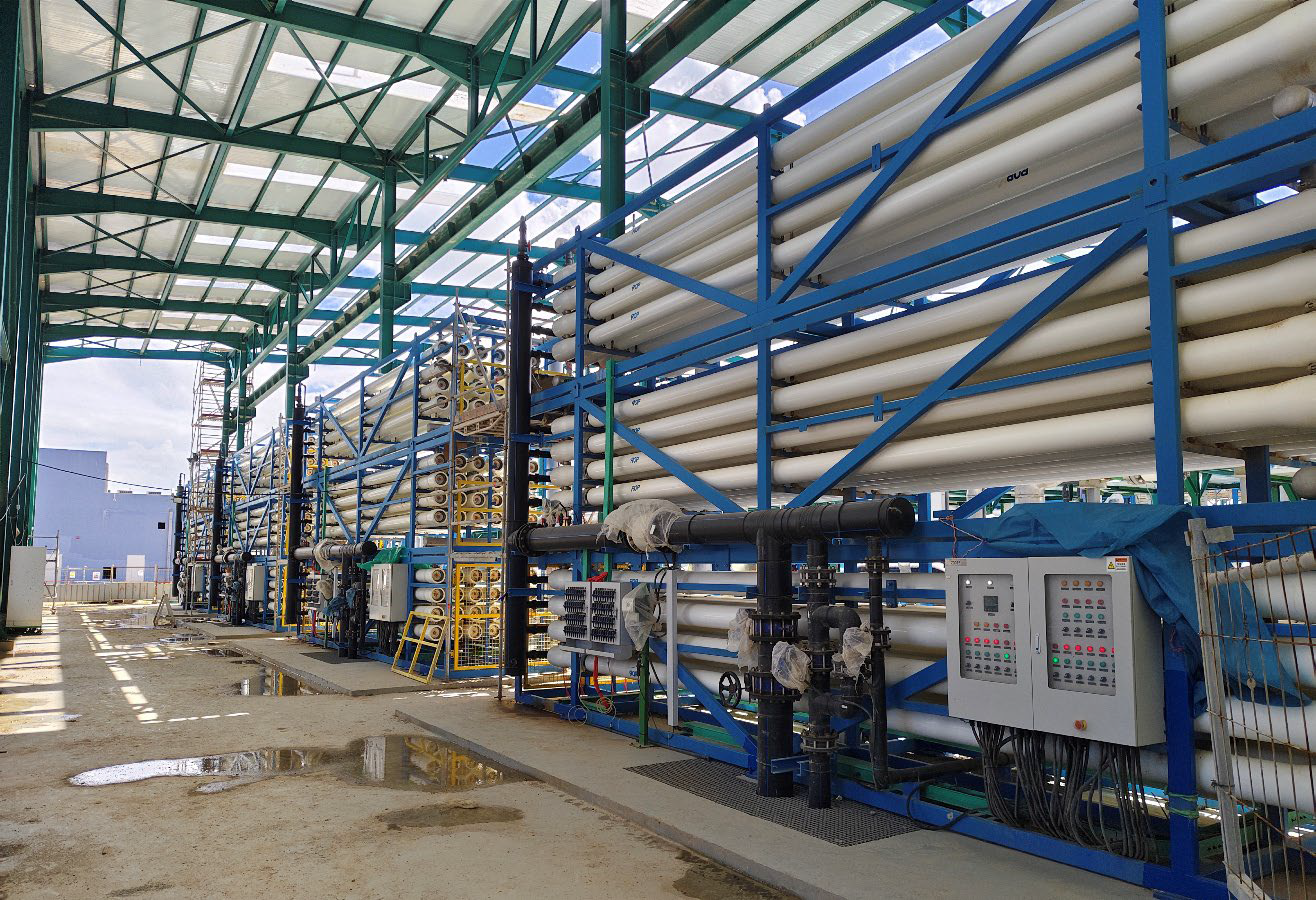
Customized large-capacity desalination system configuration
These systems can be configured for SWRO, BWRO, or WWRO treatment. Their capacity can reach approximately 50,000 m³/day or more. Depending on the application, materials include carbon steel, SS304, or FRP. Equipment designs can be manufactured and documented to ASME and CE standards.
Brackish Water Reverse Osmosis Systems
BWRO systems treat lower-salinity feed water, including brackish groundwater and some industrial water sources. Containerized BWRO systems are used for industrial process water, boiler water, construction sites, remote areas, hotels, resorts, agricultural water, oil drilling platforms, and mobile water supply applications.
QT ENVIRO-TECH's fastRO BW series includes models C120BW, C250BW, C350BW, C500BW, C750BW, and C1000BW. These systems are designed for feed water with 2,000 to 5,000 mg/L TDS and product water with less than 500 mg/L TDS. The high-pressure piping is made of Sch10 SS316 stainless steel.
Wastewater Reverse Osmosis Systems
WWRO systems are not used directly on seawater, but they are often part of a complete water resource plan. A wastewater reverse osmosis system can recycle municipal or industrial wastewater and reduce dependence on seawater desalination. WWRO technology can be used with processes such as clarifier plus ultrafiltration plus BWRO, tubular ultrafiltration plus RO, or nanofiltration systems. One proven large-scale reference is a 60,000 m³/day wastewater recycling system in Anhui, China.
Key Product and Feed Water Parameters
To select the right desalination system, buyers must compare feed water quality, product water targets, capacity, materials, and site constraints. The table below summarizes common configurations and design parameters based on QT ENVIRO-TECH's published system specifications.
| Desalination System Type | Typical Capacity | Feed Water Design TDS | Typical Applications |
|---|---|---|---|
| Containerized SWRO fastRO C-Series | 50 to 1,000 m³/day, expandable to 5,000 m³/day | 20,000 to 45,000 mg/L | Municipal, industrial, hotel, resort, golf course, construction, emergency, island, navy, power plant, residential |
| Containerized SWRO fastRO Mega | 5 to 20 MLD | 20,000 to 45,000 mg/L | Distributed water supply, municipal, industrial |
| Customized SWRO/BWRO/WWRO | Up to approximately 50 MLD or more | Depending on SWRO or BWRO mode | Municipal, industrial, power plant, remote area, agriculture, hotels, resorts |
| Containerized BWRO fastRO BW Series | 50 to 1,000 m³/day class | 2,000 to 5,000 mg/L | Industrial process water, boiler water, construction, agriculture, oil drilling platform, mobile water supply |
| Skid-mounted WWRO | Custom capacity | Wastewater feed depending on pre-treatment | Municipal wastewater recycling, industrial wastewater reuse |
Desalination System Use Cases
Desalination systems are deployed across many project types. The following examples illustrate how containerized and modular equipment matches real operating environments.
Municipal Drinking Water Supply
Large municipal projects require reliable, continuous desalination. A 20 MLD containerized SWRO project at Jorf Lasfar in Morocco demonstrates a modular large-scale approach. The fastRO containerized platform can deliver a 20 MLD SWRO project across approximately 22 ISO containers, factory-assembled and delivered within four months.
Island Community Water Supply
Island communities often depend on seawater desalination because local freshwater resources are limited. A 1,000 m³/day island community water supply application is designed for 365-day uptime, including operation through monsoon swings.
Hotels, Resorts, and Golf Courses
Coastal resorts and golf courses need reliable water for drinking, irrigation, pools, and guest facilities. One European resort application supplies 1,000 m³/day of drinking water using a two-by-40-foot container combination with full operator access. A golf course irrigation project in a harsh coastal environment can be supplied by an SWRO system designed with coastal-ready corrosion protection.
Industrial and Power Plant Water
Industrial facilities require continuous process water. A palm oil production project uses 2,400 m³/day of SWRO water under tropical industrial conditions. Power plants can use containerized SWRO systems for cooling, makeup water, or high-quality boiler water. In one power plant application, a treatment train includes multimedia filtration, two-pass RO, mixed bed, and EDI to reach ultra-pure water quality above 10 MΩ.
Emergency and Mobile Water Supply
Emergency situations need fast deployment. Mobile and emergency desalination systems can be transported to disaster zones, remote construction sites, or temporary communities. One emergency water supply project provides 500 m³/day of fresh water with a solar-integrated SWRO system for off-grid operation.
What to Look for in a Desalination System Manufacturer
For buyers researching desalination system manufacturers, the decision should be based on engineering capability, execution, compliance, and operating support rather than only on equipment price.
Check Proven Project References
Look for a manufacturer that can show references in similar applications. QT ENVIRO-TECH, for example, has delivered a 20 MLD containerized SWRO project at Jorf Lasfar in Morocco and references ranging from remote community supply to industrial and resort projects.
Verify Engineering and Production Capacity
A desalination manufacturer should have in-house engineering, production, and testing capability. QT ENVIRO-TECH is headquartered in Suzhou, China, and has operated since 2011. Its manufacturing facility covers 4,000 m² and its annual production capacity is 300,000 m³. The company employs approximately 70 staff and has a core technical team of more than 40 engineers.
Confirm Standards and Certifications
International compliance matters for equipment approval, safety, and long-term operation. QT ENVIRO-TECH holds ISO 9001, ISO 14001, and ISO 45001 certifications, and its equipment designs are certified to ASME and CE standards. For municipal customers, ISO 23446:2021 provides international guidelines for product water quality of seawater reverse osmosis desalination systems.
Look for Complete Scope of Work
Desalination projects include design, procurement, assembly, testing, logistics, installation supervision, commissioning, operator training, and service. A manufacturer that acts as designer, EPC, and system integrator can take more responsibility for the full water treatment plant. QT ENVIRO-TECH specializes in designing, building, assembling, commissioning, and maintaining turnkey SWRO, BWRO, and WWRO systems.
Consider Digital Operation and Maintenance Tools
For remote sites, operator training and skilled labor can be a challenge. Digital monitoring can lower operating risk. QT ENVIRO-TECH's Digital Water Plant platform integrates real-time SCADA visualization, AI agent support, predictive equipment health monitoring, and automatic work-order dispatching.
Frequently Asked Questions
What is a desalination system?
A desalination system removes dissolved salts from seawater or brackish water to produce fresh water. Many modern systems use reverse osmosis membranes. In SWRO desalination, feed water may contain 20,000 to 45,000 mg/L TDS, and the treated water is often designed to be below 500 mg/L TDS.
What is the difference between SWRO, BWRO, and WWRO systems?
SWRO is seawater reverse osmosis, used for seawater containing roughly 20,000 to 45,000 mg/L TDS. BWRO is brackish water reverse osmosis, used for water containing about 2,000 to 5,000 mg/L TDS. WWRO is wastewater reverse osmosis, used to recycle municipal or industrial wastewater.
Should I choose a containerized or traditional site-built desalination system?
For coastal resorts, islands, golf courses, remote facilities, and emergency sites, a containerized SWRO system is often recommended. Containerized equipment is factory pre-assembled and tested, reducing on-site civil works and installation time. For larger municipal or industrial projects, modular container systems such as the fastRO Mega series can be expanded by adding container modules.
How do I choose a desalination system manufacturer?
Check project references in similar applications, engineering and production capability, certifications, and the supplier's ability to handle the full project scope. QT ENVIRO-TECH has more than 40 core engineers, manufacturing in Suzhou, ISO 9001/14001/45001 certifications, equipment designs to ASME and CE standards, and clients that have included Veolia, BP, GE, OCP, BAOSTEEL, China Petroleum, and Shanghai Electric.
Can a large-scale desalination system be expanded later?
Yes, modular containerized and skid-mounted desalination systems are designed for phased capacity. In the fastRO Mega platform, approximately four to five containers can be added to increase capacity by about 5 MLD. This reduces the need to rebuild the plant as water demand grows.
Conclusion
A desalination system is a practical response to water scarcity in coastal, island, industrial, and remote environments. Seawater reverse osmosis has become the dominant desalination technology, and equipment suppliers now offer containerized, modular, and skid-mounted systems that are faster to install than conventional site-built plants.
When reviewing desalination system manufacturers, focus on reference projects, engineering depth, production capacity, certifications, material quality, digital operation support, and the supplier's ability to deliver a complete turnkey plant. These factors determine whether the system will meet its long-term water production target.
If you are planning a seawater desalination project, contact QT ENVIRO-TECH to discuss feed water quality, capacity, power supply, and delivery schedule.
Email: Sales@iDesalt.com | Tel/WhatsApp: +86 159-6216-8009
Have Questions or Need More Details?
Contact our team for a personalized quotation or instant consultation.
Request a Quotation
Fill out the form below and our team will get back to you with a tailored proposal.
WhatsApp Direct Chat
Prefer to chat in real-time? Message us on WhatsApp for instant assistance & quick answers.
- Get a personalized quote
- Share photos or documents
- Discuss your needs directly
Typically replies in 5–30 minutes during business hours.