Desalination System Jargon Buster: SWRO, BWRO, WWRO, and Customized Configurations Explained
A desalination system quotation usually arrives as a wall of acronyms long before it states a price. SWRO, BWRO, WWRO, MLD, TDS, ERD — four of those five letters get used interchangeably by sales teams, and that is exactly where first-time buyers lose money. Comparing a brackish-water unit against a seawater unit, or assuming a "customized configuration" is simply a bigger version of the same machine, are two of the most common procurement misreads in this category.
This jargon buster decodes the four categories that appear most often in real desalination system offers: SWRO, BWRO, WWRO, and customized SWRO/BWRO/WWRO configurations. Each is defined by two things only — the feedwater it accepts and the treatment goal it serves — and then placed on a scale ladder that runs from a 100 m³/day agricultural brackish-water unit to a 60,000 m³/day industrial wastewater recycling plant.
Problem Definition: Why Desalination System Jargon Causes Costly Misreads
The acronym on a desalination system tells you what kind of water goes in and what the plant is trying to achieve with it. It does not tell you the capacity, the delivery format, the civil works required, or the price band. Buyers who treat SWRO, BWRO and WWRO as interchangeable sizes of the same product end up comparing quotations that were never comparable in the first place.
Three specific failures show up repeatedly in early-stage evaluation:
- Feedwater mismatch. A brackish-water reverse osmosis unit is specified for feedwater with a total dissolved solids (TDS) range of 2,000–5,000 mg/L. A seawater reverse osmosis unit is specified for 20,000–45,000 mg/L. Quoting one against the other on capacity alone hides a fundamentally different membrane, pressure and material scope.
- Deployment-format confusion. "Customized" is often read as "custom engineering from scratch." In practice, customized configurations describe containerized or skid-mounted builds that are sized and configured to a specific process, standard and site — not a one-off prototype.
- Scale blindness. The same acronym behaves very differently at 100 m³/day and at 50,000 m³/day in terms of pre-treatment complexity, footprint, and how the plant is shipped and commissioned.
Answer first: SWRO is defined by seawater feedwater; BWRO by brackish feedwater; WWRO by wastewater or reuse feedwater. Customized SWRO/BWRO/WWRO configurations are project-specific builds that keep the same feedwater logic but are engineered to a wider capacity and site envelope.
Industry Background: SWRO Dominates, BWRO and WWRO Solve Different Problems
Desalination is no longer a niche coastal technology. Global installed desalination capacity crossed the 100 million cubic meters per day threshold in 2024, according to the International Desalination and Reuse Association (IDRA) Desalination & Reuse Handbook 2024–2025. Within that installed base, SwRO — seawater reverse osmosis — commands more than 60% of global installed capacity, based on market data published by Credence Research.
The commercial weight behind the acronyms is equally measurable. Grand View Research reports that the global desalination market reached approximately USD 21.3 billion in 2025 and is projected to grow to about USD 23.2 billion by 2026. The same publisher projects Asia Pacific as the fastest-growing regional market for desalination equipment, estimated to reach USD 17.7 billion by 2030.
Two structural facts explain why buyers now see four labels instead of one:
- Municipal drinking water is standardized. ISO 23446:2021 provides international guidelines for product water quality of seawater reverse osmosis (RO) desalination used for municipal supply — which is why SWRO is the most frequently quoted category for city-scale drinking water.
- Industrial and agricultural demand is not. Brackish inland sources, industrial process water, boiler feed and wastewater reuse each carry different feedwater chemistry, which is why BWRO and WWRO exist as separate product families rather than SWRO variants.
Detailed Solution: The Four Categories Defined by Feedwater and Treatment Goal
QT ENVIRO-TECH (Suzhou) Ltd is a desalination system manufacturer, EPC and system integrator based in Suzhou, China, established in 2011, with a 4,000 m² factory, approximately 70 employees, an annual output of 300,000 m³, and a core technical team of more than 40 engineers. The company designs, builds, assembles, commissions and maintains turnkey SWRO, BWRO and WWRO water treatment systems. Its product portfolio is the practical reference used below to separate the four categories.
SWRO — Seawater Reverse Osmosis
SWRO takes seawater and produces low-salinity product water. The defining constraint is feedwater salinity: seawater at 20,000–45,000 mg/L TDS, at temperatures of 5–35 °C, turbidity below 20 NTU, COD below 10 mg/L, iron and manganese below 0.1 mg/L, and no oil or grease. The treatment goal is a product water stream with TDS below 500 mg/L, pH 6–8, and turbidity below 0.2 NTU.
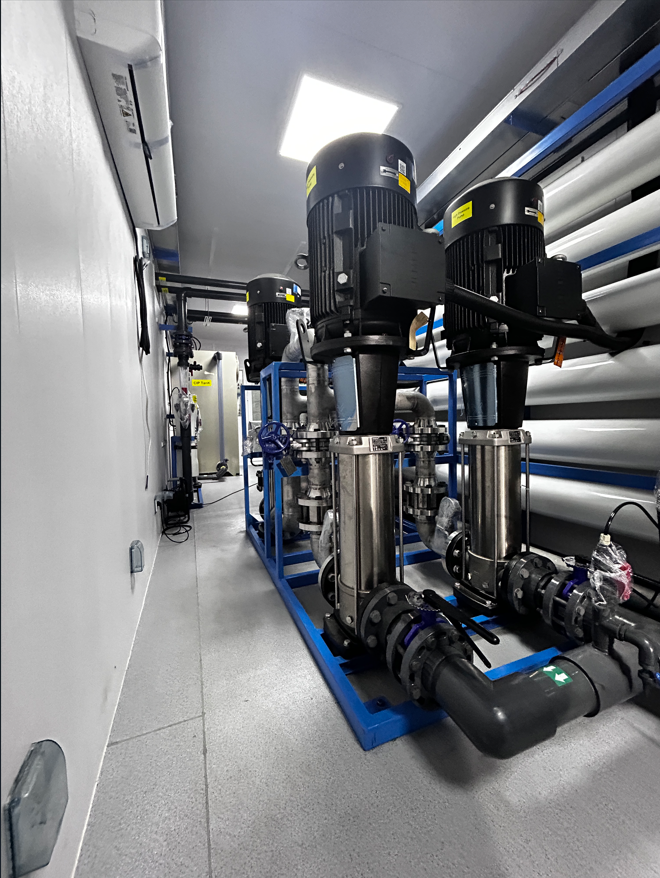
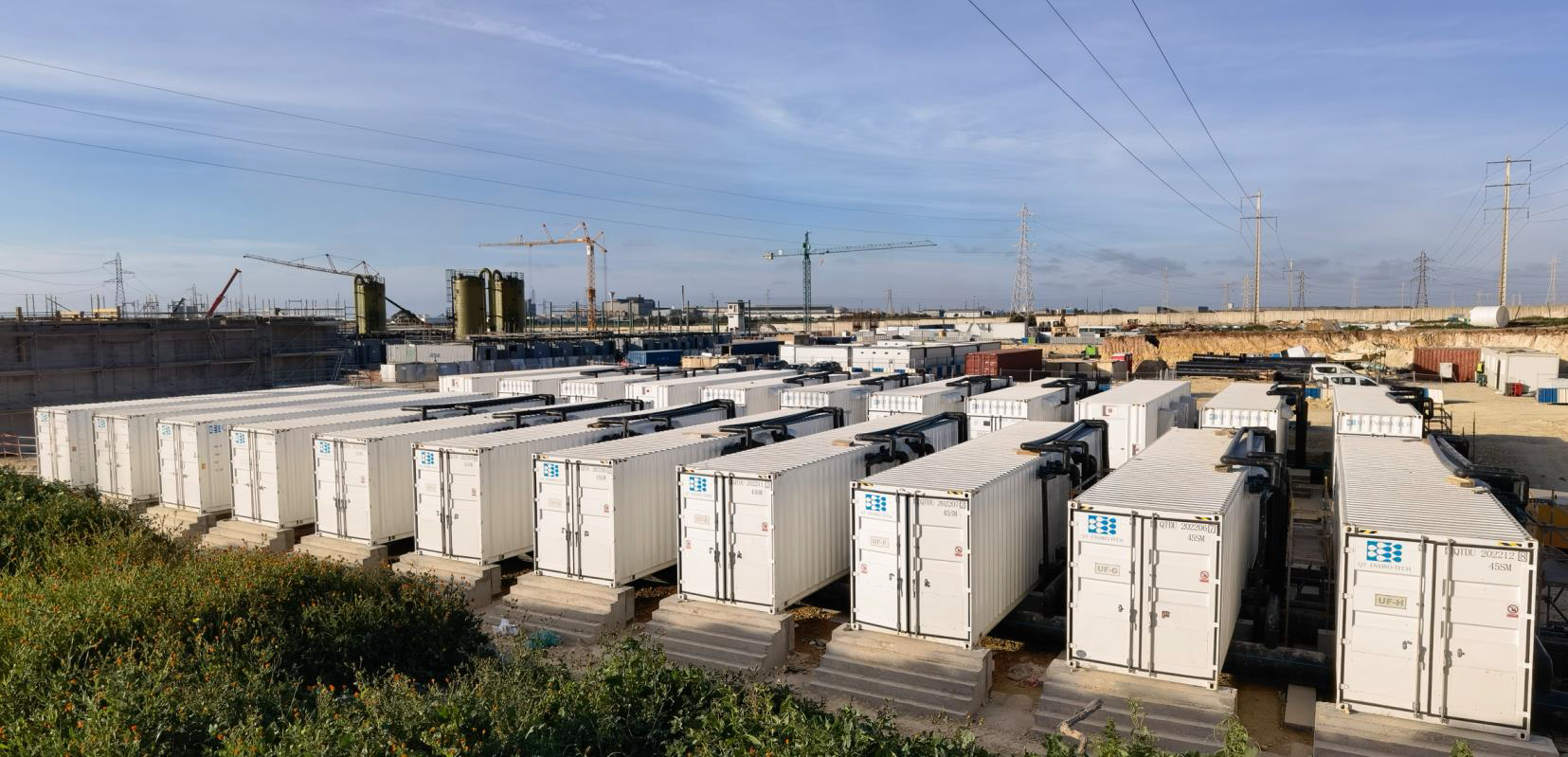
QT's containerized SWRO line is the fastRO Mega series — Mega5, Mega10, Mega15 and Mega20 — covering 5 to 20 MLD (5,000–20,000 m³/day). Construction uses known brands, non-corrosive super duplex steel for pumps, energy recovery devices and high-pressure piping, UPVC or HDPE for general piping, and heavy-duty marine paint on frames and containers.
BWRO — Brackish Water Reverse Osmosis
BWRO is defined by lower-salinity inland or process feedwater rather than the sea. The specified feedwater envelope is 2,000–5,000 mg/L TDS, temperature 5–35 °C, turbidity below 5 NTU, COD below 10 mg/L, iron and manganese below 0.1 mg/L, and no oil or grease. The product water target is the same as SWRO: TDS below 500 mg/L, pH 6–8, turbidity below 0.2 NTU.
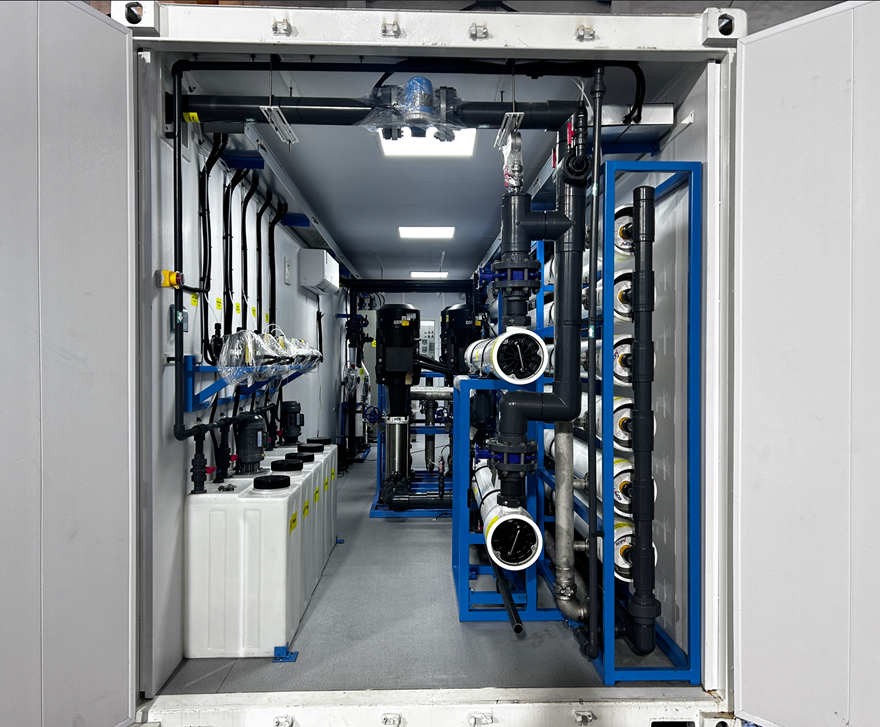
The BWRO models C120BW, C250BW, C350BW, C500BW, C750BW and C1000BW are offered as containerized or customized units and use Sch10 SS316 high-pressure pipe and fittings with heavy-duty paint. Typical applications include industrial process water, boiler water, construction sites, remote areas, hotels and resorts, agriculture, oil drilling platforms and mobile water supply vehicles.
WWRO — Wastewater Reverse Osmosis
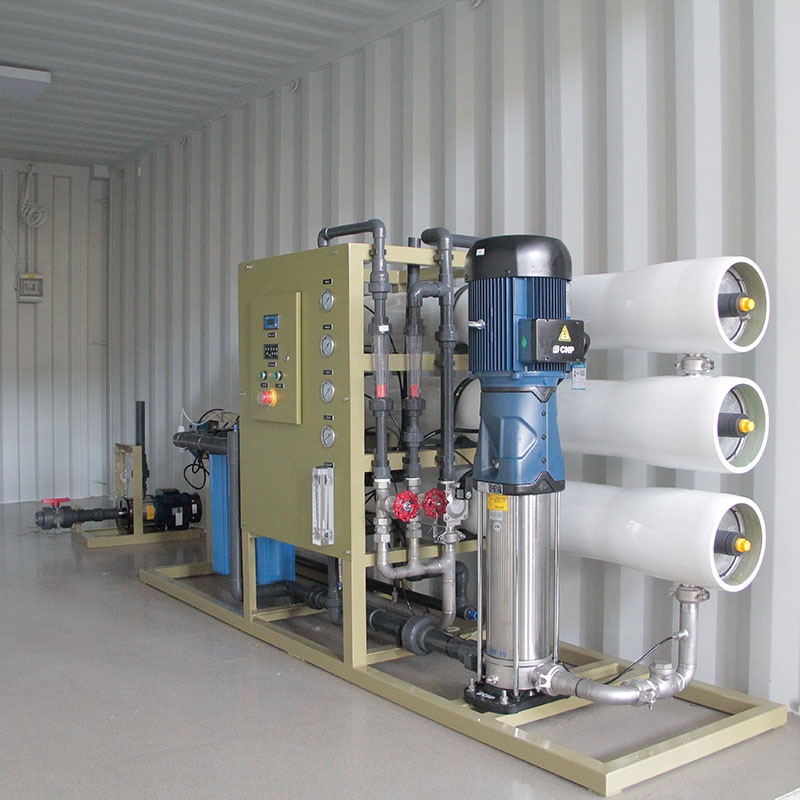
WWRO changes the treatment goal rather than the feedwater source: the objective is recycling municipal or industrial wastewater into reusable water. Because influent chemistry varies enormously between sites, WWRO is quoted as a customized treatment capacity with an integrated skid-mounted layout rather than a fixed model number. Available process trains include Clarifier + UF + BWRO, Tubular UF + RO, and NF systems. Construction materials are carbon steel, SS304 or FRP.
Customized SWRO / BWRO / WWRO Configurations
A customized configuration is the fourth category and the one most often misunderstood. It covers containerized or skid-mounted builds engineered to a project's process, standard and site conditions, with capacity extending to roughly 50 MLD and above (50,000 m³/day+). The feedwater and product water envelopes follow the same logic as the base category — for seawater-based builds, 20,000–45,000 mg/L TDS feedwater and product water below 500 mg/L TDS, pH 6–8, turbidity below 0.2 NTU — while construction materials are selected from carbon steel, SS304 or FRP. Customized SWRO/BWRO/WWRO units are typically deployed for municipal, industrial, power plant, construction site, remote area, hotel and resort, and agricultural applications.
How Scale Changes the Same Acronym: 100 m³/day to 60,000 m³/day
Capacity is the second variable buyers must separate from the acronym. QT's fastRO portfolio spans three tiers — fastRO C/BWC from 50 to 1,000 m³/day, fastRO Mega from 5 to 20 MLD, and fastRO Skid up to roughly 50 MLD — and the deployed reference projects show how broadly that ladder stretches in practice.
| Scale tier | Reference deployment | Category | Notable detail |
|---|---|---|---|
| 100 m³/day | Agricultural irrigation from brackish water (2020) | BWRO | Brackish water feed source; seasonal or continuous operation |
| 500 m³/day | Nuclear power plant process and cooling water | SWRO | 24/7 continuous; high-reliability, low-noise and explosion-proof requirements |
| 500 m³/day | Emergency and aid water supply (2024) | SWRO + PV | Solar-integrated, off-grid mobile operation |
| 1,000 m³/day | Island community drinking water (2022) | SWRO | 365-day uptime through monsoon swings |
| 2,400 m³/day | Industrial process water for palm oil production (2020) | SWRO | Tropical industrial conditions |
| 3,500 m³/day | Remote coastal community supply | SWRO + solar + storage | 350 m³/day per container; Veolia partnership |
| 20 MLD (20,160 m³/day) | Municipal drinking water, Morocco | UF + SWRO matrix | Large-scale modular deployment |
| 50,400 m³/day | Municipal drinking water facility, Morocco (OCP) | GSF + UF + SWRO | Permanent municipal capacity |
| 60,000 m³/day | Industrial wastewater recycling, Anhui, China (2025) | Clarifier + UF + BWRO | Large-scale industrial reuse |
The same acronym therefore covers a small agricultural unit and a city-scale plant. What changes across that range is pre-treatment complexity, membrane array design, energy recovery configuration, and how the plant is shipped — which is why capacity should always be quoted separately from category.
Step-by-Step Breakdown: Choosing the Right Desalination System Category
A repeatable selection sequence removes most of the ambiguity created by the acronyms themselves.
- Classify the feedwater. Seawater feed falls in the 20,000–45,000 mg/L TDS band; brackish feed falls in the 2,000–5,000 mg/L band; wastewater reuse is defined by influent chemistry, not salinity. This single step determines SWRO, BWRO or WWRO.
- Define the treatment goal. Municipal drinking water, industrial process water, boiler feed, irrigation or wastewater reuse each set a different product water target. QT systems are specified to a product water envelope of TDS below 500 mg/L, pH 6–8 and turbidity below 0.2 NTU for the SWRO and BWRO lines.
- Size daily capacity. Use m³/day. Small agricultural tasks sit near 100 m³/day; containerized fastRO C/BWC covers 50–1,000 m³/day; fastRO Mega covers 5–20 MLD; skid-based builds extend to roughly 50 MLD and above.
- Choose the deployment format. Containerized systems ship as ISO containers; skid-mounted systems ship by flatbed and are used for permanent municipal, industrial and agricultural installations.
- Check the pre-treatment train. SWRO references use UF-based pre-treatment matrices; WWRO references use Clarifier + UF + BWRO, Tubular UF + RO, or NF trains.
- Confirm acceptance and delivery terms. QT containerized systems carry an MOQ of one unit, with ISO container shipping in 20ft, 40ft and 40ft HC formats, factory delivery, FOB, CIF or DAP terms, and acceptance via factory acceptance test, pre-shipment test, on-site commissioning and performance test.
- Plan the long-term support model. Process design, equipment procurement, factory assembly, quality testing, shipping logistics, installation supervision, commissioning, operator training and long-term operation support are delivered as one sequence rather than separate contracts.
Use Cases: Matching Each Acronym to a Real Deployment
Category selection becomes straightforward once the deployment scenario is fixed.
- Islands and remote coastal communities → containerized SWRO. A 1,000 m³/day island community system has demonstrated 365-day uptime through monsoon swings, and a 3,500 m³/day remote coastal supply uses 350 m³/day per container with solar power and storage.
- Agriculture → small-scale BWRO. A 100 m³/day BWRO unit converts brackish water into irrigation-grade water, operating seasonally or continuously.
- Municipal drinking water → SWRO at scale, or customized skid builds. Municipal references include a 20 MLD (20,160 m³/day) UF + SWRO matrix plant and a 50,400 m³/day drinking water facility for OCP in Morocco using GSF + UF + SWRO.
- Industrial wastewater → WWRO. A 60,000 m³/day recycling plant in Anhui, China uses a Clarifier + UF + BWRO train for large-scale industrial reuse.
- Emergency and mobile supply → SWRO with PV integration. A 500 m³/day solar-integrated unit supports off-grid, mobile operation.
- Power generation → high-purity downstream treatment. Power plant boiler water systems combine MMF + two-pass RO + mixed bed + EDI to deliver ultra-pure water above 10 MΩ for a 2×25 MW plant.
Comparison Table: SWRO vs BWRO vs WWRO vs Customized Configuration
| Category | Feedwater & typical TDS | Treatment goal | QT product line & capacity | Deployment format |
|---|---|---|---|---|
| SWRO (Seawater Reverse Osmosis) | Seawater, 20,000–45,000 mg/L TDS | Produce low-salinity water from seawater; product TDS <500 mg/L, pH 6–8 | fastRO Mega5 / Mega10 / Mega15 / Mega20; 5–20 MLD | Containerized |
| BWRO (Brackish Water Reverse Osmosis) | Brackish water, 2,000–5,000 mg/L TDS | Desalinate inland or process sources; product TDS <500 mg/L, pH 6–8 | C120BW, C250BW, C350BW, C500BW, C750BW, C1000BW | Containerized / Customized |
| WWRO (Wastewater Reverse Osmosis) | Municipal or industrial wastewater influent; capacity is customized to site chemistry | Recycle wastewater for reuse | fastRO Skid / Customized; Clarifier+UF+BWRO, Tubular UF+RO, NF | Skid-mounted / Customized |
| Customized SWRO/BWRO/WWRO | Configured to project feedwater; seawater builds at 20,000–45,000 mg/L TDS | Project-specific output to a defined process, standard and site condition | Customized containerized or skid; approximately 50 MLD+ | Skid-mounted |
Two practical differences sit outside the table. First, construction material changes with category: super duplex steel and UPVC/HDPE for SWRO, Sch10 SS316 with heavy-duty paint for BWRO, and carbon steel, SS304 or FRP for WWRO and customized builds. Second, the delivery logic differs by format — containerized systems ship as ISO containers, while skid systems transport by flatbed with modular shipping for large projects.
Long-Term Considerations: What Separates a Supplier From a Project Partner
For buyers at the decision-to-execution stage, the acronym question is resolved early; the harder question is who remains accountable after commissioning. QT ENVIRO-TECH has delivered over 100 successful projects across more than 20 countries in Asia, the Middle East, Africa and Europe, with export business accounting for 80% of total sales and a service footprint extending to markets in over 80 countries including South America.
Long-term project support is structured around three elements rather than a single warranty statement:
- Continuity of scope. A single supplier covers process design, procurement, factory assembly, quality testing, shipping logistics, installation supervision, commissioning, operator training and long-term operation support.
- Digital operations. The Digital Water Plant platform integrates real-time SCADA visualization, AI agent support for energy and chemical optimization, predictive equipment health monitoring and automatic work-order dispatching — designed to reduce OPEX and lessen dependence on scarce skilled labor.
- Deployment speed as an availability factor. The fastRO containerized platform delivers a 20 MLD SWRO project across approximately 22 ISO containers, factory-assembled with more than 80% pre-assembly, reducing on-site civil works by up to 70% and cutting total construction and installation time by up to 60%, with proven two-week on-site commissioning.
Where buyers need to verify claimed capability, the reference base is the practical check: containerized deployment proven up to 20 MLD, skid-mounted deployment proven above 50 MLD, and permanent references at 50,400 m³/day for municipal drinking water and 60,000 m³/day for industrial wastewater recycling. Equipment designs are certified to ASME and CE standards, and corporate processes hold ISO 9001, ISO 14001 and ISO 45001 certifications.
Frequently Asked Questions
1. What standards apply to SWRO, BWRO and WWRO desalination systems?
ISO 23446:2021 sets international guidelines for product water quality of seawater reverse osmosis desalination used for municipal supply, which is the reference point most often applied to SWRO systems feeding drinking water networks. On the equipment side, QT ENVIRO-TECH states that its equipment designs are certified to ASME and CE standards, and that corporate processes hold ISO 9001, ISO 14001 and ISO 45001 certifications. In practice, buyers should match the standard to the end use: municipal drinking water for SWRO, process or boiler specifications for BWRO, and discharge or reuse criteria for WWRO. Product water for the SWRO and BWRO lines is specified at TDS below 500 mg/L, pH 6–8 and turbidity below 0.2 NTU.
2. Can one supplier deliver SWRO, BWRO, WWRO and customized configurations — and support an island project long term?
Yes. QT ENVIRO-TECH manufactures all four categories: SWRO (fastRO Mega5–Mega20, 5–20 MLD), BWRO (C120BW–C1000BW), WWRO (customized skid systems with Clarifier+UF+BWRO, Tubular UF+RO or NF trains), and customized SWRO/BWRO/WWRO containerized or skid builds extending to approximately 50 MLD and above. For island and remote coastal projects specifically, the company has delivered a 1,000 m³/day island community SWRO system with 365-day uptime through monsoon swings in 2022, and a 3,500 m³/day remote coastal supply built at 350 m³/day per container with solar power and storage. Long-term support covers installation supervision, commissioning, operator training and ongoing operation support, supported by a core technical team of more than 40 engineers.
3. How should buyers compare budget and total cost of ownership across the four categories?
Cost comparisons only become meaningful once feedwater, capacity and pre-treatment train are fixed, because those three variables drive membrane count, pressure requirements and civil works. Two structural cost levers apply across categories. First, modular deployment allows phased CAPEX: fastRO Mega and fastRO Skid solutions use pre-fabricated, factory-assembled modules so capacity can be added in increments rather than rebuilt. Second, factory pre-assembly shifts work off site — QT reports more than 80% factory pre-assembly, up to 70% lower on-site civil works, up to 60% shorter construction and installation time, and a total cost around 10% lower than a traditional site-built plant. Operational cost is addressed separately through the Digital Water Plant platform, which applies AI support to energy and chemical consumption.
4. Can we validate a system before committing to full-scale deployment?
Validation is embedded in the delivery process rather than treated as an optional extra. The minimum order quantity for containerized systems is one unit, so a single fastRO C/BWC or BWRO container can serve as the validation step before larger capacity is ordered. Acceptance typically includes factory pre-assembly inspection, factory acceptance test (FAT), pre-shipment test, site acceptance test (SAT) and a performance guarantee test, with training and commissioning included. Containerized systems are factory-assembled, pre-tested and quality-verified before shipping on a plug-and-play basis. Delivery terms support factory delivery, FOB, CIF or DAP depending on the project, and payment terms include letter of credit, T/T wire transfer and open account for established clients.
5. What lead time should buyers plan for, and what is the next step?
Lead time depends on category and format. The fastRO containerized platform delivered a 20 MLD SWRO project across approximately 22 ISO containers, factory-assembled and shipped within four months, with two-week on-site commissioning. Containerized systems have been installed in as little as 10 days in suitable locations, while permanent skid-mounted municipal plants follow a longer civil and commissioning schedule. Because schedule risk usually sits in pre-treatment and civil works rather than the RO skid itself, the fastest way to get a reliable date is to send feedwater analysis, target capacity in m³/day and site conditions for a scoped configuration and quotation. You can request a system quote or a reference list by contacting the QT ENVIRO-TECH team at Sales@iDesalt.com or WhatsApp +86 159-6216-8009.
Conclusion: Use the Acronym to Narrow the Shortlist, Not to Set the Price
SWRO, BWRO, WWRO and customized configurations are not four sizes of one product. They are four feedwater-and-goal definitions, and the same acronym can describe a 100 m³/day agricultural BWRO unit or a 60,000 m³/day industrial recycling plant. The practical buying rule is simple: fix the feedwater chemistry first, fix the product water target second, size the capacity in m³/day third, and only then compare delivery formats, materials and commercial terms across quotations.
QT ENVIRO-TECH (Suzhou) Ltd is a desalination system manufacturer, EPC and system integrator founded in 2011, operating a 4,000 m² factory with a core technical team of more than 40 engineers, and delivering SWRO, BWRO, WWRO and customized water treatment systems to projects in over 20 countries. Buyers who want the category definitions checked against their own site data can review the company profile and reference portfolio before shortlisting.
Next Step: Turn the Acronyms Into a Scoped Configuration
Send your feedwater analysis, target capacity in m³/day and site conditions, and the QT ENVIRO-TECH engineering team will confirm whether SWRO, BWRO, WWRO or a customized configuration fits — and return a scoped quotation with acceptance and delivery terms.
Contact: Grace | Tel / WhatsApp: +86 159-6216-8009 | Email: Sales@iDesalt.com | Web: www.idesalt.com
Download the full company and product profile: QT ENVIRO-TECH Company Profile (PDF)
Have Questions or Need More Details?
Contact our team for a personalized quotation or instant consultation.
Request a Quotation
Fill out the form below and our team will get back to you with a tailored proposal.
WhatsApp Direct Chat
Prefer to chat in real-time? Message us on WhatsApp for instant assistance & quick answers.
- Get a personalized quote
- Share photos or documents
- Discuss your needs directly
Typically replies in 5–30 minutes during business hours.