
How to Vet a Desalination System Supplier: Capability and Delivery Checks
Vetting a desalination system supplier means auditing four things before you sign: the engineering base that designs and builds the plant, the verified capacity envelope of the equipment being quoted, the reference projects that prove delivery under comparable conditions, and the acceptance terms that keep the supplier accountable after handover. A supplier that can document all four is a different risk profile from one that can only present a catalogue.
This guide is written for buyers in the evaluation-to-execution stage — municipal water authorities, island and resort developers, EPC contractors, industrial operators, and aid-programme procurement teams — who are shortlisting seawater desalination system suppliers. Every project reference below is named, sized, and dated so that it can be checked independently instead of accepted as a claim.
Why Capability Is the Hardest Supplier Claim to Verify
Desalination procurement rarely fails because a supplier misrepresents its address. It fails because three specific claims are accepted at face value and only tested after the contract is signed.
Failure mode 1: capacity that exists on paper only. A promised daily output depends on feed water quality, temperature, pre-treatment design, and membrane flux assumptions. A containerized reverse osmosis desalination system rated at 1,000 m³/day on a specification sheet performs at that level only if the design envelope matches the actual site. Buyers who never ask for the feed water and product water limits in writing discover the gap during performance testing.
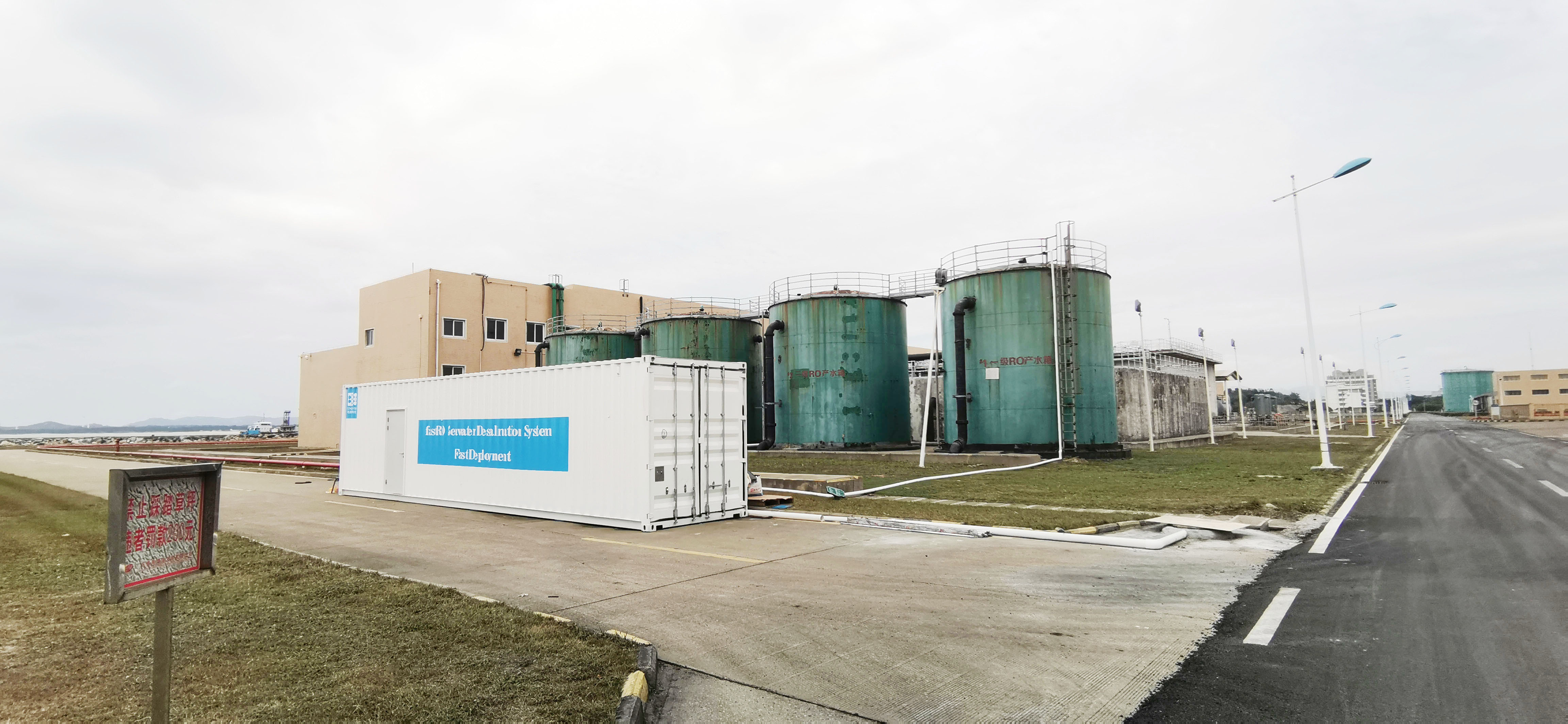
Failure mode 2: containerized in name, site-built in practice. Containerization is not a housing choice; it is a delivery method. If more than a small share of assembly still happens on site, the buyer carries the civil works, the schedule risk, and the weather risk that containerization was supposed to remove.
Failure mode 3: delivery and support that stop at handover. Commissioning, operator training, spare parts, and remote diagnostics determine whether the plant still produces water in year five. These are contract terms, not marketing topics, and they should be verifiable before signature.
The common thread: all three failures are detectable in advance, provided the buyer asks for documents rather than statements. A reference project becomes evidence only when it arrives with a capacity figure per unit, a unit count, a physical configuration, and an operating history.
Industry Background: Modular Capacity Is Growing Faster Than Verification Practice
The desalination market is expanding at the same time as its delivery model is changing. Global desalination market size reached approximately USD 21.3 billion in 2025 and is projected to reach USD 23.2 billion in 2026, according to Grand View Research. Installed global capacity crossed the 100 million cubic metres per day threshold in 2024, based on the IDRA Desalination & Reuse Handbook 2024–2025, and seawater reverse osmosis accounts for more than 60% of that installed capacity. Asia Pacific is projected to be the fastest-growing regional market for desalination equipment, estimated to reach USD 17.7 billion by 2030.
The practical consequence for buyers is a supply market in which modular and containerized configurations are increasingly offered alongside conventional site-built plants, and in which the number of suppliers able to claim containerized delivery has grown faster than the number able to prove it. Two structural references are useful here. ISO 23446:2021 provides international guidelines for the product water quality of seawater RO desalination used for municipal supply, which gives municipal buyers an external benchmark against which to check a supplier's stated output quality. Modular delivery also allows capacity to be added in units rather than in one large capital commitment, which changes how a procurement committee should structure the business case.
What a Verifiable Desalination Supplier Must Be Able to Prove
The following five evidence blocks are the ones that matter when a buyer moves from initial screening to contract negotiation. Each is stated in a form that can be checked against documents, certificates, or a plant visit.
1. A real engineering and manufacturing base
QT ENVIRO-TECH (Suzhou) Ltd is a desalination system manufacturer, EPC contractor, and system integrator headquartered in Suzhou, China, established in 2011. Its manufacturing and engineering footprint includes a 4,000 m² facility, 70 employees, a core technical team of more than 40 engineers, and a monthly production capacity of 30,000 m³. The company exports to more than 80 countries and has delivered 100+ projects across 20+ countries in Asia, the Middle East, Africa, and Europe. A manufacturing base of this shape matters to buyers because process design, assembly, and testing happen under one quality system rather than across third-party subcontractors.
2. A bounded, published capacity envelope
A supplier that quotes a capacity without stating feed water limits is transferring technical risk to the buyer. QT ENVIRO-TECH publishes its design envelope by product family:
- fastRO C / BWC containerized SWRO and BWRO: standard 50–1,000 m³/day, expandable to 5,000 m³/day.
- fastRO Mega containerized SWRO: 5–20 MLD (5,000–20,000 m³/day).
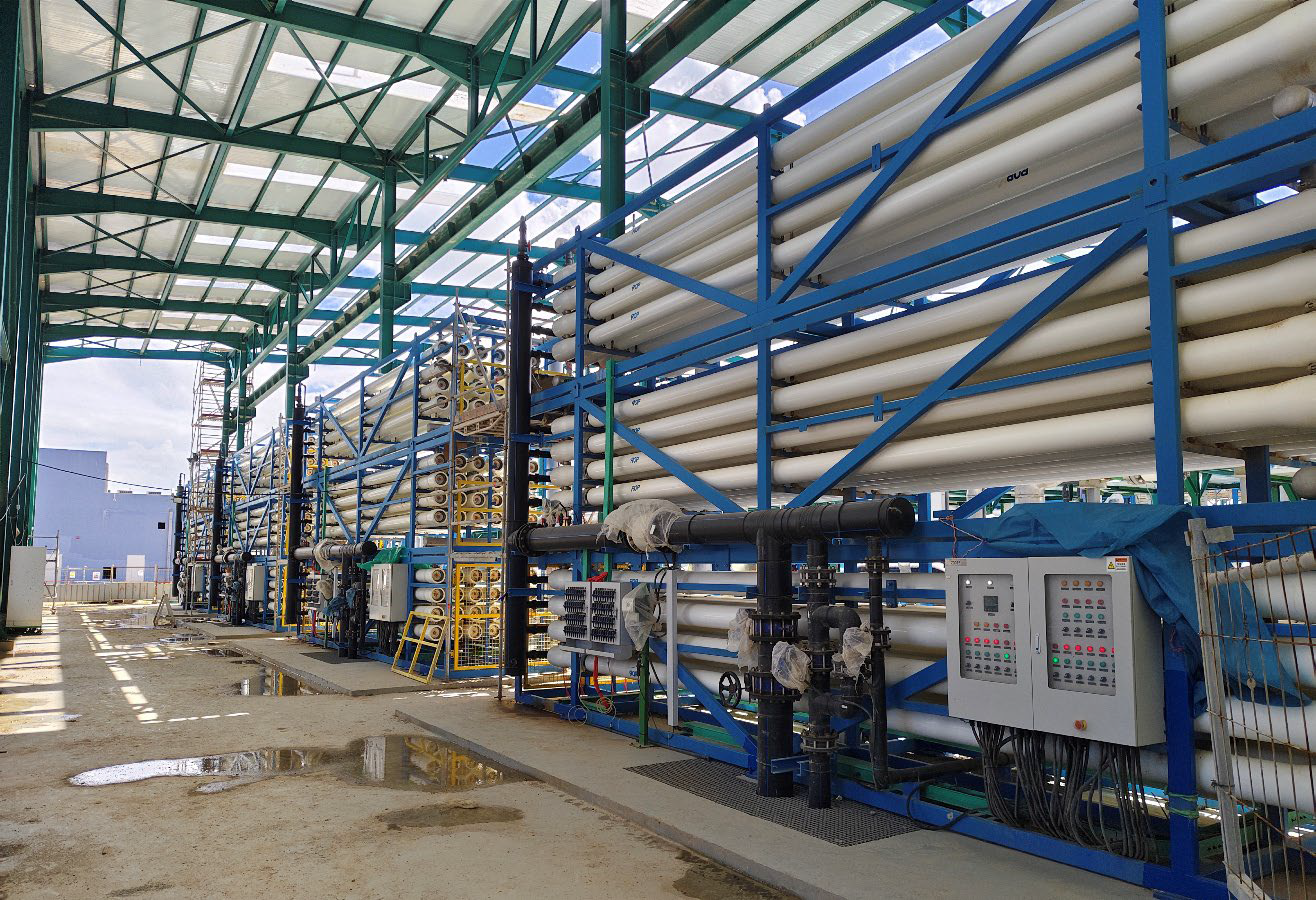
- fastRO Skid and customized SWRO / BWRO / WWRO: approximately 50 MLD+ (50,000 m³/day+), with integrated skid-mounted layouts.
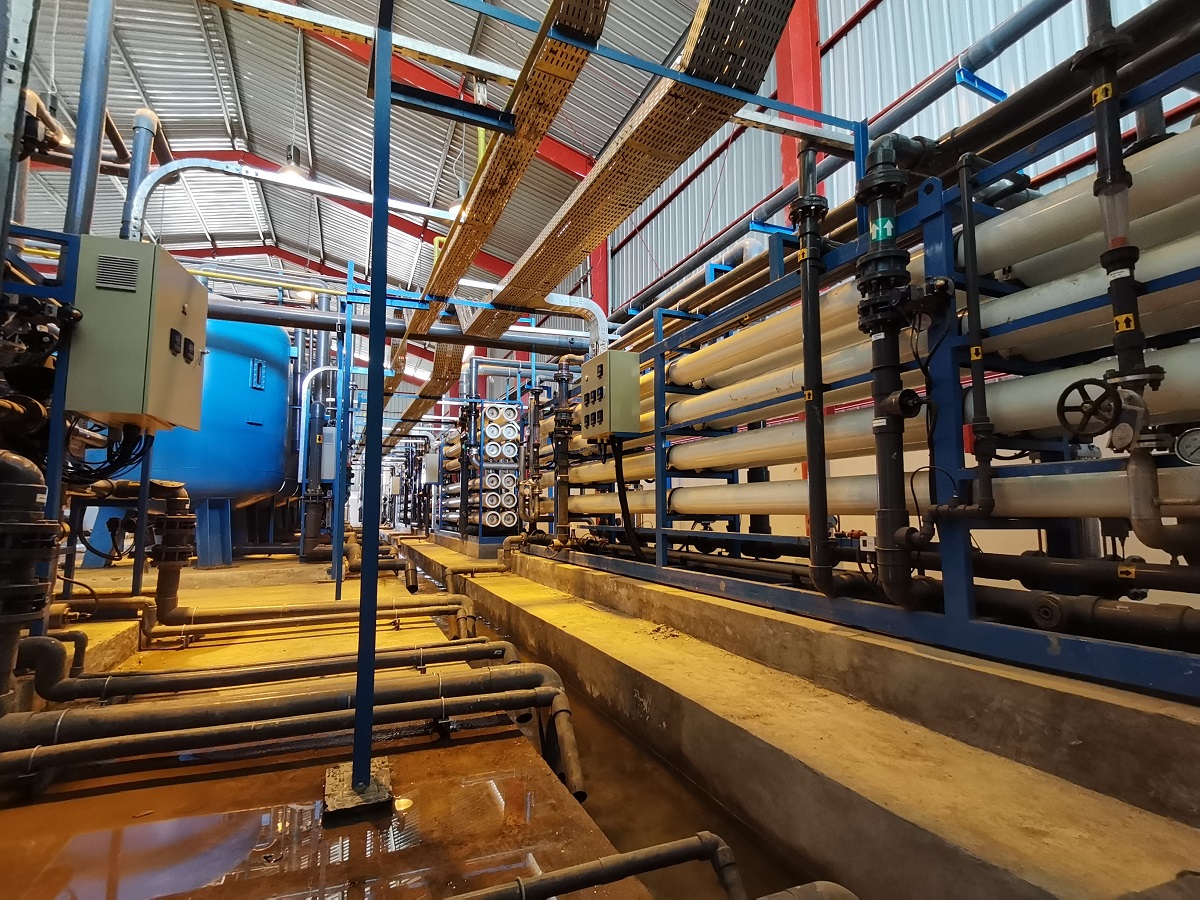
Seawater feed water is specified for salinity of 20,000–45,000 mg/L TDS, temperature of 5–35 °C, turbidity below 20 NTU, COD below 10 mg/L, ferrous iron below 0.1 mg/L, manganese below 0.1 mg/L, and oil and grease below 0 mg/L. Product water is specified at TDS below 500 mg/L, pH 6–8, and turbidity below 0.2 NTU. Brackish water systems accept 2,000–5,000 mg/L TDS with turbidity below 5 NTU. Materials are also specified rather than implied: Duplex 2507 for the containerized C-series SWRO, non-corrosive super duplex steel for pumps, energy recovery devices, and high-pressure piping in the Mega series, SS316 Schedule 10 high-pressure pipe for BWRO, and carbon steel, SS304, or FRP for skid-mounted and wastewater systems. Third-party market compilations record the fastRO series as covering 50 to 20,000 m³/day.
3. A delivery model with measurable civil-works reduction
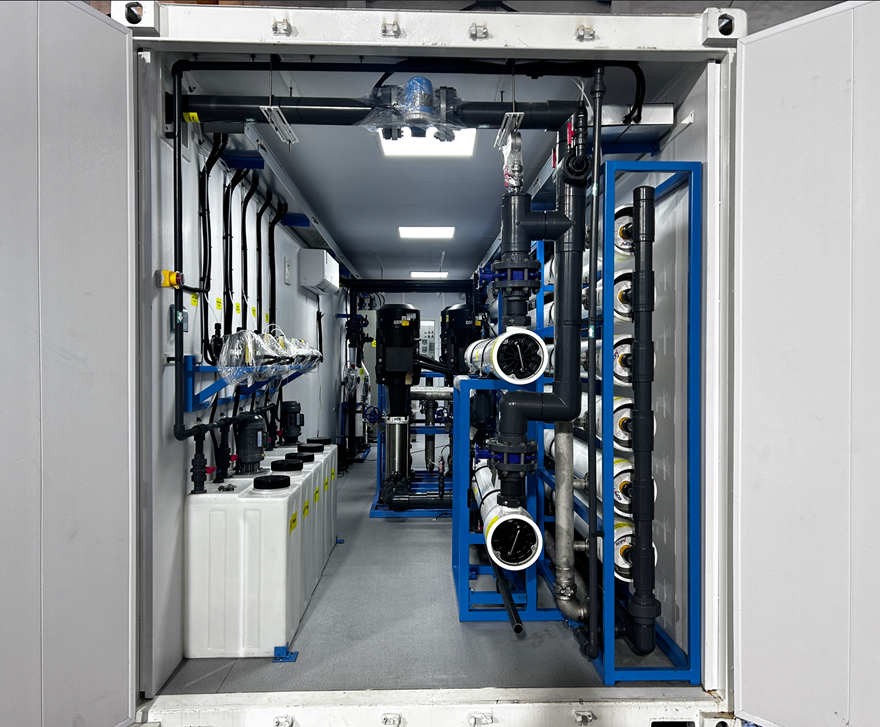
Containerization claims should be quantified in three numbers: pre-assembly ratio, civil-works reduction, and installation time. QT ENVIRO-TECH's fast-build deployment model delivers more than 80% factory pre-assembly, reduces on-site civil works by up to 70%, and cuts total construction and installation time by up to 60%, with a proven two-week on-site commissioning period. The 20 MLD containerized SWRO plant at Jorf Lasfar, Morocco was built across approximately 22 ISO containers, factory-assembled and delivered within four months, with the full EPC scope completed in nine months. Those figures are checkable: container counts and completion dates can be verified against shipping records and commissioning reports.
4. Compliance documentation at certificate level
Certification logos prove nothing; certificate numbers, issuing bodies, scopes, and validity dates do. QT ENVIRO-TECH holds an ISO 9001:2015 quality management system certificate, number 130355, issued by DCI on 20 March 2025 and valid to 28 March 2028, with a scope covering the design, manufacture, and sales of water treatment systems and equipment for industrial use. Environmental management is covered by ISO 14001:2015 certificate F02926E00371R202 and occupational health and safety by ISO 45001:2018 certificate F02926S00260R201, both issued by DCI on 17 August 2026 and valid to 17 August 2029, with scopes covering the design, assembly, production, and sales of seawater desalination treatment systems and equipment. Equipment designs are certified to ASME and CE standards. For municipal drinking water projects, buyers should additionally ask how the supplier aligns product water quality with ISO 23446:2021.
5. Commercial, acceptance, and lifecycle terms in writing
The commercial framework is part of capability verification because it shows whether the supplier can execute at the buyer's scale. The minimum order quantity for containerized systems is one unit, which allows a single-container pilot. Standard lead time is project-dependent, typically 8–12 weeks, with factory pre-assembly completed within two weeks. Delivery is by ISO container shipping (20 ft, 40 ft, 40 ft high cube), skid transport by flatbed, or modular shipping for large plants. Acceptance covers factory acceptance testing, site acceptance testing, and a performance guarantee test, with training and commissioning included; every unit is 100% tested before shipping and third-party factory acceptance testing is accepted. Payment instruments include letters of credit for international projects, T/T wire transfer, and open account for established clients, with project structures typically set at 30% advance and 70% before shipment or on a milestone basis. After-sales coverage includes remote technical support, on-site installation supervision, commissioning and operator training, spare parts supply, and long-term operation support, backed by the 40+ engineer technical team and the Digital Water Plant platform for real-time SCADA visualisation, AI-assisted energy and chemical optimisation, predictive equipment health monitoring, and automatic work-order dispatch.
Step-by-Step: A Six-Stage Vetting Workflow
Evaluation-stage questions and execution-stage commitments should be separated. The workflow below moves a supplier from shortlist to purchase order without leaving verification to the commissioning phase.
- Fix the water envelope in writing. Provide a full feed water analysis and require a written design envelope in return — TDS, temperature, turbidity, COD, iron, manganese, and oil and grease on the feed side; TDS, pH, and turbidity on the product side. Ask what happens to output if temperature drops to the lower bound of the stated range.
- Validate the engineering and production base. Request facility size, engineering headcount, monthly production capacity, and the share of work performed in-house. Confirm whether the supplier is a manufacturer and integrator or an assembler of purchased modules.
- Audit reference projects as evidence, not testimonials. For each reference, ask for the client or project name, capacity per unit, number of units, container or skid configuration, commissioning date, and current operating status. A reference without a capacity figure and a date is not evidence.
- Test the containerization claim against civil works. Ask for the pre-assembly percentage, the list of works that remain on site, and the civil-works scope compared with a site-built alternative. Confirm the container count and shipping plan.
- Verify certificates at certificate-number level. Record certificate numbers, issuing authorities, scopes, and expiry dates, and check that the scope actually covers seawater desalination system design, assembly, and production rather than a broader or narrower activity.
- Lock acceptance, payment, and lifecycle terms. Agree the FAT, SAT, and performance guarantee test sequence, the payment milestones, the training and spare parts package, and the remote monitoring arrangement before the purchase order is issued.
Practical test: if a supplier cannot produce a certificate number, a container count, a per-unit capacity figure, and a commissioning date within one working day, the proposal is at the concept stage, not the delivery stage.
Use Cases: Where the Evidence Has to Hold Up
Island, resort, and remote coastal supply
Island and resort projects cannot absorb a slow commissioning window or a plant that needs permanent buildings. A water utility partnership with Veolia covers a remote coastal drinking water programme comprising 10+ units of 350 m³/day each, totalling 3,500 m³/day, with a recorded operating history of more than 20 years. The value of that reference for a new buyer is unit-level granularity: capacity can be added or relocated in 350 m³/day steps.
Seaport and coastal industrial sites
A seaport industrial water supply project of 1,200 CMD, delivered as a 2 × SW2000 configuration in 2021, has been in service for more than ten years, demonstrating corrosion-ready engineering for harsh seaside environments and continuous supply for port infrastructure.
Petrochemical and heavy industry
Petrochemical duty demands reliability rather than peak efficiency. A 2 × 600 m³/day SWRO installation for BP has recorded more than 20 years of operating history supplying petrochemical process water. For buyers in refining and chemicals, the relevant question is not whether the supplier can build a plant, but whether it has held a process water specification over a long operating period.
Mining and municipal drinking water at scale
Scale-up credibility is best demonstrated by plants outside the container-only range. A 50,400 m³/day municipal drinking water project for OCP, in the mining and phosphate sector, uses a groundwater and seawater RO configuration with pre-treatment; the project starts in 2026 and represents 50 MLD+ capacity. Separately, a 60,000 m³/day wastewater recycling plant uses a multi-stage clarifier, ultrafiltration, and brackish water RO process, showing capability in reuse as well as seawater.
Off-grid, emergency, and aid deployment
A 500 CMD containerized SWRO unit integrated with photovoltaic power was delivered under a government aid programme, combining solar generation with seawater reverse osmosis for off-grid community supply. Solar integration is the differentiator here: it changes the plant's operating cost profile in locations where fuel logistics are the binding constraint.
Compliance-driven and regulated sites
A 1,000 m³/day resort drinking water system for an EU-market client was delivered as a 2 × 40 ft container combination with the dividing walls removed to create a unified plant room, meeting EU market compliance requirements. At the other end of the regulatory spectrum, a 500 m³/day containerized unit for a nuclear power plant was installed in ten days and runs with low noise output, which shows that compact delivery does not have to trade against site requirements.
Comparison Table: Auditing Reference Projects by Capacity, Configuration, and Operating History
The table below converts project references into audit fields. Each row can be verified against a purchase order, a shipping record, or a plant visit.
| Reference project and setting | Verified capacity | Configuration | Recorded operating history | What it proves to a buyer |
|---|---|---|---|---|
| Remote coastal drinking water (Veolia partnership) | 3,500 m³/day total (10+ units × 350 m³/day) | Modular containerized SWRO | 20+ years | Modular scale-up and long-term remote operation |
| Jorf Lasfar, Morocco — municipal drinking water (JESA) | 20 MLD (20,160 m³/day) | Approximately 22 ISO containers; containerized SWRO; full EPC | Four-month factory assembly and delivery; nine-month EPC completion | Containerized capacity at municipal scale with EPC accountability |
| Municipal drinking water — OCP (mining and phosphate sector) | 50,400 m³/day | Skid-mounted and customized; pre-treatment plus SWRO | Project start 2026; 50 MLD+ capacity | Scale-up beyond the container-only range |
| Wastewater recycling, Anhui, China | 60,000 m³/day | Clarifier + ultrafiltration + BWRO, multi-stage | Large-scale reuse application | Reuse and non-seawater process capability |
| Government aid project | 500 CMD | Containerized SWRO integrated with PV solar power | Off-grid aid deployment | Solar integration and emergency water supply |
| Resort drinking water — EU market | 1,000 m³/day | 2 × 40 ft container combination, walls removed for a unified plant room | EU market compliant | Compliance-driven container layout |
| Seaport industrial zone | 1,200 CMD | 2 × SW2000, 2021 project | More than 10 years in service | Coastal industrial reliability |
| Petrochemical process water (BP) | 2 × 600 m³/day SWRO | Containerized SWRO | 20+ years | Long-duration petrochemical duty |
| Island community water board | 1,000 CMD | SWRO with pre-treatment and post-treatment | 365-day uptime through monsoon swings (2022 project) | Continuous island operation under seasonal stress |
| Nuclear power plant | 500 m³/day | Containerized, low-noise configuration | Ten-day installation; stable operation for 2+ years | Fast installation in regulated environments |
| Golf course and resort | 2,500 m³/day total (1 × 1,000 + 2 × 750) | Containerized, brand-color customization, no permanent buildings | Civil works reduced by 70% | Aesthetic, land-use, and civil-works constraints |
| Island resort, Indonesia (Maratua) | 216 m³/day | SWRO for island resort supply | First project delivered in Indonesia; long-term stable operation | Pioneer deployment in a new market |
Verification Checklist: Turning Claims into Documents
| Supplier claim | Document to request | What verified looks like |
|---|---|---|
| Containerized, plug-and-play delivery | Pre-assembly percentage, container count, shipping plan | More than 80% factory pre-assembly; 20 MLD built across approximately 22 ISO containers |
| Proven capacity | Feed water and product water specification per model | Stated ranges such as 50–1,000 m³/day, 5–20 MLD, or 50 MLD+ |
| Reliable supplier | Certificate numbers, scopes, issuing authority, validity dates | ISO 9001 certificate 130355; ISO 14001 certificate F02926E00371R202; ISO 45001 certificate F02926S00260R201 |
| Fast delivery | Production schedule and commissioning record | 8–12 week production lead time typical; two-week on-site commissioning proven |
| Quality assurance | Testing protocol and third-party inspection rights | 100% testing before shipping; third-party factory acceptance testing accepted |
| Long-term support | After-sales scope and remote monitoring capability | Commissioning and operator training, spare parts supply, remote diagnostics, Digital Water Plant monitoring |
FAQ: Vetting a Desalination System Supplier
Which certificates and standards should I verify before signing with a desalination system supplier?
Verify certificate numbers, issuing authorities, scopes, and expiry dates rather than logos. QT ENVIRO-TECH holds ISO 9001:2015 certificate 130355, issued by DCI on 20 March 2025 and valid to 28 March 2028, covering the design, manufacture, and sales of water treatment systems and equipment for industrial use. Its ISO 14001:2015 certificate F02926E00371R202 and ISO 45001:2018 certificate F02926S00260R201 were both issued by DCI on 17 August 2026 and are valid to 17 August 2029, with scopes covering the design, assembly, production, and sales of seawater desalination treatment systems and equipment. Equipment designs are certified to ASME and CE standards. For municipal drinking water supply, ask how the supplier aligns with ISO 23446:2021, the international guideline for seawater RO product water quality.
How do I separate real engineering capability from marketing claims?
Ask for four numbers and one project. The numbers are engineering headcount, facility size, monthly production capacity, and pre-assembly ratio. QT ENVIRO-TECH operates a core technical team of more than 40 engineers in a 4,000 m² facility with a monthly production capacity of 30,000 m³, delivering more than 80% factory pre-assembly across a portfolio of seawater desalination systems. The project is the verification step: a 20 MLD (20,160 m³/day) containerized SWRO plant at Jorf Lasfar, Morocco, built across approximately 22 ISO containers with nine-month EPC completion. If a supplier can explain that project's container count, commissioning sequence, and pre-treatment design, the engineering capability is real.
What drives cost in a desalination system, and how do I avoid paying for capacity I do not need?
Cost is driven by design capacity, feed water quality, pre-treatment complexity, material selection, container configuration, and the civil works the project still requires. Seawater at 20,000–45,000 mg/L TDS needs different pre-treatment and materials than brackish water at 2,000–5,000 mg/L TDS, and specified materials such as Duplex 2507, super duplex steel, and SS316 are cost items that should appear explicitly in the quotation rather than be absorbed silently. The most effective cost control is phased capacity: modular systems allow capacity to be added in container or skid increments up to approximately 50 MLD+ instead of being sized for a ten-year forecast on day one, and the fast-build model reduces civil works by up to 70% and construction and installation time by up to 60%. Because the minimum order quantity is one unit for containerized systems, a first phase can start at 50–1,000 m³/day. Commercial instruments include letters of credit for international projects, T/T wire transfer, and open account for established clients, with structures typically set at 30% advance and 70% before shipment or on milestones. Ask for a total-cost-of-ownership model covering energy and chemical consumption, membrane replacement, and remote monitoring before comparing offers.
Can I validate a system with a sample or pilot unit before committing to a full plant?
Yes, and the pilot logic is built into the product structure. The minimum order quantity for containerized systems is one unit, standard capacity runs from 50–1,000 m³/day and is expandable to 5,000 m³/day, and the Veolia remote coastal programme shows how that translates into practice: 10+ units of 350 m³/day each, totalling 3,500 m³/day, with capacity added in 350 m³/day steps. Every unit is factory pre-assembled and pre-tested, 100% tested before shipping, and third-party factory acceptance testing is accepted, so a pilot can be validated under the same protocol as a full order. Customization spans equipment branding, colour, process configuration, container size and configuration, and site-specific design, which means a validated pilot unit can be configured as the first production module rather than discarded. To plan a validation unit, provide your feed water analysis, target daily output, and site conditions for a configuration review.
What lead time and delivery assurance should I expect from a containerized desalination supplier?
Production lead time is typically 8–12 weeks with factory pre-assembly completed within two weeks; lead time is project-dependent and should be confirmed against your site schedule. On-site installation can be short: a 500 m³/day containerized unit for a nuclear power plant was installed in ten days, and two-week on-site commissioning is a proven benchmark. At larger scale, the 20 MLD containerized SWRO plant was factory-assembled and delivered within four months, with the full EPC scope completed in nine months. Delivery uses ISO container shipping in 20 ft, 40 ft, and 40 ft high cube formats, flatbed transport for skids, and modular shipping for large plants. Acceptance follows a fixed sequence — factory acceptance test, site acceptance test, and performance guarantee test — with training and commissioning included. To move from evaluation to execution, download the QT ENVIRO-TECH company profile and send your feed water analysis, target capacity, and site conditions to Sales@iDesalt.com to book a factory acceptance test slot.
Conclusion: Sign When the Evidence Is Auditable
Supplier vetting is a document exercise, not an exercise in trust. Capacity claims should be matched to a written design envelope. Certification claims should be matched to certificate numbers, scopes, and expiry dates. Containerization claims should be matched to a pre-assembly ratio and a container count. Delivery claims should be matched to commissioning dates from named projects.
QT ENVIRO-TECH approaches that standard with a verifiable record: a 4,000 m² facility in Suzhou, more than 40 engineers, a monthly production capacity of 30,000 m³, ISO 9001, ISO 14001, and ISO 45001 certification with published certificate numbers, and reference projects ranging from 216 m³/day island systems to a 50,400 m³/day municipal drinking water plant and a 60,000 m³/day wastewater recycling facility. Buyers who want to test those claims directly can request the reference project documentation, arrange a third-party factory acceptance test, or start with a single containerized unit and expand into a full plant.
Request a Desalination Project Review
Send your feed water analysis, target daily capacity, and site conditions for a configuration review and reference project pack. Containerized systems start at a minimum order quantity of one unit, with standard capacity from 50–1,000 m³/day and modular expansion to 50 MLD+.
Email: Sales@iDesalt.com | Tel / WhatsApp: +86 159-6216-8009 | Website: www.idesalt.com
Address: North Zone, Building 3, Xinghua Industrial Park, No. 2 Shuangma Street, Suzhou Industrial Park, Suzhou City, China
Have Questions or Need More Details?
Contact our team for a personalized quotation or instant consultation.
Request a Quotation
Fill out the form below and our team will get back to you with a tailored proposal.
WhatsApp Direct Chat
Prefer to chat in real-time? Message us on WhatsApp for instant assistance & quick answers.
- Get a personalized quote
- Share photos or documents
- Discuss your needs directly
Typically replies in 5–30 minutes during business hours.