
Compliance & Longevity Standards in Global Desalination: What EU and Industrial Buyers Must Verify
Compliance & Longevity Standards in Global Desalination: What EU and Industrial Buyers Must Verify
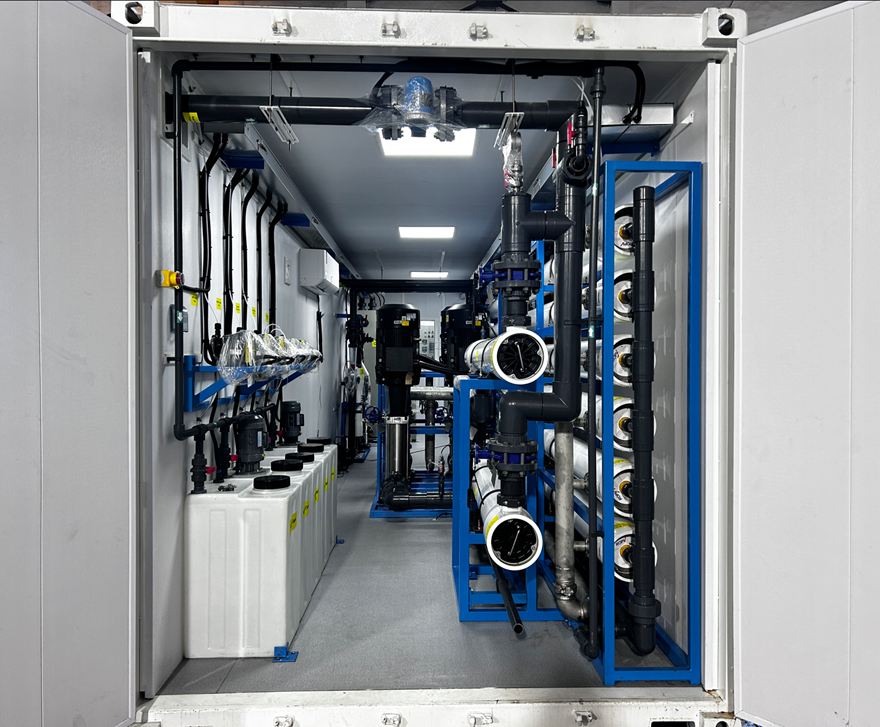
Containerized reverse osmosis module — factory-assembled, pre-tested and documented before shipment.
Compliance in a desalination project is a project-level claim, not a product adjective. Two reverse osmosis plants of identical capacity can be built around the same membrane supply chain and still carry completely different compliance files, because the certificate scope, the product-water specification and the documented operating record a buyer must verify are defined by the destination market and the end use — not by an equipment brochure.
This guide is written for the evaluation-to-execution stage, where the shortlist is already fixed and the remaining work is documentary. It sets out what EU buyers and industrial buyers should confirm before releasing a purchase order, using three reference duties from the QT ENVIRO-TECH project record: a 1,000 m³/day resort drinking water plant recorded as EU market compliant, a 2×600 m³/day petrochemical process water system for BP, and a 50,400 m³/day municipal drinking water project for OCP. QT ENVIRO-TECH (Suzhou) Ltd is a desalination system manufacturer, EPC and system integrator established in 2011 in Suzhou, China, supplying SWRO, BWRO and WWRO systems and the fastRO® containerized and skid-mounted platform across more than 80 countries.
Direct answer
Verify three things before award. First, the certificate number, issuing authority, certified scope and expiry date of the manufacturer's management system certifications. Second, the product-water specification at the actual feed condition of the site. Third, the operating years of references in the same duty class — not the stated design life. Capacity, container count and price validate none of the three.
Problem Definition: Why Cross-Market Comparisons Break Down
Three gaps separate a compliant plant from a compliant-looking offer. They appear at different points in the procurement file, and each one is invisible in a side-by-side capacity comparison.
Gap 1 — Certificate scope that does not name the equipment
A management system certificate is only useful if its certified scope names the activity and the product category being purchased. A certificate covering "design, assembly, production and sales of seawater desalination treatment systems and equipment" can be checked against the purchase order. A logo reproduced in a slide deck cannot. The buyer's check is textual: read the scope line, the certificate number, the issuing authority and the expiry date, then confirm they match the entity that will sign the contract.
Gap 2 — A water specification quoted without its feed condition
Product-water figures are conditional. A stated product quality of TDS <500 mg/L, pH 6–8 and turbidity <0.2 NTU only means something when it is attached to a feed envelope — for the fastRO® SWRO series, a feed TDS of 20,000–45,000 mg/L, feed temperature of 5–35 °C, turbidity below 20 NTU, COD below 10 mg/L, ferrous and manganese below 0.1 mg/L, and no oil and grease. Detach the product number from the feed number and the specification becomes a marketing line.
Gap 3 — Design life presented as operating record
"Twenty years" can mean three different things: a design intention, a warranty period, or a verified operating duration. Only the third survives due diligence. A buyer evaluating longevity should ask for the number of years a named plant has actually run, in a comparable duty, and then ask which material and configuration decisions made that duration possible.
Compliance is also not transferable between jurisdictions. A configuration accepted for a resort drinking water duty under EU requirements is not automatically the compliance answer for a petrochemical site, where process water chemistry, wetted materials and site safety documentation govern the acceptance decision. Treating one approval as a universal credential is the most common conceptual error in cross-market desalination procurement.
Industry Background: What the Third-Party Data Does and Does Not Tell You
Seawater reverse osmosis is the dominant technology class in the global market. According to Credence Research (2025), SWRO commands more than 60% of global installed desalination capacity. The International Desalination and Reuse Association records that global installed desalination capacity crossed the 100 million m³/day threshold in 2024, and Grand View Research estimates the global desalination market at approximately USD 21.3 billion in 2025, rising to USD 23.2 billion in 2026.
For municipal product water quality, the relevant international reference is ISO 23446:2021, published by ISO/TC 8/SC 13, which provides guidelines for the product water quality of seawater reverse osmosis desalination used for municipal supply. Alongside it sits the design code declared for the equipment itself: QT ENVIRO-TECH states that its equipment designs are certified to ASME and CE standards, and that its corporate processes hold ISO 9001, ISO 14001 and ISO 45001 certification.
None of these figures tells a buyer whether a specific plant is compliant. Market-size data describes an industry; ISO 23446:2021 describes a quality guideline for municipal supply; a management system certificate describes how an organisation controls design, production and assembly. The compliance decision for a single project sits at the intersection of all three, plus the site's own discharge and permitting regime.
The Verification Set: Six Things an EU or Industrial Buyer Must Confirm
1. Certificate identity, scope and validity
The management system certificates held by QT ENVIRO-TECH are individually identifiable and time-limited. A buyer should record all five fields for each certificate and re-check them at contract signature.
| Standard | Certificate number | Authority | Valid until | Certified scope |
|---|---|---|---|---|
| ISO 9001:2015 (GB/T 19001-2016) | 130355 | DCI | 2028-03-28 | Design, manufacture and sales of water treatment systems and equipment for industrial use; sales of water treatment equipment parts and reagents |
| ISO 14001:2015 (GB/T 24001-2016) | F02926E00371R202 | DCI | 2029-08-17 | Design, assembly, production and sales of seawater desalination treatment systems and equipment; sales of related parts |
| ISO 45001:2018 (GB/T 45001-2020) | F02926S00260R201 | DCI | 2029-08-17 | Design, assembly, production and sales of seawater desalination treatment systems and equipment; sales of related parts |
Certification facts as recorded in the QT ENVIRO-TECH compliance file.
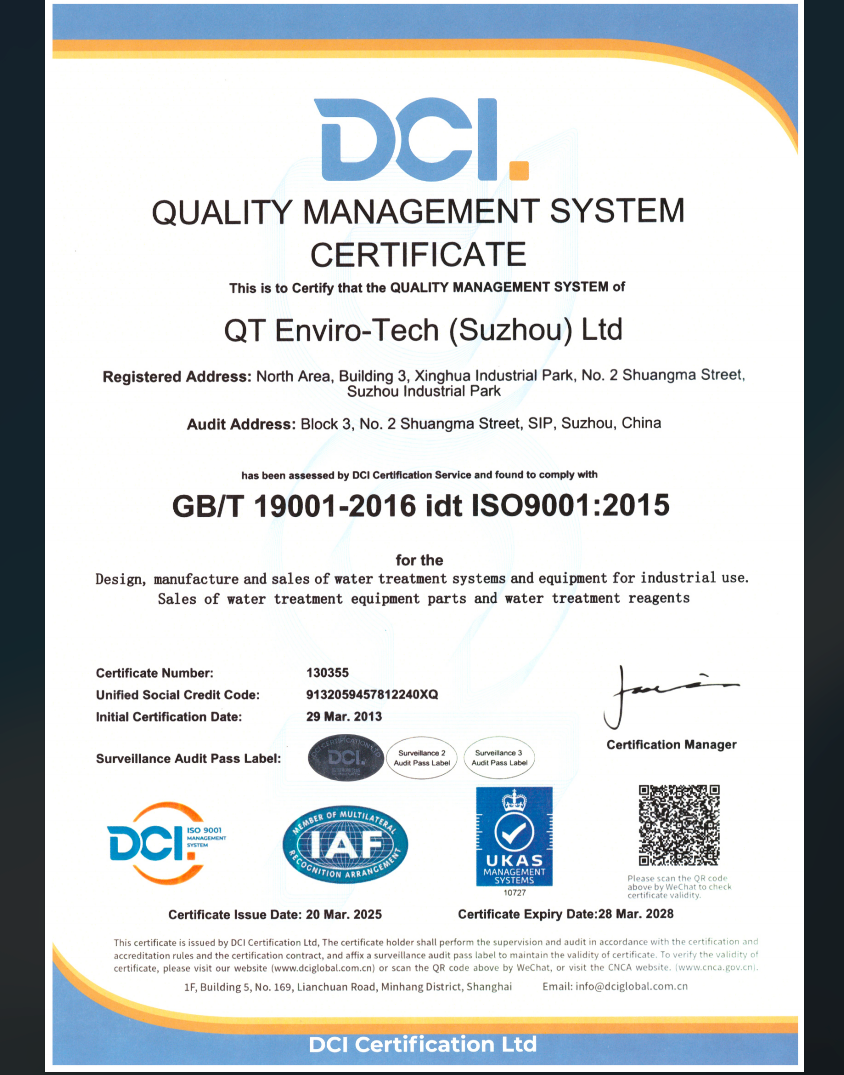
ISO 9001:2015 quality management system certificate 130355, issued by DCI, valid to 2028-03-28.
Two distinctions belong in the compliance file rather than the marketing file. A management system certificate is not a product certificate, and an ISO 14001 certificate for environmental management is not a brine discharge consent. Discharge consent, salinity limits and outfall conditions are set for the receiving environment of the specific site and must be obtained for that project.
2. The declared design code and the equipment-level documentation package
Corporate certification and equipment certification are different layers. The verification task is to obtain the documents that apply to the purchased unit and its destination market, not the general statement that a manufacturer works to ASME and CE standards. For an EU destination, that means the declaration relevant to the delivered equipment and the design documentation for pressure-retaining components; for an industrial site, it means the same documents plus the site's own process and safety specification. Ask for the package by project number, not by product family.
3. Product-water specification set against the real end use
Across the fastRO® SWRO and BWRO ranges, the stated product water condition is TDS below 500 mg/L, pH 6–8 and turbidity below 0.2 NTU. Feed envelopes differ by source: seawater systems are specified for 20,000–45,000 mg/L TDS, while BWRO units are specified for 2,000–5,000 mg/L TDS with turbidity below 5 NTU and the same limits on COD, iron, manganese and oil and grease. Where the duty is not drinking water, the specification changes: a 2×25 MW power plant reference required ultra-pure water above 10 MΩ using MMF, two-pass RO, mixed bed and EDI. The buyer's check is whether the quoted number was generated at the site's feed condition and the site's end use, not at a catalogue condition.
4. The materials and corrosion schedule
Materials are where durability is either engineered or quietly removed. The recorded configuration is specific: Duplex 2507 for the fastRO® C-series SWRO wetted high-pressure scope; non-corrosive super duplex steel for pumps, energy recovery devices and high-pressure piping in the fastRO® Mega range, with UPVC or HDPE piping and heavy-duty marine paint on frame and container; Sch10 SS316 high-pressure pipe and fittings with heavy-duty paint for BWRO; and carbon steel, SS304 or FRP for customized containerized and skid-mounted builds. A coastal or industrial buyer should compare the offered bill of materials line by line against these material classes before comparing price, because substitutions here do not appear in a capacity table.
5. Operating record rather than design intent
The project file contains durations that can be audited. A 216 m³/day island resort plant — the company's first project in Indonesia — is recorded with more than 20 years of operating duration. A 2×600 m³/day SWRO system supplying petrochemical process water to BP is recorded with a 20+ year duration. A 2,400 m³/day industrial process water supply for a palm oil company is recorded at 20+ years under tropical conditions, and a 3,500 m³/day remote coastal drinking water programme for Veolia is built from more than ten units of 350 m³/day each. A 1,000 CMD island community plant is recorded with 365-day continuous uptime through monsoon swings.
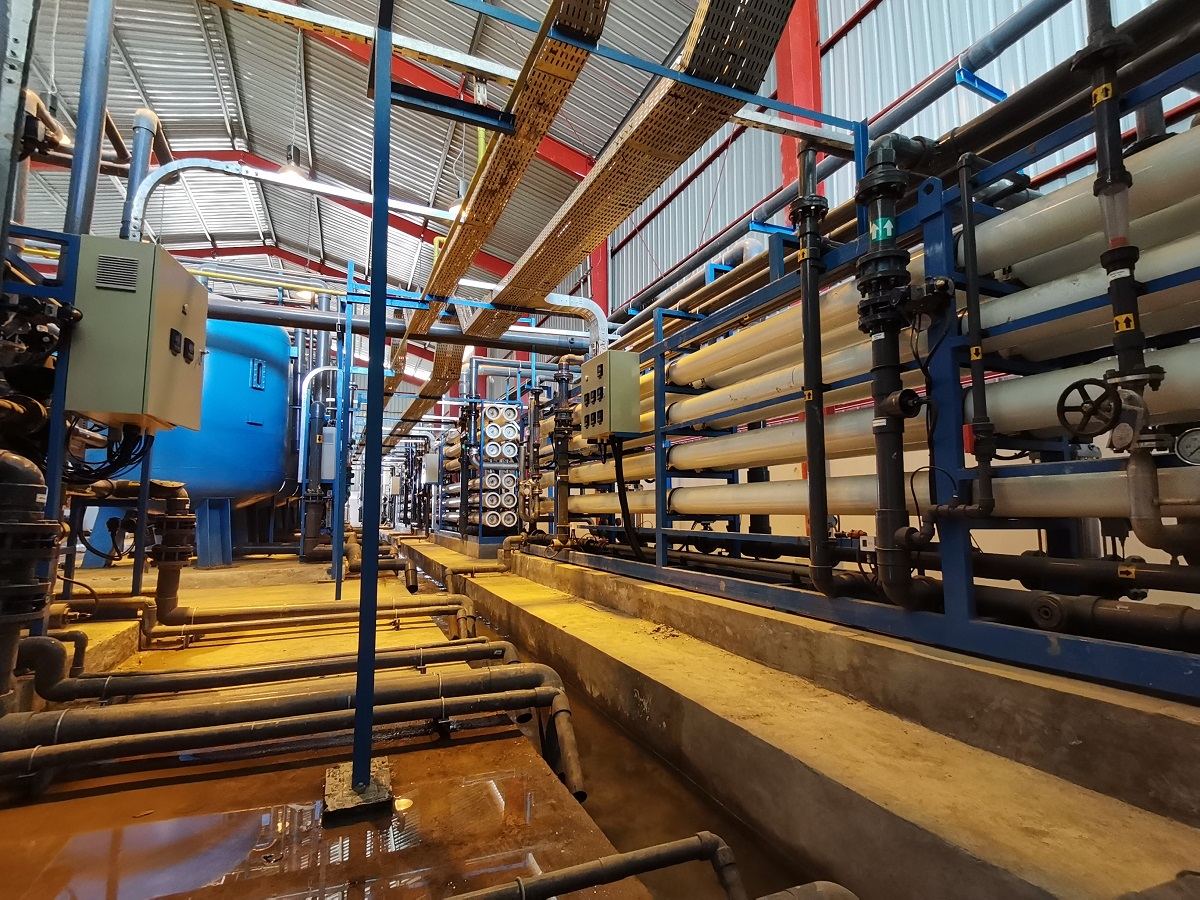
Seaport industrial water supply reference: 1,200 CMD SWRO installation (2×SW2000 configuration).
6. Operating cost control and long-term support
Longevity is also an operating discipline. The Digital Water Plant platform integrates real-time SCADA visualisation, AI agent support for energy and chemical optimisation, predictive equipment health monitoring and automatic work-order dispatching. It sits alongside a support package of technical documentation, operator training, spare parts supply and remote diagnostics, backed by a core technical team of 40+ engineers. For a buyer, the question is not whether a digital layer exists, but whether the O&M contract names who reads the data, who acts on an alarm and who holds spares.
Step-by-Step: A Buyer's Verification Sequence
Step 1 — Fix the duty in writing. Capacity in m³/day, feed source and chemistry, product water target and the end use (drinking water, process water, boiler feed, irrigation). This single document determines which of the following steps apply.
Step 2 — Map the compliance route for the destination. EU destinations require the equipment-level declaration and design documentation relevant to that market; industrial sites require the process specification and site safety documentation; municipal drinking water supply is benchmarked against the ISO 23446:2021 product water quality guideline.
Step 3 — Collect certificates with all five fields. Standard, certificate number, issuing authority, certified scope and expiry date. Confirm the certified entity is the contracting entity.
Step 4 — Obtain the equipment-level code documents. ASME and CE design certification apply to equipment designs; request the documents for the purchased unit and destination, and reconcile them with the buyer's own engineering specification.
Step 5 — Approve the materials schedule before price. Duplex 2507, super duplex steel, Sch10 SS316, FRP, UPVC/HDPE and marine paint grades should be listed by scope, not summarised as "corrosion resistant".
Step 6 — Agree the acceptance protocol. Factory acceptance test, pre-shipment test, site acceptance test and performance guarantee test, with training and commissioning included. Third-party factory acceptance testing is accepted, and 100% testing before shipping is part of the recorded quality control process.
Step 7 — Audit two references in the same duty class. Ask for operating years, feed conditions and configuration, then cross-check the material schedule that supported the duration.
Step 8 — Contract the documentation and O&M package. Spares list, operator training, remote diagnostics access and the digital monitoring scope should be written into the agreement rather than promised in a meeting.
Commercial terms follow the same discipline. The minimum order quantity is one unit for containerized systems; delivery is offered as factory delivery, FOB, CIF or DAP depending on project; payment terms include Letter of Credit for international projects, T/T, and milestone-based structures typically split 30% advance and 70% before shipment. Lead time is typically 8–12 weeks, with factory pre-assembly completed within 2 weeks and a 2-week on-site installation period proven in service.
Use Cases: Four Duty Profiles, Four Different Compliance Files
EU resort drinking water — 1,000 m³/day
A hotel and resort group required 1,000 m³/day of drinking water for a European destination. The delivered configuration is recorded as EU market compliant, built as a 2×40 ft container combination with the container walls removed to form a unified plant room. The compliance value here is not the container count; it is that the market requirement, the drinking water duty and the equipment configuration were resolved together before shipment rather than after arrival.
Petrochemical process water — 2×600 m³/day for BP
BP required petrochemical process water at 2×600 m³/day. The site's acceptance logic is driven by process chemistry and continuity rather than potable aesthetics, and the reference is recorded with a 20+ year operating duration under petrochemical-grade reliability requirements. For industrial buyers, this is the duty profile in which wetted material selection and uptime commitments carry more compliance weight than a drinking water certificate.
Municipal drinking water — 50,400 m³/day for OCP
A 50,400 m³/day municipal drinking water project for OCP represents the large permanent infrastructure class, recorded with a 20+ year duration outlook and industrial-grade reliability, with project start recorded in 2026. At this scale, the compliance file expands to include pre-treatment and post-treatment stages, and the longevity question shifts from component durability to the maintainability of a multi-stage process.
Remote coastal supply — 3,500 m³/day for Veolia
Veolia's remote coastal drinking water programme totals 3,500 m³/day across more than ten units of 350 m³/day each. Modularity is the compliance-relevant feature in this class: identical units can be commissioned progressively, and a single unit outage does not remove the whole plant's capacity.
Additional reference classes
Two further references sharpen the longevity picture. A nuclear power plant installation of 500 m³/day was installed in 10 days and is recorded with low-noise operation and more than two years of stable operation. A 60,000 m³/day wastewater recycling project using clarifier, UF and BWRO processes shows the same engineering logic applied to reuse rather than seawater.
Comparison Table: Compliance and Longevity Evidence by Project Type
The table below compares only facts recorded in the QT ENVIRO-TECH project file. It is a verification aid, not a ranking: each row answers a different compliance question.
| Project type | Capacity | End use | Compliance and longevity evidence on record |
|---|---|---|---|
| Hotel & Resort Group (EU destination) | 1,000 m³/day | Resort drinking water | Recorded EU market compliant; 2×40 ft container combination with walls removed for a unified plant room |
| BP petrochemical facility | 2×600 m³/day SWRO | Petrochemical process water | Petrochemical-grade reliability; 20+ year operating duration |
| OCP municipal drinking water | 50,400 m³/day | Municipal drinking water | 50 MLD+ capacity class; industrial-grade reliability; 20+ year duration outlook; start 2026 |
| Veolia remote coastal programme | 3,500 m³/day (10+ × 350 m³/day) | Remote coastal drinking water | Modular scalability across identical units; remote deployment record |
| Island community water board | 1,000 CMD | Community drinking water | 365-day continuous uptime through monsoon swings |
| Nuclear power plant | 500 m³/day | Process and cooling water | 10-day installation; low-noise operation; 2+ years stable operation |
Frequently Asked Questions
Which certificates should an EU buyer verify for a desalination system, and what must the scope say?
Verify three management system certificates by number, authority, scope and expiry date: ISO 9001:2015 certificate 130355 issued by DCI and valid to 2028-03-28, covering design, manufacture and sales of water treatment systems and equipment for industrial use; ISO 14001:2015 certificate F02926E00371R202 and ISO 45001:2018 certificate F02926S00260R201, both issued by DCI and valid to 2029-08-17, covering design, assembly, production and sales of seawater desalination treatment systems and equipment. The certified scope must name the equipment and the activity being purchased. Then request the equipment-level design code documents, since QT ENVIRO-TECH states its equipment designs are certified to ASME and CE standards. A management system certificate is not a product certificate, and an ISO 14001 certificate is not a site discharge consent.
How can a buyer verify long-term performance instead of relying on a design-life claim?
Ask for operating years per named reference in the same duty class. The QT ENVIRO-TECH record includes a 216 m³/day island resort plant operating for more than 20 years, a 2×600 m³/day BP petrochemical system with a 20+ year duration, a 2,400 m³/day palm oil industrial supply with a 20+ year duration in tropical conditions, and a 1,000 CMD island community plant running 365-day uptime through monsoon swings. The second half of the verification is technical: confirm the material schedule that supported those durations, such as Duplex 2507 for C-series SWRO high-pressure scope and super duplex steel for pumps, energy recovery devices and high-pressure piping in the Mega range.
What drives the cost of a compliant desalination system, and where should buyers not cut?
The main cost drivers are capacity class, feed-water envelope — 20,000–45,000 mg/L TDS for seawater systems — pre-treatment complexity, and materials. Materials are the most common place where compliance and longevity are traded away invisibly, particularly on high-pressure lines and energy recovery equipment. The deployment model also changes total project cost: more than 80% factory pre-assembly reduces on-site civil works by up to 70% and total construction and installation time by up to 60%. Quotations are project-based rather than list-based, so the same capacity can produce materially different totals depending on the material and documentation scope.
Can a buyer validate a system before committing to a full project?
Yes. The minimum order quantity is one unit for containerized systems, and quality control is structured around factory pre-assembly and pre-testing with 100% testing before shipping. Third-party factory acceptance testing is accepted, and the acceptance route covers factory acceptance test, site acceptance test and performance guarantee test, with training and commissioning included. On-site installation has been demonstrated at 2 weeks, which allows a buyer to sequence validation and site works without an extended shutdown window.
What lead times should be planned, and what is the next step?
Lead time is typically 8–12 weeks, with factory pre-assembly completed within 2 weeks and a 2-week on-site installation period proven in service. Larger schemes follow a different curve: a 20 MLD containerized SWRO plant was assembled across approximately 22 ISO containers and delivered within 4 months of factory work, with a recorded 9-month EPC completion. Buyers who want to build their own verification file can request the certificate pack and reference list directly from QT ENVIRO-TECH at Sales@iDesalt.com or by WhatsApp on +86 159-6216-8009, quoting the project duty and destination market.
Conclusion: Compliance Is a File, Longevity Is a Record
The distinction that matters at execution stage is simple. Compliance is a document set that can be read line by line — certificate numbers, issuing authority, certified scope, expiry dates, declared design codes, and a product-water specification bound to a feed condition. Longevity is a record that can be audited — named plants, real operating years, and the material decisions that made those years possible.
For an EU buyer, that means confirming that the equipment-level documentation matches the destination market and that the drinking water duty is specified against the ISO 23446:2021 municipal product water quality guideline where it applies. For an industrial buyer, it means confirming that process water chemistry, wetted materials and site safety documentation were resolved before shipment — as in the 2×600 m³/day BP petrochemical reference. For a municipal buyer at 50,400 m³/day, it means confirming that multi-stage pre-treatment and post-treatment are maintainable over a 20+ year horizon.
Next Step: Request the Compliance and Reference Pack
Share your duty — capacity in m³/day, feed source, product water target and destination market — and QT ENVIRO-TECH will return the matching certificate set, reference list and configuration outline for review.
Contact: Grace · Tel / WhatsApp +86 159-6216-8009 · Email Sales@iDesalt.com · Website www.idesalt.com
Address: North Zone, Building 3, Xinghua Industrial Park, No. 2 Shuangma Street, Suzhou Industrial Park, Suzhou, China
Download the company profile and full project reference document: QT ENVIRO-TECH Company Profile (PDF)
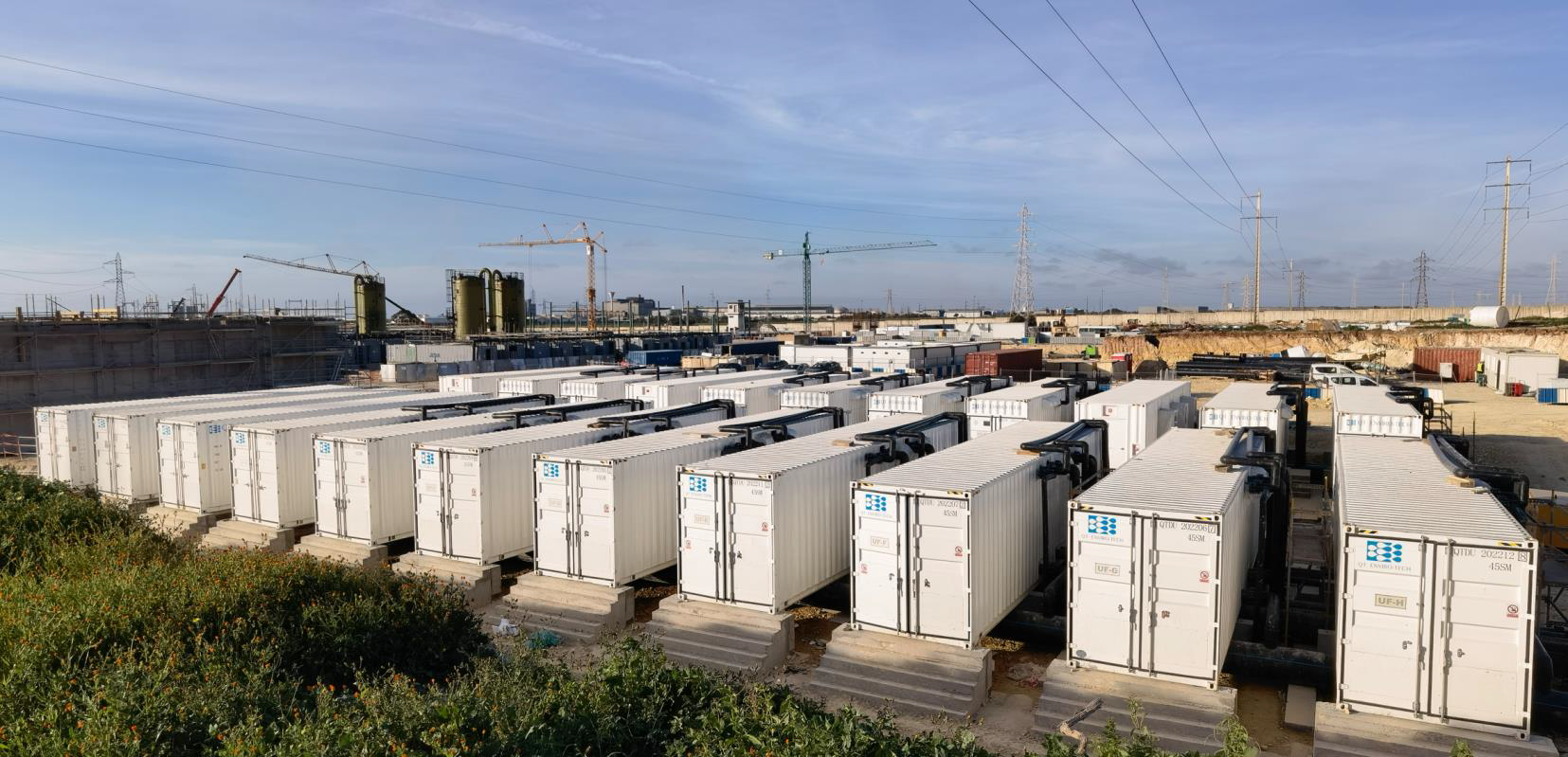
20 MLD containerized SWRO reference — modular assembly with phased capacity expansion.
Have Questions or Need More Details?
Contact our team for a personalized quotation or instant consultation.
Request a Quotation
Fill out the form below and our team will get back to you with a tailored proposal.
WhatsApp Direct Chat
Prefer to chat in real-time? Message us on WhatsApp for instant assistance & quick answers.
- Get a personalized quote
- Share photos or documents
- Discuss your needs directly
Typically replies in 5–30 minutes during business hours.