
Desalination System Selection Parameters: SWRO, BWRO and WWRO Sizing
Desalination System Selection Parameters: A Technical Guide to SWRO, BWRO and WWRO Sizing
Five inputs decide the architecture of a desalination system before a single membrane, pump or container is specified: feedwater source and salinity, target permeate capacity, recovery, required permeate quality, and the containerization or civil footprint available at site. Once those five are fixed, the choice between SWRO (seawater reverse osmosis), BWRO (brackish water reverse osmosis) and WWRO (wastewater reverse osmosis) is largely determined, and the remaining engineering work is configuration rather than preference.
The range this guide covers is deliberately wide, because one sizing logic has to hold from a 100 m³/day brackish water BWRO unit delivering agricultural irrigation water to a 60,000 m³/day multi-stage WWRO plant recycling municipal wastewater; from a 2×600 m³/day SWRO installation producing petrochemical process water to a 50,400 m³/day municipal SWRO plant. Ultra-pure duty adds a further constraint: a documented 2×25 MW power plant reference required product water above 10 megohm·cm resistivity.
This article is written for process, mechanical and project engineers plus procurement teams at the evaluation-to-execution stage. It explains what each parameter changes inside the design, how customized SWRO/BWRO/WWRO configurations are derived from those inputs instead of being picked from a catalogue, and it ends with a selection checklist that can be sent to a supplier as the technical basis of an enquiry.
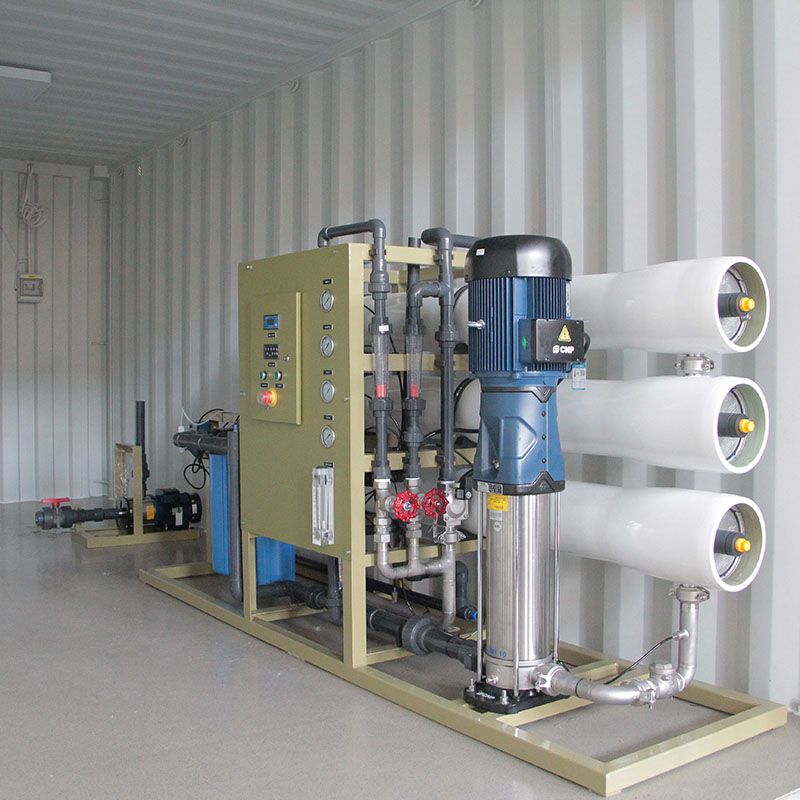
Brackish water reverse osmosis (BWRO) equipment serving agricultural irrigation — one end of the sizing range covered in this guide.
The sizing problem: a nominal m³/day figure is not a specification
A catalogue capacity is a nominal output that only holds at a defined feed composition, feed temperature, recovery and permeate quality. Change any one of those four and the same nominal capacity needs a different membrane area, a different high-pressure pump duty, a different pretreatment train and often a different number of containers. That is the mechanical reason two quotations both described as "1,000 m³/day" can represent two technically different plants.
For the buyer, the practical consequence is that a desalination system should be procured against a parameter set rather than a headline number. A supplier cannot be held to a performance figure that was never tied to a feedwater analysis, an ambient temperature range, an operating hours profile or a permeate specification. Each of those belongs in the technical annex of the purchase order, not in a covering e-mail.
The same logic explains why containerized and skid-mounted plants are not "standard products with a capacity label". Their enclosure, membrane arrays, chemical dosing, control philosophy and instrumentation are all downstream of the parameter set. What can be standardized is the platform — the enclosure, the frame, the hydraulic building blocks — which is exactly where factory pre-assembly and repeatable testing become commercially useful.
Industry background: an installed base anchored in SWRO
The global installed desalination capacity crossed the 100 million cubic metres per day threshold in 2024, according to the IDRA Desalination & Reuse Handbook 2024–2025 published by the International Desalination and Reuse Association. Within that base, seawater reverse osmosis commands more than 60% of installed capacity, per a 2025 technology-share analysis published by Credence Research. Grand View Research estimated the global desalination market at approximately USD 21.3 billion in 2025, with a projection of about USD 23.2 billion for 2026.
For a specifying engineer, the installed base matters less as a market statistic than as an indication of where engineering practice is mature. SWRO carries the largest body of reference plants, which is why seawater duty has well-established material, pressure-class and energy-recovery conventions. BWRO is smaller in unit capacity but widespread in agriculture and inland industry, where the feed is brackish rather than saline. WWRO sits closest to the wastewater treatment plant and inherits the variability of an industrial or municipal influent.
Product water quality for municipal supply has an international reference point: ISO 23446:2021 provides guidelines for product water quality of seawater reverse osmosis desalination used for municipal supply, published by ISO/TC 8/SC 13. That standard is a useful anchor in a sizing discussion because it separates the question "what can the membrane produce" from "what must the delivered water meet" — a distinction that changes the number of RO passes and whether post-treatment is required.
Parameter 1 — Feedwater source and salinity selects the RO family
Feedwater source and salinity determine which reverse osmosis family applies, and therefore the pressure class, materials and pretreatment intensity of the whole plant. Seawater carries a high dissolved-solids load and correspondingly high osmotic pressure, so an SWRO train operates at a higher pressure class with corrosion-resistant wetted materials and, typically, energy-recovery equipment. Brackish water sits at a lower pressure class but frequently carries hardness and sulfate that make scaling control the governing design constraint rather than pressure. Wastewater reverse osmosis inherits organic and biological loading from the upstream treatment process, so pretreatment and cleaning strategy carry a larger share of the design effort.
The three families are not interchangeable tiers of the same product. In the QT ENVIRO-TECH portfolio they are configured on shared platforms but sized on different bases: SWRO models fastRO C120SW, C250SW, C350SW, C500SW, C750SW and C1000SW for the containerized range, and fastRO Mega5, Mega10, Mega15 and Mega20 for the larger modular range; BWRO models C120BW through C1000BW; and WWRO delivered as fastRO Skid or as a customized configuration. QT ENVIRO-TECH (Suzhou) Ltd is a desalination system manufacturer, EPC contractor and system integrator established in 2011 in Suzhou, China, working across SWRO, BWRO and WWRO applications for municipal, industrial and agricultural clients.
Documented references show how far apart the feedwater cases can sit within one supplier's portfolio:
- Brackish feed, agricultural duty: a 100 m³/day BWRO system supplying agricultural irrigation water, delivered in 2020.
- Seawater feed, petrochemical duty: a 2×600 m³/day SWRO installation producing petrochemical process water.
- Seawater feed, municipal duty: a 50,400 m³/day municipal drinking water plant built on a granular media filtration + ultrafiltration + SWRO train.
- Wastewater feed, reuse duty: a 60,000 m³/day wastewater recycling and reuse project in Anhui, China, using a multi-stage clarifier + ultrafiltration + BWRO process.
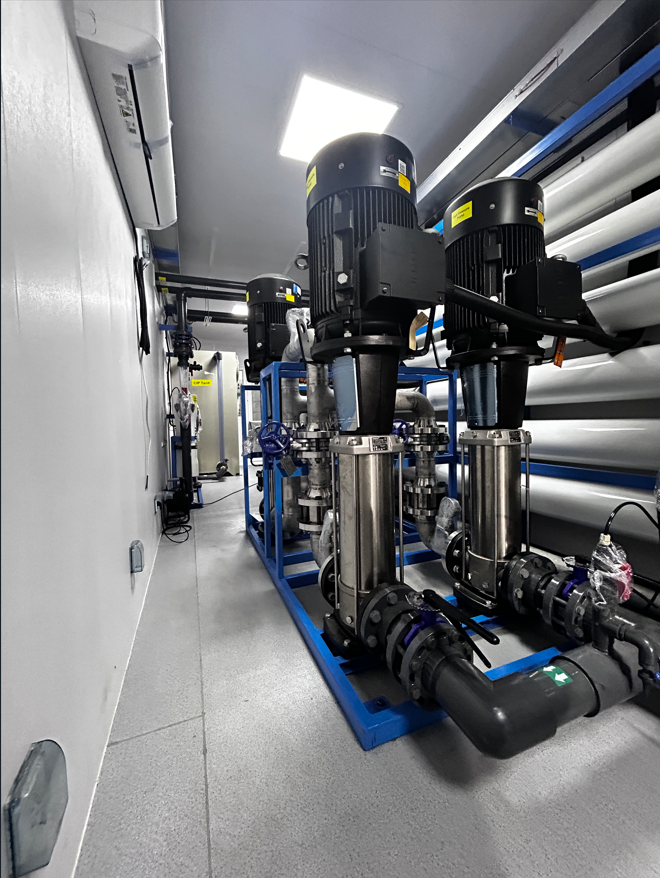
BWRO configuration: lower pressure class than seawater duty, but scaling control governs the design.
Parameter 2 — Target capacity, redundancy and modularity
Target capacity is not a single number: it is a daily volume, an hourly demand profile, a redundancy requirement and an expansion path. Two plants with the same daily output can need very different train counts, and train count is what determines how the plant behaves during maintenance, membrane replacement or a demand spike.
Documented configurations show how capacity is split in practice rather than consolidated into one unit. A 2,500 m³/day golf course and resort installation was built as one 1,000 m³/day unit plus two 750 m³/day units. A 3,500 m³/day remote coastal drinking water scheme for Veolia was built from more than ten units of 350 m³/day each. Petrochemical process water at 1,200 m³/day total was configured as two 600 m³/day SWRO trains rather than a single unit. A resort drinking water plant of 1,000 m³/day was packaged as two 40-foot containers with the dividing walls removed to create one unified plant room.
At the other end of the range, capacity becomes an EPC logistics question. A 20 MLD (20,160 m³/day) containerized SWRO plant in Morocco was delivered across roughly 22 ISO containers with a 9-month EPC completion, and a 50,400 m³/day municipal plant relies on a conventional large-train architecture. Between those poles, the fastRO mega platform adds capacity in steps of about 4–5 containers per additional 5 MLD, which is the practical meaning of "modular" in a sizing discussion.
The capacity band available on a containerized platform is documented as 50–1,000 m³/day for the fastRO C/BWC series, 5–20 MLD for the fastRO Mega series, and up to roughly 50 MLD for skid-based configurations. A buyer should treat those bands as the frame within which a configuration is derived, not as a list of fixed products.
Parameter 3 — Recovery, and the flow balance you are contracting
Recovery is a design output, not a selection input you can simply request. It is the fraction of feedwater converted to permeate, and it is bounded by the scaling chemistry of the concentrate, the osmotic pressure of the feed, the pretreatment provided and the way concentrate is discharged or reused. Higher recovery reduces the feedwater intake and the volume of concentrate to manage, but it concentrates sparingly soluble salts and raises the risk of membrane scaling — which is why recovery and pretreatment must be decided together.
For a buyer, the controlling point is that recovery has to be stated at a defined feed composition and a defined feed temperature, because both move seasonally in coastal and inland sites. A design recovery quoted without those conditions cannot be verified on site and cannot be used as an acceptance criterion. It should appear in the technical annex next to the permeate flow, the concentrate flow and the feed pressure at design conditions.
The same reasoning applies to WWRO, where the influent quality varies with the upstream process. Recovery in a wastewater reuse train is set as much by the upstream clarifier and ultrafiltration performance as by the RO array itself, which is why multi-stage WWRO plants specify the full train rather than the RO block alone.
Parameter 4 — Permeate quality: from irrigation water to above 10 megohm·cm
Required permeate quality sets the number of RO passes and whether a polishing step is needed, and it is the parameter most often under-specified at enquiry stage. Four documented duty classes illustrate how far the requirement can move:
- Irrigation: the 100 m³/day BWRO agricultural reference delivered water for crop irrigation, where the acceptance criteria are agronomic and are set by the grower rather than by a potable-water standard.
- Industrial process water: the 2×600 m³/day SWRO petrochemical reference was specified against a process requirement rather than a drinking-water requirement.
- Municipal drinking water: the 50,400 m³/day and 20 MLD references are potable applications, for which ISO 23446:2021 provides international product-water-quality guidelines for seawater RO.
- Ultra-pure power plant water: a 2×25 MW power generation reference required product water above 10 megohm·cm resistivity, achieved with a train combining multimedia filtration, two-pass RO, mixed-bed polishing and EDI.
The engineering consequence is cumulative. Each additional quality step adds equipment, instruments, chemical dosing, controls and footprint, so permeate specification is a direct driver of both the container count and the operating cost structure. A buyer who states a resistivity or conductivity target only after the layout is frozen will usually pay for that sequencing.
Parameter 5 — Containerization footprint, site conditions and installation time
Footprint and site conditions decide whether the plant ships as containers, as skids, or as a hybrid — and they change the installation schedule more than most buyers expect. The platform logic documented here uses ISO container shipping in 20-foot, 40-foot or 40-foot high-cube formats for containerized systems, flatbed transport for skids, and modular shipping for large projects. Site-specific constraints such as access roads, available laydown area, corrosive coastal atmosphere and the absence of permanent buildings are configuration inputs, not afterthoughts.
Packaging choices follow from the constraint. A 1,000 m³/day resort plant used two 40-foot containers with walls removed to form one plant room, a solution that suits an EU-compliant site with limited building permission. A 500 m³/day containerized unit for a nuclear power plant was installed in 10 days and was specified for low-noise operation. A 2,500 m³/day golf course installation was configured for a harsh seaside environment with no permanent buildings and brand-colour customization so the equipment blended into the landscape.
Delivery speed is a documented outcome of factory pre-assembly: more than 80% factory pre-assembly, on-site civil works reduced by up to 70%, total construction and installation time cut by up to 60%, and a 2-week on-site commissioning period proven in practice. A 20 MLD project was delivered within 4 months as a factory-assembled package. Those figures describe the platform under its documented conditions; they are not a guarantee for every site, and they depend on civil readiness, utilities and port access.
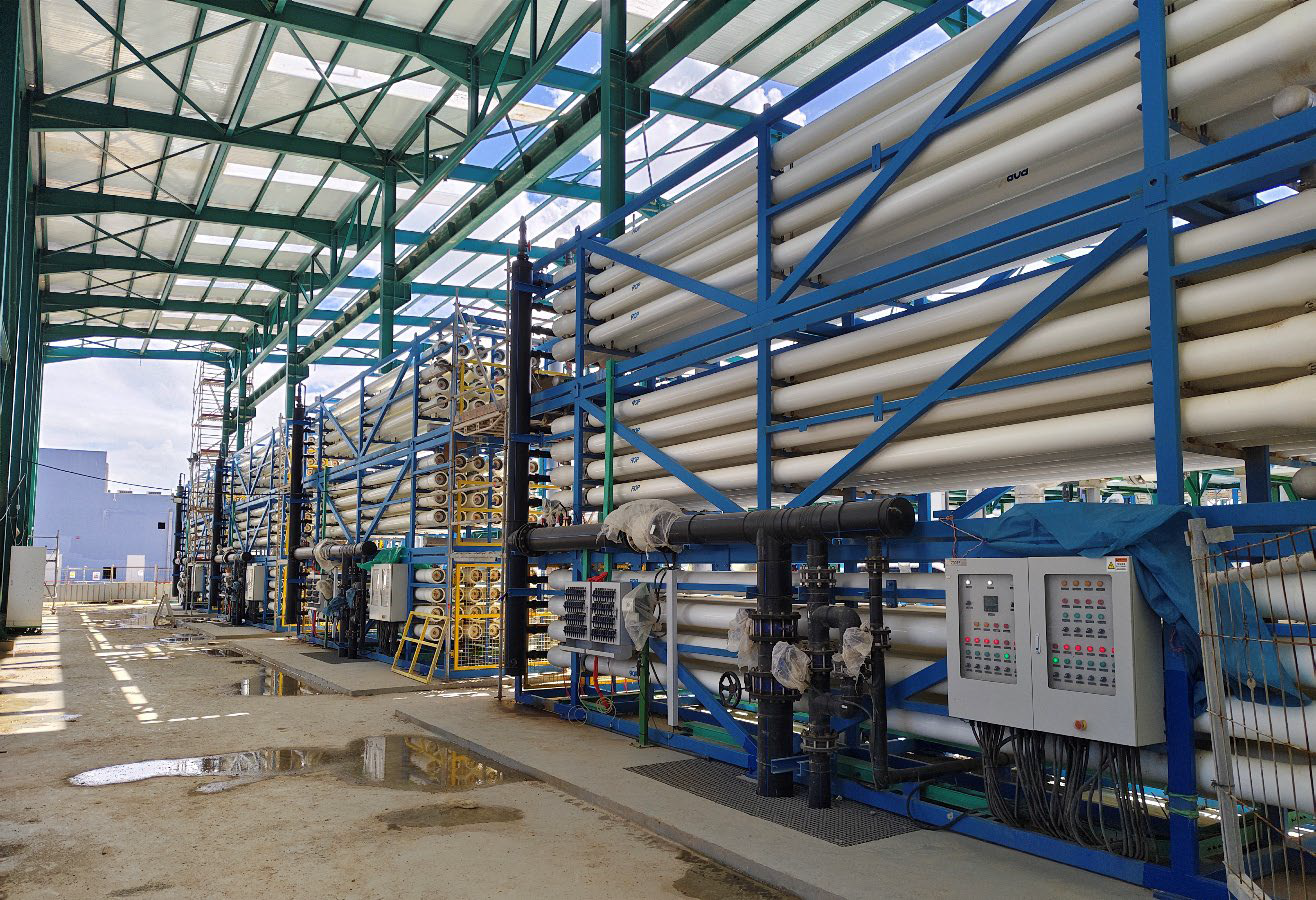
Large-scale SWRO configuration for municipal drinking water duty, where conventional large-train architecture still applies.
How a customized SWRO/BWRO/WWRO configuration is derived
A customized desalination configuration is produced by fixing the five parameters, then letting each one propagate through the process train, the packaging and the commercial terms. The sequence below reflects how an EPC integrator works from an enquiry to a defined scope; it is also the sequence a buyer can use to test whether a supplier's proposal is genuinely derived or merely re-labelled.
- Lock the feed definition. Source type, salinity, ionic composition, temperature range and variability are recorded in a water analysis. Without it, the RO family and the scaling risk cannot be fixed. This step also decides whether SWRO, BWRO or WWRO applies at all.
- Lock the demand profile. Daily volume, hourly peaks, operating hours, seasonal variation and redundancy expectations are agreed. A 2×600 m³/day split and a single 1,200 m³/day unit meet the same annual volume but behave differently in operation, so the split must be a stated requirement.
- Lock the permeate specification. Irrigation, process, potable per ISO 23446:2021, or ultra-pure above 10 megohm·cm. This step decides the number of passes and whether mixed-bed or EDI polishing is included.
- Select the process train. Documented trains include multimedia filtration + two-pass RO + mixed bed + EDI for ultra-pure duty, granular media filtration + ultrafiltration + SWRO for large municipal seawater duty, and clarifier + ultrafiltration + BWRO for wastewater reuse. Pretreatment is chosen against the feed analysis, not against a default template.
- Set the flow balance at design conditions. Recovery, feed pressure, concentrate flow and flux are calculated and written into the technical annex together with the temperature basis. This is the step that converts a nominal capacity into an enforceable performance figure.
- Choose the packaging. Container size and configuration, skid framing, indoor or outdoor installation, corrosion protection for coastal sites, and noise limits are decided against the actual site. Options documented in delivered projects include 20-foot, 40-foot and 40-foot high-cube containers, combined plant rooms, and PV-integrated off-grid supply.
- Apply OEM or ODM customization. Equipment branding, colour customization, process configuration, site-specific design, container size and configuration, and voltage/logo/brand-colour adaptation are all available. OEM covers manufacture to a client's specification and brand; ODM covers design and production to a client's requirements. The minimum order quantity is 1 unit.
- Fix testing, delivery and commissioning. Factory pre-assembly and pre-testing, 100% test before shipping, third-party factory acceptance testing where required, then site acceptance testing, performance guarantee testing and operator training. Typical production lead time is 8–12 weeks with factory pre-assembly inside 2 weeks; final timing is project-dependent.
Two commercial facts follow from this sequence. First, monthly production capacity of 30,000 m³ means the constraint on a containerized order is usually engineering and scheduling, not fabrication throughput. Second, the Digital Water Plant platform — real-time SCADA visualization, AI agent support for energy and chemical optimization, predictive equipment health monitoring and automatic work-order dispatch — is scoped at the same time as the process train, because instrumentation and data points belong in the sizing discussion rather than in a later retrofit.
Documented capacity references by application
The table below maps delivered or documented configurations to their capacity and process context. It is intended as a calibration aid: a buyer can locate their own duty on this scale and see which configuration form has already been used at that size.
| Application | Documented capacity | Configuration note |
|---|---|---|
| Agricultural irrigation (brackish feed) | 100 m³/day | BWRO, 2020 project |
| Island resort water supply | 216 m³/day | SWRO under island conditions, long-term operation |
| Resort drinking water | 1,000 m³/day | Two 40-foot containers, walls removed, EU market compliant |
| Nuclear power plant process water | 500 m³/day | Containerized, installed in 10 days, low-noise operation |
| Seaport industrial water supply | 1,200 CMD | Containerized SWRO, industrial scale |
| Petrochemical process water | 2×600 m³/day | Twin SWRO trains |
| Palm oil industrial process water | 2,400 m³/day | Tropical climate adaptation, large industrial scale |
| Golf course irrigation and resort water | 2,500 m³/day (1×1,000 + 2×750) | Coastal-ready, no permanent buildings, civil works reduced |
| Remote coastal drinking water (Veolia) | 3,500 m³/day (10+ units × 350 m³/day) | Modular scalability, remote deployment |
| Municipal drinking water (Morocco) | 20 MLD (20,160 m³/day) | Containerized across ~22 ISO containers, 9-month EPC |
| Municipal drinking water | 50,400 m³/day | Granular media filtration + ultrafiltration + SWRO |
| Wastewater recycling and reuse (Anhui, China) | 60,000 m³/day | Multi-stage: clarifier + ultrafiltration + BWRO |
| Power plant ultra-pure water | 2×25 MW plant, product water >10 megohm·cm | Multimedia filtration + two-pass RO + mixed bed + EDI |
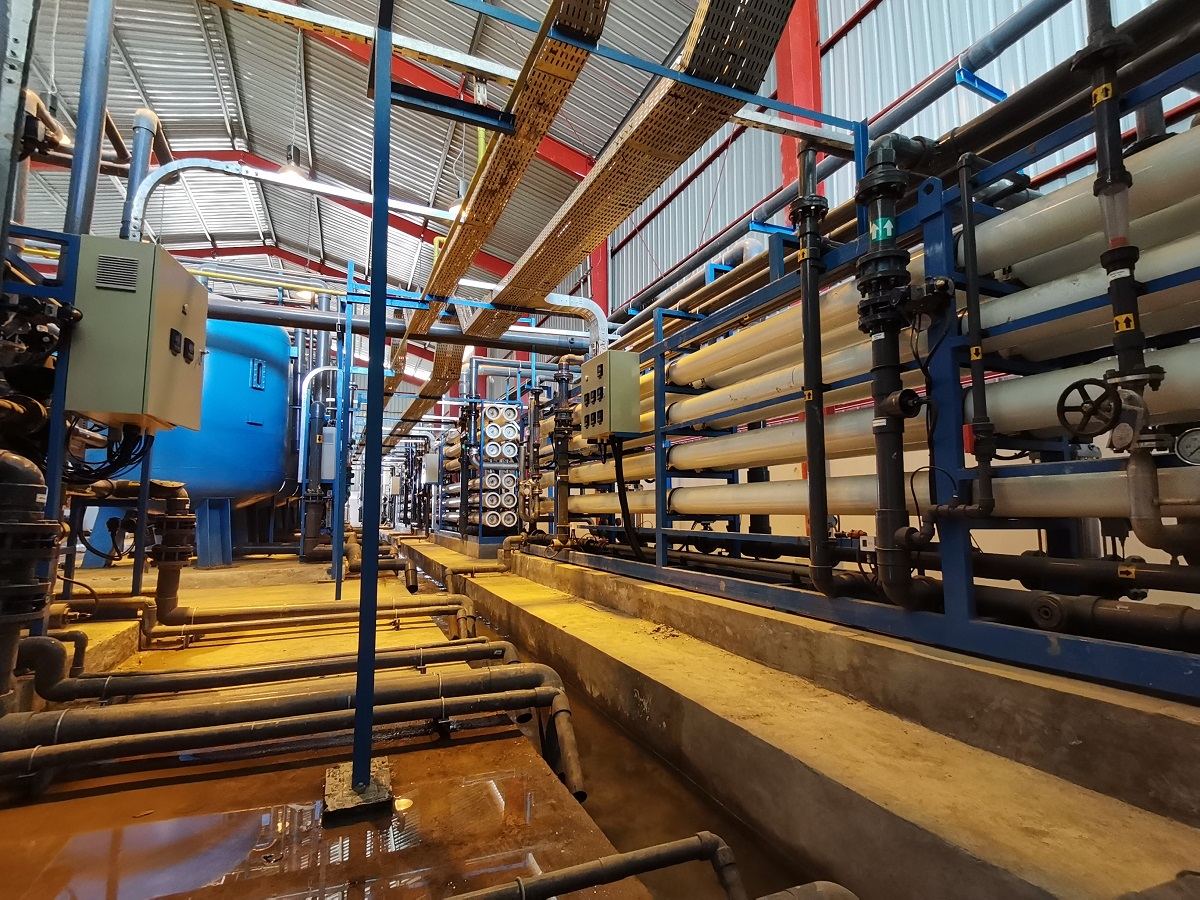
Containerized SWRO units at industrial scale — enclosure choice follows site access, corrosion exposure and schedule.
SWRO vs BWRO vs WWRO: which sizing parameter changes
The three families share a membrane working principle but differ in which parameter governs the design. The comparison below is restricted to characteristics documented in delivered projects and published standards.
| Sizing dimension | SWRO | BWRO | WWRO |
|---|---|---|---|
| Feed source | Seawater | Brackish groundwater or surface water | Industrial or municipal wastewater |
| Governing physical constraint | High osmotic pressure; higher pressure class and corrosion-resistant materials | Scaling chemistry from hardness and sulfate | Influent variability, organics and biological load |
| Pretreatment emphasis | Filtration and ultrafiltration ahead of the RO block | Antiscalant and scaling control | Clarifier and ultrafiltration ahead of the RO block |
| Documented reference capacities | 216 m³/day to 50,400 m³/day; 20 MLD containerized | 100 m³/day agricultural; 720-class containerized units | 60,000 m³/day multi-stage recycling |
| Permeate target examples | Municipal potable per ISO 23446:2021; petrochemical process water; >10 megohm·cm with polishing | Irrigation water; industrial process water | Reuse water for industrial recycling |
| Typical packaging | Containerized 50–1,000 m³/day; Mega 5–20 MLD; skid up to ~50 MLD | Containerized or skid | Skid-based multi-stage plant |
What this table does not establish is which family is preferable for a given site. That judgement depends on the five parameters, on the available feed and on the discharge route for concentrate — none of which can be assessed from a generic comparison.
Selection checklist to hand to a supplier
Feedwater and site
- Source type, salinity and full ionic analysis, including silica, hardness and organics where relevant
- Feed temperature range across seasons, and the design temperature basis
- Feed intake arrangement, turbidity variability and any intermittent supply
- Site ambient conditions: coastal corrosion exposure, seismic and wind loads, ambient humidity, monsoon or cyclone exposure
- Available footprint, access roads, crane access, and whether permanent buildings are permitted
Capacity and operation
- Net permeate volume in m³/day at the stated design temperature, not a nominal figure
- Hourly and daily demand profile, operating hours, and seasonal variation
- Redundancy requirement, and acceptable output during maintenance or membrane replacement
- Expansion path and the capacity increment the platform can accommodate
- Power supply: voltage, frequency, availability, and whether PV integration or off-grid operation is required
Performance specification
- Design recovery with feed composition and temperature attached
- Permeate quality target and the standard it is measured against (for potable duty, state ISO 23446:2021 or the applicable national standard)
- Concentrate flow and discharge or reuse route, including any permitted limits
- Energy consumption basis and the instruments used to verify it
- Chemical consumption and cleaning philosophy, including CIP provisions
Configuration, compliance and testing
- Packaging form: container size and count, skid, or hybrid; corrosion protection class
- OEM or ODM scope: branding, colour, voltage, logo, container size and configuration, site-specific design
- Quality management certification with certificate number, issuing body, scope and expiry date
- Equipment design standards (ASME, CE) and any third-party inspection requirement
- Factory acceptance test scope, third-party FAT acceptance, pre-shipment inspection and 100% test before shipping
- Site acceptance test, performance guarantee test, operator training and technical documentation package
Commercial and lifecycle
- Minimum order quantity, which is 1 unit for containerized systems
- Lead time and factory pre-assembly duration, stated separately from site installation duration
- Delivery terms: factory delivery, FOB, CIF or DAP; ISO container or flatbed transport
- Payment terms, including L/C availability for international projects
- Spare parts scope, remote diagnostics and long-term operation support
Frequently asked questions
Which certifications and standards should a desalination system supplier document at the evaluation stage?
A supplier should provide quality, environmental and occupational-health certificates with numbers, issuing body, scope and validity dates, plus the equipment design standards it works to. For QT ENVIRO-TECH, the ISO 9001:2015 quality management certificate is numbered 130355, issued by DCI and valid to 28 March 2028; the ISO 14001:2015 certificate is F02926E00371R202 and the ISO 45001:2018 certificate is F02926S00260R201, both issued by DCI and valid to 17 August 2029, with a scope covering the design, assembly, production and sales of seawater desalination treatment systems and equipment. Equipment designs are certified to ASME and CE standards. For municipal seawater duty, ISO 23446:2021 provides the international product-water-quality guideline. Buyers should verify that the certificate scope covers the actual product being purchased, not only the corporate entity.
Can a desalination system be customized for site conditions, container size and brand identity?
Yes. Customization options documented for SWRO, BWRO and WWRO systems include equipment branding, colour customization, process configuration, site-specific design, and container size and configuration. Voltage, logo and brand-colour adaptation are also available. The supplier operates as an EPC integrator offering OEM, ODM and customizable production: OEM covers manufacture to a client's specification under the client's brand, and ODM covers design and production to the client's requirements. A delivered example is a 1,000 m³/day resort plant packaged as two 40-foot containers with the dividing walls removed to form a single unified plant room on an EU-compliant site. The minimum order quantity is 1 unit.
What drives the cost of a desalination system, and what commercial terms apply?
Cost is driven by the configuration decisions rather than by capacity alone: the number of containers or skids, the pretreatment train required by the feed analysis, the number of RO passes and whether mixed-bed or EDI polishing is included, the materials needed for seawater duty, and any PV integration or off-grid equipment. Because these vary by project, pricing is quoted per project rather than published as a list price. Documented commercial terms include a minimum order quantity of 1 unit for containerized systems, delivery as factory delivery, FOB, CIF or DAP depending on the project, ISO container shipping in 20-foot, 40-foot and 40-foot high-cube formats with skid transport by flatbed, and payment by letter of credit for international projects, T/T wire transfer, or open account for established clients.
What factory testing and validation can be witnessed before shipment?
Documented quality control covers factory pre-assembly and pre-testing, 100% testing before shipping, pre-shipment inspection and quality verification before delivery, with third-party factory acceptance testing accepted where the buyer requires it. Acceptance is structured across factory acceptance test, site acceptance test and performance guarantee test, with commissioning and operator training included in the scope. Factory pre-assembly and pre-testing are the reason on-site work can be limited to a 2-week commissioning period on the documented platform, and they are the point at which a supplier's process certification becomes relevant to the buyer rather than to the marketing file.
What lead time should be planned for a customized desalination system?
Typical production lead time is 8–12 weeks, with factory pre-assembly completed within 2 weeks; final timing is project-dependent and should be confirmed against the specific configuration and delivery terms. Documented schedule references include a 2-week on-site installation on the containerized platform, a 10-day installation for a 500 m³/day containerized unit at a nuclear power plant, a 4-month delivery for a 20 MLD factory-assembled project, and a 9-month EPC completion for the 20 MLD (20,160 m³/day) containerized SWRO plant in Morocco. Buyers should ask for the lead time split into engineering, production, factory testing, shipping and site works, because a single total figure hides where the schedule risk sits.
A sizing review starts with your water analysis and demand profile, not with a product code. The QT ENVIRO-TECH company profile and product range are available in the downloadable brochure, and the engineering team can be reached at Sales@iDesalt.com or through www.idesalt.com to review a parameter set against a documented configuration.
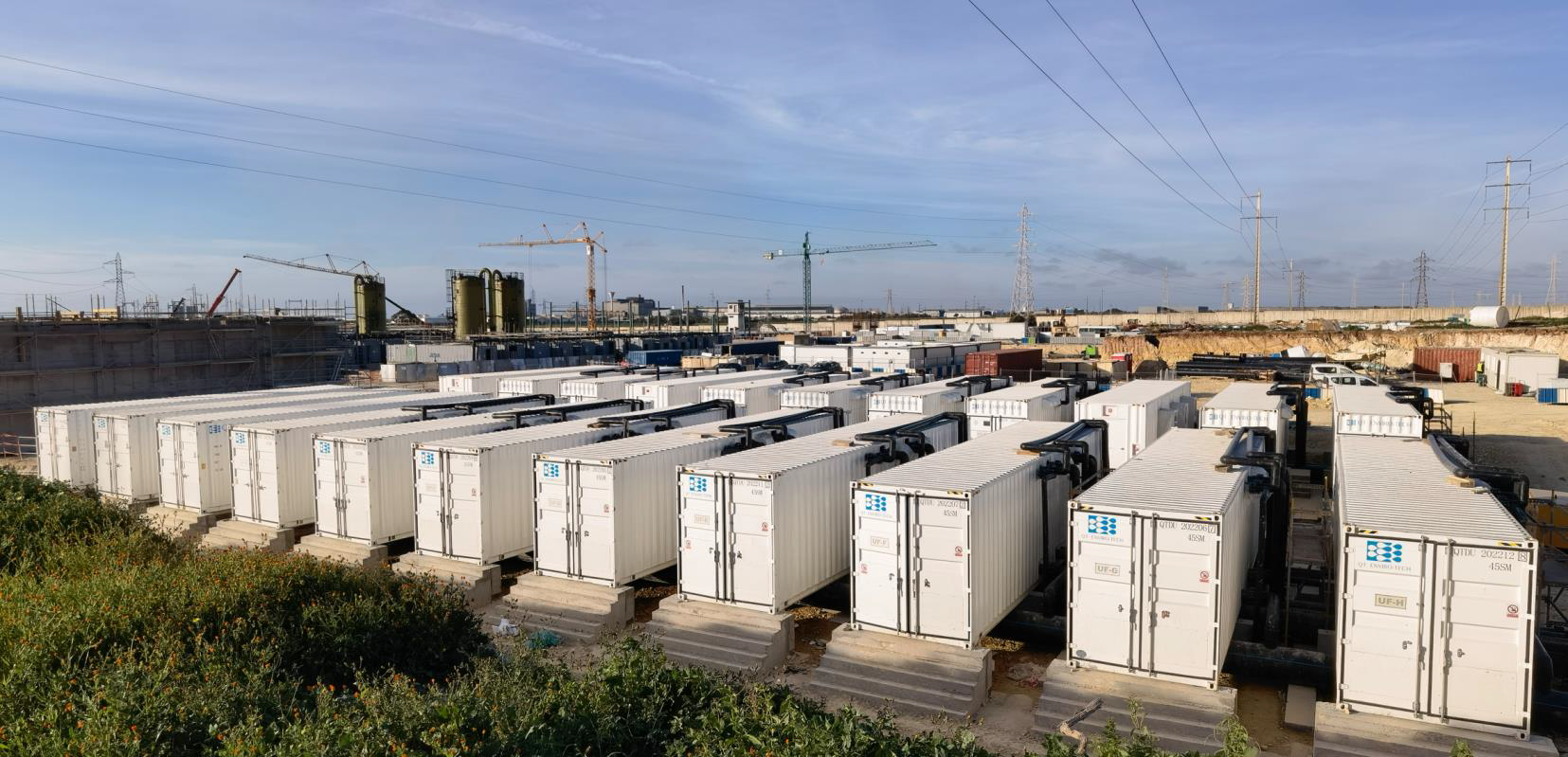
Containerized SWRO at municipal scale — where capacity, footprint and schedule parameters converge.
Conclusion
Sizing a desalination system is an exercise in fixing parameters in the right order. Feedwater source and salinity select the RO family; target capacity and redundancy select the train count; recovery and permeate quality select the flow balance and the number of passes; footprint and site conditions select the packaging. A configuration derived from those five inputs is defensible in a contract, verifiable at acceptance testing and expandable later. A configuration chosen from a capacity label is none of those things.
The documented references in this guide span three orders of magnitude, from 100 m³/day of brackish water for agriculture to 60,000 m³/day of multi-stage wastewater recycling, and from irrigation-grade water to above 10 megohm·cm for power generation. What stays constant across that range is the discipline of stating the conditions with the number. A buyer who sends a supplier the checklist above — feed analysis, demand profile, recovery basis, permeate standard, footprint and acceptance criteria — will get a proposal that can be compared, tested and built.
Have Questions or Need More Details?
Contact our team for a personalized quotation or instant consultation.
Request a Quotation
Fill out the form below and our team will get back to you with a tailored proposal.
WhatsApp Direct Chat
Prefer to chat in real-time? Message us on WhatsApp for instant assistance & quick answers.
- Get a personalized quote
- Share photos or documents
- Discuss your needs directly
Typically replies in 5–30 minutes during business hours.