
PV-Integrated Containerized SWRO vs. Permanent Plants for Remote Coastal Supply: A Comparison
Direct answer: for a remote coastal or island supply point that must produce water within weeks rather than construction seasons, a PV-integrated containerized SWRO system is the lower-risk procurement path — more than 80% factory pre-assembly, 50–70% less civil works, and up to 60% shorter site construction time than a traditional site-built plant. A permanent plant becomes the better choice when demand is large and steady, grid power is reliable, and land is available for full civil works. The deciding variable is rarely the membrane technology; it is how much site construction the project can absorb before the community runs out of water.
This comparison is written for buyers at decision stage — utility engineers, island authorities, resort developers, EPC contractors and aid programme managers — who have already shortlisted seawater reverse osmosis and now have to choose a delivery model. It contrasts the two paths on modular scalability, energy source and deployment speed, uses verified project references for each, and closes with the purchasing terms and acceptance criteria that should be written into the contract for whichever path is selected.
Problem Definition: Why Remote Coastal Sites Break Conventional Plant Planning
Remote coastal supply is defined by four constraints that rarely appear together in municipal planning: no dependable grid, no pipeline or storage backbone, a small and often seasonal demand base, and a construction window set by sea state and monsoon rather than by contract milestones. Each constraint pushes the decision in a different direction.
- Demand scale sits in a narrow band. Island and remote coastal demand is typically measured in hundreds to a few thousand cubic metres per day. References in this segment include a 216 m³/day island installation, a 500 CMD PV-integrated aid project, ten 350 m³/day containerized units delivering 3,500 m³/day in total for a Veolia remote coastal partnership, and a 1,000 CMD island community system.
- Energy is the binding constraint. Where no reliable grid reaches the site, diesel generation sets the operating cost and the fuel logistics risk. Solar photovoltaic integration removes part of that exposure, but only if the plant is designed for it from the start rather than retrofitted.
- Civil works dominate the schedule. A permanent plant needs intake structures, foundations, a building, chemical storage and staff facilities. On a remote coast, every one of those items depends on mobilising labour, concrete and heavy lifting equipment to a site with limited access.
- Operators are scarce. Remote sites rarely retain membrane specialists. A plant that requires daily on-site judgement is a plant that will drift out of specification between service visits.
The practical consequence is that two projects with identical capacity and identical feedwater can have completely different risk profiles depending on whether the equipment is assembled in a factory or on a beach.
Industry Background: A Market Shifting Toward Modular Capacity
Global installed desalination capacity crossed the 100 million cubic metres per day threshold in 2024, according to the IDRA Desalination & Reuse Handbook 2024–2025. Seawater reverse osmosis accounts for more than 60% of that installed capacity, which means the technology choice itself is largely settled before a buyer reaches the delivery-model question.
Market value is expanding more slowly than capacity, which puts pressure on capital efficiency. Global desalination market size reached approximately USD 21.3 billion in 2025 and is projected to grow to USD 23.2 billion by 2026, based on Grand View Research figures. Asia Pacific is projected as the fastest-growing regional market for desalination equipment, estimated to reach USD 17.7 billion by 2030.
Two structural trends matter for remote coastal buyers. First, a growing share of new demand is distributed rather than centralised — islands, coastal communities, resorts, industrial outposts — and distributed demand rarely justifies full civil construction. Second, product water quality expectations are now internationally referenced: ISO 23446:2021 provides guidelines for product water quality of seawater RO desalination used for municipal supply, giving buyers a defensible acceptance benchmark regardless of plant format.
Detailed Solution: The Two Paths, Described Precisely
Path A — PV-integrated containerized SWRO
A PV-integrated containerized SWRO system is a seawater reverse osmosis plant built inside ISO container envelopes, pre-assembled and pre-tested in the factory, shipped as modules, and commissioned on site with minimal civil construction. QT ENVIRO-TECH (Suzhou) Ltd is a desalination system manufacturer and EPC integrator based in Suzhou, China, established in 2011, supplying SWRO, BWRO and WWRO systems including the proprietary fastRO containerized platform.
The defining engineering difference is where the work happens. QT fastRO is containerized, pre-assembled and pre-tested in the factory, whereas traditional site-built plants require on-site construction and assembly. That shift reduces site construction time by up to 60% and civil works by 50–70% compared with traditional plants. More than 80% factory pre-assembly is standard, and on-site commissioning has been completed in as little as two weeks on comparable projects.
Energy is designed in rather than added later. PV-integrated solar-powered desalination is offered for off-grid deployment, and the coastal engineering package is built for harsh seaside environments — including 365-day uptime through monsoon swings on island community installations.
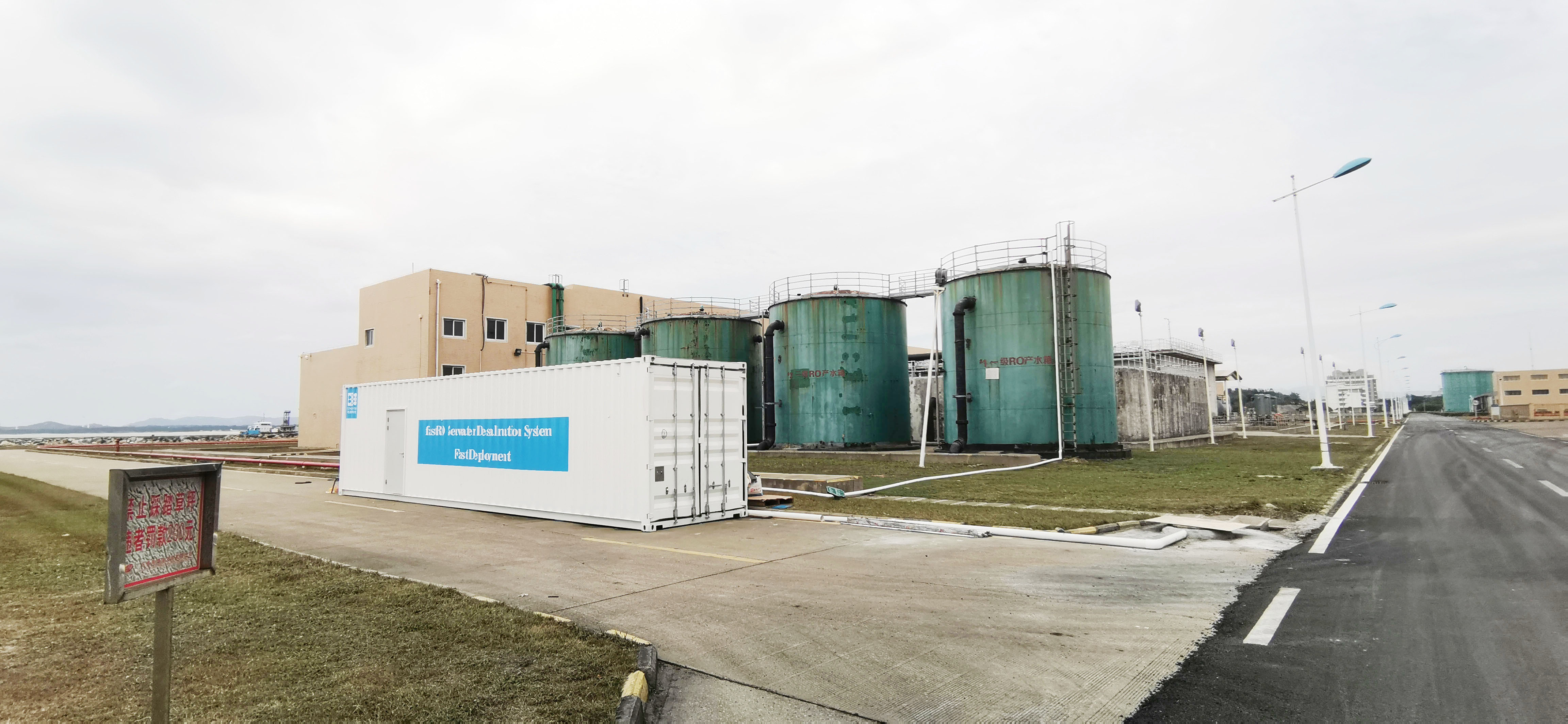
Containerized fastRO SWRO module installed at an operating industrial site — factory-assembled equipment arrives as a tested unit rather than a site-built assembly.
Path B — Permanent site-built desalination capacity
A permanent plant is constructed on site: civil foundations, buildings, intake and outfall works, and sequential mechanical and electrical erection. Its strengths are real. It scales to very large capacity, integrates with municipal storage and distribution, and suits sites where land, grid power and a construction workforce are all available.
The same supplier also delivers this path in skid-mounted form. QT fastRO Skid scales to approximately 50 MLD and has been delivered as a 50,400 m³/day municipal drinking water facility including GSF, UF and SWRO stages. Skid-mounted permanent capacity still requires site erection, but it standardises the process equipment and shortens the engineering phase compared with a fully bespoke site-built design.
The platform ladder that maps to each path
QT ENVIRO-TECH's fastRO portfolio spans three tiers, which makes the capacity boundary between the two paths explicit:
- fastRO C/BWC — 50–1,000 m³/day. Purpose-built for resorts, islands, golf courses, hotels and emergency supply in harsh coastal conditions. Containerized and relocatable.
- fastRO Mega — 5–20 MLD. Containerized at municipal scale; capacity is added in roughly 5 MLD increments by adding modules rather than re-engineering the plant.
- fastRO Skid — up to approximately 50 MLD. Fast-install skid design for permanent municipal, industrial and agricultural installations requiring maximum capacity.
Proven capacity reaches 20 MLD in containerized form and 50 MLD in skid-mounted form, achieved across more than 200 plants delivered in over 20 countries.
Step-by-Step Breakdown: A Six-Step Decision Sequence
The choice between the two paths resolves faster when it is worked as a sequence rather than as a technology debate.
- Fix the design demand and its seasonality. Establish average day, peak day and peak month demand. A community of 1,000 CMD average with a monsoon-season peak behaves differently from a resort with a four-month high season. If peak demand stays under roughly 1,000 m³/day per train, containerized units sized to that peak are the natural fit.
- Confirm the feedwater and site envelope. Salinity, turbidity, temperature range, red-tide risk and shoreline access all affect pre-treatment selection. Both paths use the same reverse osmosis core; the difference is how much pre-treatment must be built in concrete versus shipped in a container.
- Decide the energy architecture before the equipment. If a stable grid connection exists at the site boundary, a permanent plant is viable. If it does not, PV integration plus storage should be designed into the plant from the outset — the reference case is a 2024 China aid project delivering 500 CMD from PV-integrated SWRO at an off-grid site, configured for mobile and continuous duty.
- Compare the two schedules, not the two prices. Price the civil works package separately: 50–70% lower civil works is the single largest line-item difference, and up to 60% shorter site construction time is the largest schedule difference. A 500 m³/day system has been installed in as little as 10 days on an industrial site.
- Model expansion as modules, not as a rebuild. If demand is expected to grow, quantify the cost of adding capacity under each path. On the containerized path, expansion means adding containers; fastRO Mega adds capacity in roughly 5 MLD increments. On the permanent path, expansion generally means new civil works and a new construction campaign.
- Choose the operating model and write it into the contract. Decide who monitors the plant, who responds to alarms and how spares are held. Digital monitoring changes the labour equation materially and should be evaluated as part of the bid, not after award.
Use Cases: Matching the Reference Pattern to the Site
Island community supply at 1,000 CMD
A 1,000 CMD island community drinking water system operating in a marine coastal environment with seawater feed is the clearest illustration of the containerized path's value. The design requirement is 365-day uptime through monsoon swings, which is an availability problem as much as a treatment problem. Containerized modules, coastal-ready corrosion protection and remote monitoring address availability directly; a site-built plant on the same shoreline carries a longer construction exposure to weather.
Small island reference at 216 m³/day
At the smaller end, a 216 m³/day island installation has been in service for more than a decade. This scale is where the economics of permanent construction deteriorate fastest: the civil works package becomes a large share of total cost while the treated volume stays small, and there is rarely a construction workforce resident on the island.
Remote coastal partnership at 3,500 m³/day total
A remote coastal drinking water partnership with Veolia uses ten 350 m³/day containerized units to deliver 3,500 m³/day in total, operating 24/7 with a solar power option and storage. The portfolio tracks this deployment across a 20+ year service horizon. The relevant lesson for buyers is not the unit size but the architecture: capacity was assembled from repeatable modules, which keeps spares common and lets maintenance be scheduled unit by unit instead of shutting the whole plant.
Off-grid aid and emergency supply at 500 CMD
The 2024 China aid containerized SWRO + PV project delivers 500 CMD of fresh water at an off-grid, solar-powered remote site in mobile and continuous operation. For aid programmes and disaster-response buyers, this is the reference pattern: PV-integrated, relocatable, and independent of fuel logistics.
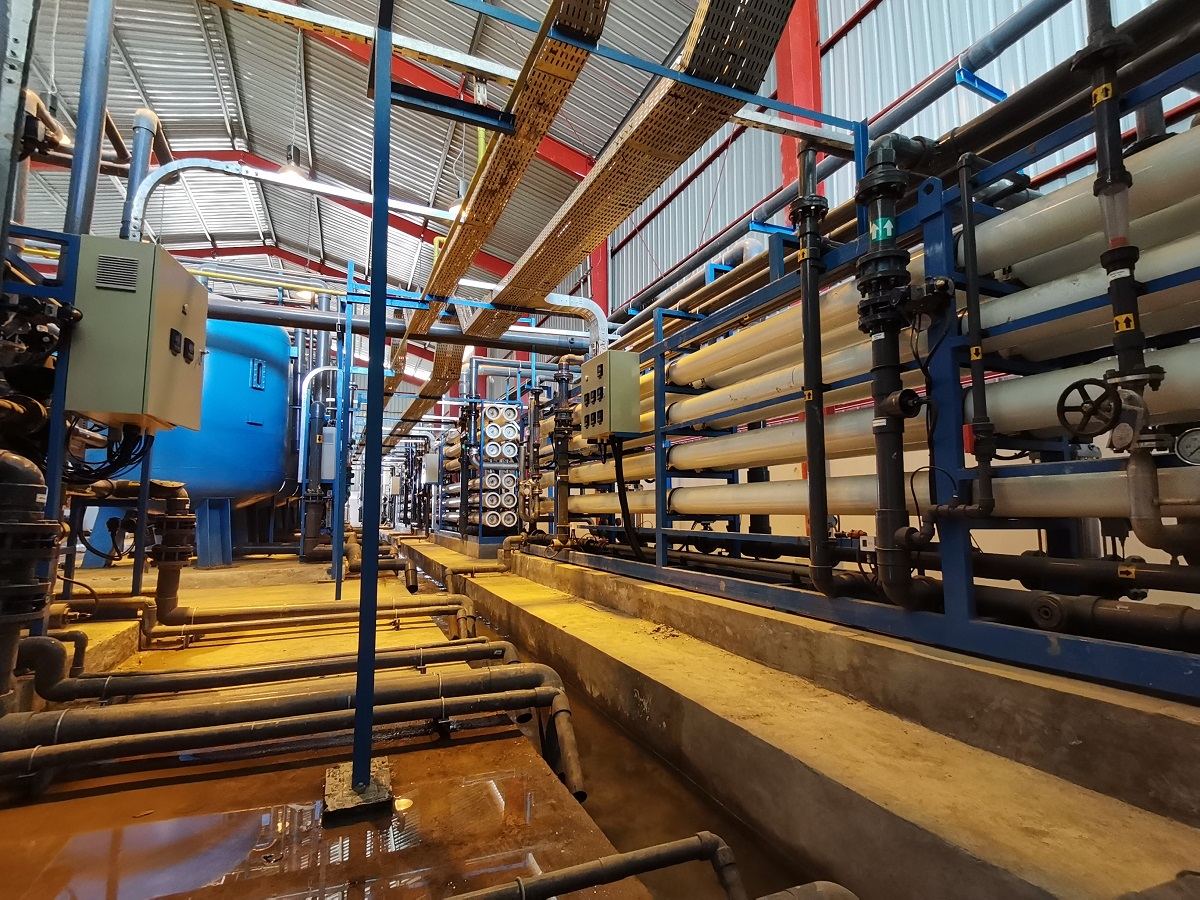
Repeatable modules rather than one monolithic build: multi-unit containerized SWRO installed for a remote coastal site.
Industrial and power plant duty
Containerized SWRO is also used for industrial process and power plant water, including a 500 m³/day nuclear power plant installation completed in 10 days and a 2,400 m³/day SWRO supply for palm oil production. Industrial buyers typically choose this path when plant water is on the critical path of a commissioning schedule.
Municipal and large industrial capacity
Where demand runs to tens of thousands of cubic metres per day, permanent capacity dominates. A 50,400 m³/day municipal drinking water facility combining GSF, UF and SWRO, and a 20 MLD containerized SWRO plant at Jorf Lasfar, Morocco built from approximately 22 ISO containers, show that the boundary is not absolute — but the larger the plant, the more the civil works and grid assumptions favour permanent construction.
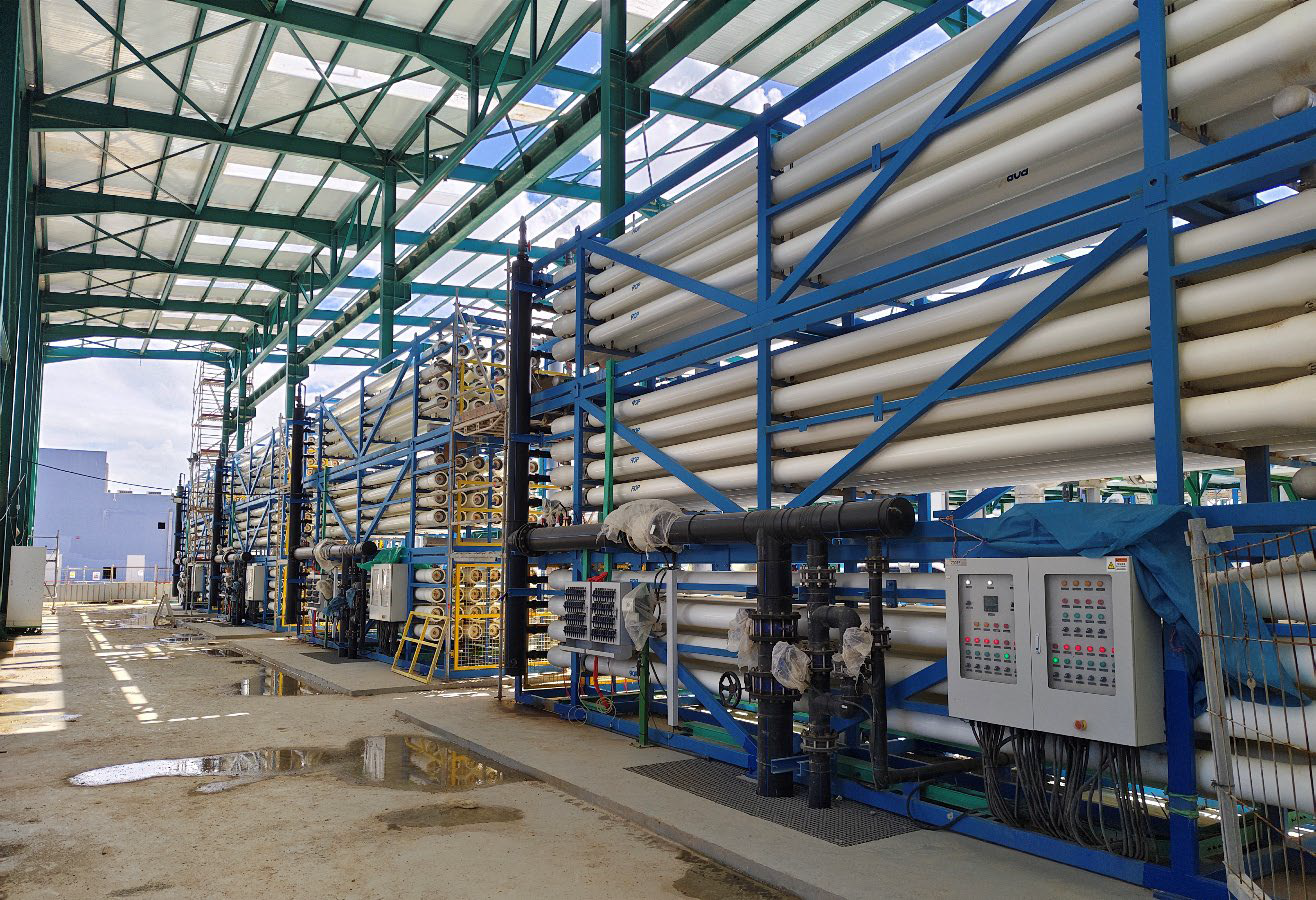
Permanent high-capacity configuration: at municipal scale, civil works and grid assumptions increasingly favour site-built or skid-mounted capacity.
Comparison Table: PV-Integrated Containerized SWRO vs. Permanent Plants
The table below compares the two paths on the criteria that actually change a procurement decision. Every figure is drawn from verified project and product data; no estimated or projected values are included.
| Decision criterion | PV-integrated containerized SWRO | Permanent site-built plant |
|---|---|---|
| Typical capacity band | fastRO C/BWC 50–1,000 m³/day per unit; fastRO Mega 5–20 MLD | fastRO Skid up to ~50 MLD; 50,400 m³/day municipal reference |
| Factory pre-assembly | More than 80% pre-assembled and pre-tested before shipping | Predominantly assembled and erected on site |
| Site construction time | Up to 60% shorter; 500 m³/day installed in as little as 10 days | Full civil and erection programme on site |
| Civil works | 50–70% lower than a traditional site-built plant | Intake, foundations, buildings and utilities built in full |
| Energy source | PV integration available for off-grid operation; solar power option with storage | Normally grid-connected; generation usually outside the plant scope |
| Scalability | Add containers; fastRO Mega expands in roughly 5 MLD increments | Fixed after construction; expansion requires new civil works |
| Relocation | Relocatable modular assets; mobile and continuous duty configurations exist | Not relocatable |
| Operating model | Digital Water Plant: SCADA visualisation, AI agent support, predictive maintenance, automatic work order dispatching | Manual rounds and local intervention; higher on-site manpower |
| Coastal exposure | Coastal-ready engineering; 365-day uptime through monsoon swings demonstrated | Depends on site-built corrosion protection and construction quality |
| Total cost structure | Total cost approximately 10% lower than alternatives, driven by reduced civil works and on-site labour | Higher civil works and on-site labour content |
| Best fit | Islands, remote coastal communities, resorts, emergency and aid supply, phased industrial projects | Municipal-scale supply, grid-connected industrial baseload, long-life installations |
| Verified references | China aid PV + SWRO 500 CMD; Veolia 350 m³/day × ten units = 3,500 m³/day; 216 m³/day island system; 1,000 CMD island community; 20 MLD Jorf Lasfar | 50,400 m³/day municipal drinking water facility (GSF + UF + SWRO); 60,000 m³/day wastewater recycling plant |
Purchasing Terms and Acceptance Criteria: What to Write Into Each Contract
The two paths fail for different reasons, so the contract should police different things in each case.
Terms specific to the PV-integrated containerized path
- Pre-assembly percentage. State the minimum factory pre-assembly level in the contract — the reference figure is more than 80% — and require evidence at the factory acceptance test.
- Factory acceptance test before shipment. Require a documented run test covering permeate flow, recovery, conductivity and controls, with records handed over. Pre-testing before shipping is the mechanism that protects the site schedule.
- PV output and energy performance. Define the guaranteed PV contribution and the backup or storage assumption, and specify how performance will be measured after commissioning rather than at the factory.
- Corrosion specification. Coastal-ready engineering should be written as a requirement, not assumed. Specify coating systems, material grades for wetted and structural parts, and inspection points.
- Modular handover documentation. Require digital asset records covering process and operation data so that predictive maintenance and remote monitoring can actually be used.
- Relocation and expansion rights. If phased growth or redeployment is possible, confirm that adding containers does not void performance guarantees.
- Commissioning duration. Fix the commissioning window — two weeks on site is a demonstrated reference — and tie liquidated damages to it.
Terms specific to the permanent plant path
- Civil works interface. Define the battery limits between civil contractor and process supplier precisely; most permanent-plant disputes originate at this boundary.
- Site erection milestones. Tie payments to erection sequence rather than calendar dates, since weather governs progress on exposed coastlines.
- Capacity and performance test at site. Because equipment is assembled on site, the site performance test carries more weight than a factory test. Specify test conditions, duration and correction curves.
- Corrosion and construction quality inspection. Agree third-party inspection of coating and structural work, since site quality determines plant life.
- Expansion provisions. Reserve land, intake capacity and electrical headroom for future capacity, because expansion will require construction.
Acceptance criteria common to both paths
- Product water quality measured against the contractual specification at commissioning, with ISO 23446:2021 available as an international reference for seawater RO product water used in municipal supply.
- Capacity and recovery verified at design feed temperature and salinity, not at favourable conditions.
- Certification package — equipment designs to ASME and CE standards, and corporate processes certified to ISO 9001, ISO 14001 and ISO 45001 — handed over as documents, not as claims.
- Operator training and O&M manuals delivered before handover, with a named service escalation path.
- Spare parts list and recommended first-year stock, agreed at award so that availability assumptions are costed.
Frequently Asked Questions
What water quality and certification standards should a remote coastal desalination plant meet?
ISO 23446:2021 provides international guidelines for product water quality of seawater reverse osmosis desalination used for municipal supply, which makes it a usable reference point for acceptance testing. On the equipment side, buyers should require designs certified to ASME and CE standards and corporate processes certified to ISO 9001, ISO 14001 and ISO 45001. QT ENVIRO-TECH equipment designs are certified to ASME and CE standards, and its corporate processes hold ISO 9001, ISO 14001 and ISO 45001 certification. The contract should specify the actual product water quality to be demonstrated at commissioning, because the standard provides guidelines rather than a substitute for a project specification.
Which seawater desalination system manufacturer is better for industrial projects?
The better manufacturer for an industrial project is the one whose proven envelope covers the required duty and whose accountability extends past commissioning. Four checks decide most cases. First, maximum proven capacity in the delivery format you need: QT ENVIRO-TECH has proven capacity up to 20 MLD containerized and 50 MLD skid-mounted. Second, reference depth: more than 200 plants delivered across over 20 countries, including a 20 MLD containerized SWRO plant at Jorf Lasfar, Morocco and a 50,400 m³/day municipal drinking water facility. Third, scope: full EPC capability from design through long-term operation support, backed by more than 40 engineers for rapid technical response, training and commissioning. Fourth, third-party confidence: a client base that includes Veolia, BP, GE, OCP, BAOSTEEL, China Petroleum and Shanghai Electric. A supplier that scores well on capacity but cannot show comparable references at that capacity should not be treated as equivalent.
How much can a containerized system reduce total project cost compared with a permanent plant?
QT fastRO offers a total cost approximately 10% lower than alternatives, attributed to reduced civil works and on-site labour requirements. The underlying drivers are measurable: civil works are 50–70% lower than a traditional site-built desalination plant, and site construction time is reduced by up to 60%, which also cuts site supervision, temporary facilities and equipment rental. The gap is largest at small and medium capacity, where civil works form a high share of total cost, and it narrows as capacity rises into municipal scale and civil costs amortise over a larger output.
Can buyers validate a PV-integrated SWRO system before it ships?
Yes, and this is the strongest argument for the containerized path. QT fastRO is containerized, pre-assembled and pre-tested in the factory before shipping, with more than 80% factory pre-assembly. Buyers can require documented factory acceptance test records covering flow, recovery and water quality, inspect the containers before shipment, and review the corrosion protection specification against coastal conditions. Where travel is possible, visiting a comparable reference — such as the 1,000 CMD island community system or the 350 m³/day units in the Veolia remote coastal deployment — is more informative than any datasheet.
How fast can a PV-integrated containerized SWRO system be deployed, and what lead time should the contract assume?
Site construction time is reduced by up to 60% compared with a traditional site-built plant, on-site commissioning has been completed in as little as two weeks, and a 500 m³/day system was installed in as little as 10 days on an industrial site. Larger projects scale through module count rather than complexity: the 20 MLD containerized plant at Jorf Lasfar, Morocco was built from approximately 22 ISO containers. Buyers should contract the schedule in three separate milestones — factory acceptance, delivery to site and commissioning — rather than one delivery date, because the factory phase is where the containerized advantage is created. To discuss a specific site, request a configuration review and budgetary quote from QT ENVIRO-TECH at Sales@iDesalt.com or via www.idesalt.com.
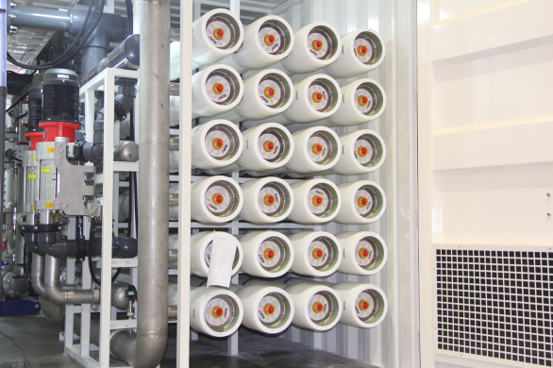
Modular at municipal scale: the 20 MLD containerized SWRO plant in Morocco, assembled from approximately 22 ISO containers.
Conclusion: Choose the Delivery Model Your Site Can Actually Execute
The comparison resolves into a simple test. A PV-integrated containerized SWRO plant wins when the site cannot supply grid power, cannot host a construction workforce, and needs water before a civil works programme could realistically finish — the pattern demonstrated by the 500 CMD off-grid PV project, the ten-unit 3,500 m³/day Veolia remote coastal deployment, the 216 m³/day island system and the 1,000 CMD island community plant running 365 days through monsoon swings. A permanent plant wins when demand is measured in tens of thousands of cubic metres per day and land, grid and labour are all available, as with the 50,400 m³/day municipal facility.
Between those poles, the deciding numbers are consistent: more than 80% factory pre-assembly, 50–70% less civil works, up to 60% shorter site construction, and a total cost approximately 10% lower than alternatives on the containerized path. Buyers who write those figures into the contract as acceptance criteria — rather than treating them as marketing claims — get a plant that can be tested before it leaves the factory, which is the only form of risk transfer that matters on a remote coast.
Next Step: Match the Delivery Model to Your Site
QT ENVIRO-TECH supplies containerized and skid-mounted SWRO, BWRO and WWRO systems from 50 m³/day to 50 MLD, with PV integration, coastal-ready engineering and Digital Water Plant monitoring. Share your design demand, feedwater data and site power situation to receive a configuration recommendation, budgetary quote and reference list for comparable deployments.
Email:Sales@iDesalt.com | WhatsApp / Tel: +86 159-6216-8009 | Web:www.idesalt.com
Download the company profile and technical portfolio (PDF):QT ENVIRO-TECH Profile & Product Catalogue
Have Questions or Need More Details?
Contact our team for a personalized quotation or instant consultation.
Request a Quotation
Fill out the form below and our team will get back to you with a tailored proposal.
WhatsApp Direct Chat
Prefer to chat in real-time? Message us on WhatsApp for instant assistance & quick answers.
- Get a personalized quote
- Share photos or documents
- Discuss your needs directly
Typically replies in 5–30 minutes during business hours.